Welcome to Life Images by Jill

Welcome to Life Images by Jill.........Stepping into the light and bringing together the images and stories of our world. I am a photographer, writer and multi-media artist.
Focussing mainly on Western Australia and Australia, I am seeking to preserve images and memories of the beautiful world in which we live and the people in it.

Welcome!

Welcome!
PLEASE CLICK ON THE IMAGE TO GO TO MY RED BUBBLE STORE.
Showing posts with label bush walking. Show all posts

Saturday, 25 July 2026

Down in the winter woods - Manjimup - Western Australia

 Hi everyone, I hope life is treating you and yours well. It has been cold and wet here the last few weeks, which has given me more time for other things including my photo book from our recent holiday. 

I am doing a little sidestep this week away from my Across Australia series - don't worry I will be back with the next enstallment next time. 

However I wanted to share some photos I took recently on a photography group day out with another photography group in Manjimup, Western Australia. We went looking for fungi in Foresters Wood and Four Aces near Manjimup. It has been a yearly catchup. It was very damp underfoot - perfect for fungi. Thankyou Manjimup for the great day out! 

I didn't take my tripod (I find it so restrictive), so upped the ISO so I could take photos handheld with my macro lens. I was reasonably happy with the results. 

Life in minature - 

I think this one needs a fairy or an elf sitting on top - not a native species and highly toxic! 


Life on the log


Not just fungi ....


Below is - Paraserianthes lophantha - commonly known as Cape Leeuwin Wattle or Crested Wattle - it is the only species occurring in south-west Western Australia; the other is found in tropical Australia. Australian National Herbarium. It is very different to the usual Australian wattles which come from the Acacia family. 

Last time we visited Four Aces in 2024 we saw this Spotted Pardalote pair - female on the left, male on the right. Thanks to my husband for the bird photos. 
This time we could hear them way up in the trees, but didn't see any on the ground. 


We also recently went searching in our local nature reserve for the tiny Helmet Orchids (Corybas) which are usually starting to appear in the leaf litter this time of year. I think we might have been a little early, but we did find one group. 


and a tiny Midge Orchid - Inaturalist.org-Cyrtostylis-huegelii


If you are lucy you might see and kangaroo or a red tailed black cockatoo


Thank you so much for stopping by. Do you go fungi or orchid hunting? Perhaps you would like to tell us about it in your comments. 

You might also like - 


I value your comments and look forward to hearing from you. I will try to visit your blogs in return. Have a wonderful week. 
I am linking up to the link-ups below. Please click on the links to see fabulous contributions from around the world - virtual touring at its best!

If you are looking for a translate button - it's there near the top on the right hand side. 


Hello there! I love reading your comments. If you scroll down to the bottom you can comment too! I would love to hear from you.
Until then, enjoy your day...Life only comes around once, so do what makes you happy, be kind, and be with people who make you smile. 

Sunday, 14 September 2025

Bullara Station Stay, Exmouth Gulf, Western Australia

 Hi everyone. I hope you and yours are doing well. 

As promised last time, I am back with the first of a series of posts showcasing our recent three week caravanning trip to Geraldton, Coral Bay, Exmouth, Shark Bay, and a few places in-between. Including this week - Bullara Station Stay.  (You can click on the links to find out more) 

Bullara Station is located on Burkett Road, at the bottom of Exmouth Gulf, on the North West Cape, approximately 1170 kilometres north of WA's capital Perth and 90 kilometres south of Exmouth and 68 kilometres north of Coral Bay.  Bullara Station is just a few kilometres along Burkett Road from the Minilya-Exmouth Road. Here is a map which I hope might help you orientate. Western Australia is the biggest state in Australia. 


Our last stop had been Exmouth so it was a relaxed get-up and a relatively easy drive to Bullara Station and we arrived just before midday. We had been to Coral Bay and Exmouth a number of times, but had never visited Bullara, but we have had several friends recommend it to us. 


Nestled in 250,000 acres of land, known as Punurrba (sea breeze) by the local Yingarrda people, we found that Bullara Station Stay is very popular, and has plenty to do for a 2 or 3 day stay. Due to the very hot summer the station stay is only open April to October. The best time to visit is during down-south's winter.  There are powered and unpowered sites suitable for tents, campers and caravans (drinking water to sites). Accommodation options also include safari huts and various cabin options. 

There are lots of interesting old bits of machinery scattered around or cleverly repurposed. This old truck is now the stage for the outdoor entertainment. 


There are walk trails, you can drive to the Exmouth Gulf (4WD only), indulge at the Woolshed cafe, restaurant or bar, play Boccie with the kids, and enjoy Bullara's famous Friday burger night with entertainment (part proceeds donated from every burger). There is lots to experience at Bullara. 

Originally established in the 1920s to raise Merino sheep for wool production, the Shallcross family purchased the station in the late 1950s and transitioned to Damaras meat sheep, and in the early 2000s to Droughtmaster cattle. Around 2010 the family developed Bullara Station as a tourist destination. You can read an interesting 2021 article about Edwina Shallcross here - RRR Network news-edwina-shallcross-bullara/

After setting up our camp and lunch we explored the Tin Can / Windmill Walk - approx 2.2km circuit. It is an easy walk - just follow the tin cans! 


Below is the Split Jack flower - Capparis lasinantha. A flower new to us and so lovely. It is a twining shrub or creeper with white flowers turning yellow. I love finding flowers we haven't seen before. Its range is from Broome to Carnarvon and it flowers May to October. 

Below is the Corkwood tree - Hakea lorea - also known as bootlace oak.  It has needle like leaves and can grow to about 6 metres. Corkwood is from the Proteaceae family found in central and northern Australia. It has needle-shaped leaves, yellow, white or green flowers and hard corky bark.


Then back through the camp to check out the cafe and restaurant in old the shearing shed. The scones with jam and cream were delicious and they make pies with Bullara Beef daily. Try The Table Restaurant for a special dinner. 


It rained overnight and next day we decided not to drive out to the Gulf (4WD only - about 20km each way) because of the rains and the risk of it being boggy. That will have to wait for another time and another reason to come back! Oh well, cloudy weather is great for bush walking, but please wear a hat and carry water. 

So instead we had pancakes for breakfast and then did the Sandhill Sunset walk - in the morning...   The walk is about 2.6kms return. If you do this in the late afternoon to see the sunset you need to take a torch to find your way back. We took snacks and enjoyed them on the red sand hill.


Along the way we came across the Bower Bird bower.  This is not a nest - it is a bower that the male birds build to attract a mate. They decorate the entrance with all sorts of pretty rocks, stones, pieces of glass, pottery etc. This one had white stones and what we thought might be the small fruit of the native fig tree. Some years ago we saw a bower with a teaspoon obviously taken from someone's camp! You can see the male bower bird and the bower below. 


And some more birds - photos taken by my husband. Clockwise from top left - 
Crested Pigeon, Western Bower bird, Western Bower bird, Mudlark (also known as Magpie Lark), Pink and Grey Galah, and a Miner bird. 


I was very surprised and happy to see masses of Green bird flowers -  Crotalaria cunninghamii  - on top of the hill. These are a favourite of mine. I had never seen them growing in red sand hills before and in such numbers. The photos with the non-red background are from around Exmouth and Wooramel Station during the same trip. 


Here you can see the buds forming and the seed pods


The flowers look like little birds - so unique and gorgeous. Can you see them in the photo below? 


This is another wildflower we had never seen before - Silky pimelea - Pimelea ammocharis.  Many thanks to the Wildflower Society of Western Australia on Facebook for the identifications. 


And some other flowers from around the sand hill walk


That night we went to Bullara's famed Burger night - held every Friday - with live entertainment - and part proceeds to charity. They cooked about 400 burgers the night we were there. The Friday before they had cooked 520! You need to pre-book. Bookings can be make from the 15th day of the month prior to your arrival by ringing 08 9942 5938. In-house guests only. 

The burgers are delicious and it was an enjoyable night!


That night it started to rain about 9pm and was still raining the next morning when we were packing up at about 9am. The campsite and the dirt road out was awash. It was only a few kilometres to the bitumin road, so all good. 


Will we be back to Bullara? Most definitely. Thank you Bullara. 

For more information:

Stay tuned over the coming weeks when I take you along the Coral Coast of Western Australia, and I bring you Coral Bay, Exmouth and Shark Bay. 

You might also like:


Thank you so much for stopping by. I value your comments and look forward to hearing from you. I will try to visit your blogs in return. Have a wonderful week. 
I am linking up to the link-ups below. Please click on the links to see fabulous contributions from around the world - virtual touring at its best!

If you are looking for a translate button - it's there near the top on the right hand side. 
   

Hello there! I love reading your comments. If you scroll down to the bottom you can comment too! I would love to hear from you.
Until then, enjoy your day...Life only comes around once, so do what makes you happy, be kind, and be with people who make you smile. 


Sunday, 15 June 2025

Maidens Walk Trail and Lookout, Bunbury, Western Australia

 Hi everyone. I hope you and yours are doing well. 

It is winter here in Australia, and finally the rain has started to fall in the south west where I live. 

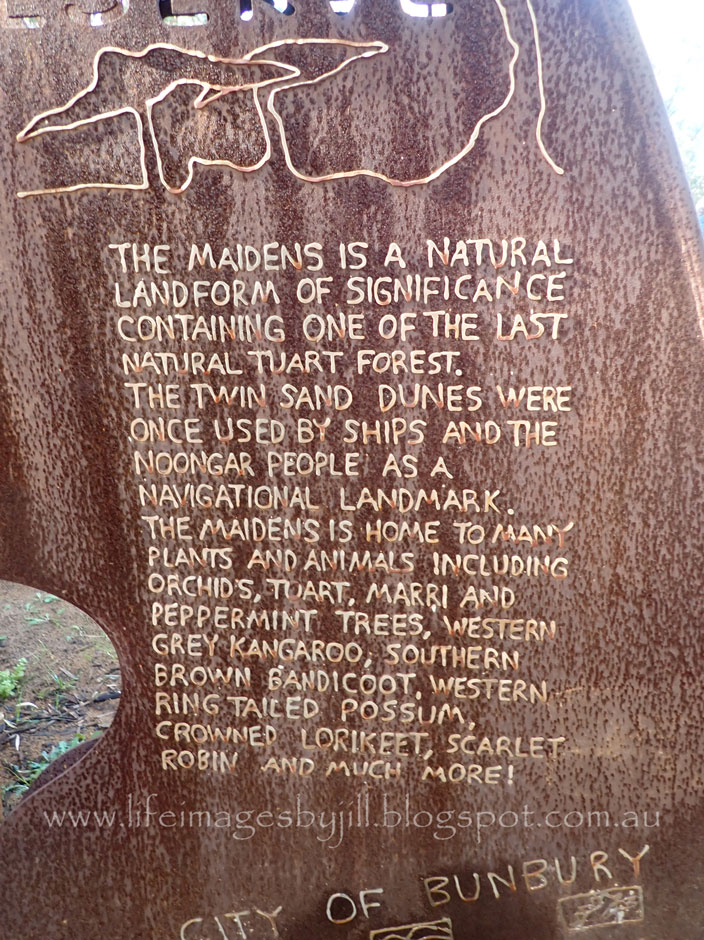
Last weekend we took advantage of a cool fine day to explore the new Maidens Reserve lookout. Maidens Reserve is a coastal nature reserve featuring lookouts, hiking and walking trails, and picnic and play spaces on the edge of Bunbury, bordering the Indian Ocean. 

The new walk paths and lookouts, designed by the Department of Biodiversity, Conservation and Attractions, recently took home the Australian Institute of Landscape Architects Western Australia highest honour - the WA Medal - for one of the best designed regional landscape architectures. They also won an award of excellence in the category of parks and open space, and a regional achievement award in the tourism category. Read more at: Bunbury Herald-Maidens Reserve Award

The judges said that as well as a powerful connection to place resulting from their collaboration with traditional owners, the rest points, ramped lookout, and improved pathways extended the reserve's reach to include families, wheelchair users and older people. 

We hadn't been out to the Maiden's Reserve for a few years, as it is not one of our close-to-home usual walking tracks, and our previous visits had been along the original sand tracks, so we decided it was time to make a return visit. 


You will find the carpark and playground off Ocean Drive in Glen Padden. 


The walk trails to the two lookouts, which give panoramic
 views over the Indian ocean and Bunbury townsite, start from here. Make sure you read the information boards before you set out, and decide which is the best walk for you. 

There is a 670 metre concrete pathway that is suitable for assisted wheelchair access, and which takes you to the 45 metre high lower lookout, and then 153 steps which take you up to the 67 metre high upper lookout. Alternatively you can climb steps all the way from the carpark to the top. 

As well as the walks to the lookout there are three longer distance and more challenging walk trails ranging from 1.2 kms to 3.5 kms.  

Please note that dogs must be kept on a lead at all times. 


Laying the in Kalgulup Regional Park, a Noongar word meaning 'place of fire', his area has been frequented by Noongar people for thousands of years. 


The Kalgulup motif represents the woody nut and leaves of the mungite - bull banksia - Banksia grandis - which typically grows in jarrah forest. The Noongar people made a sweet drink or sucked the flowers of the banksia, and the woody nuts were used as a fire stick to carry fire from one camp to another. The wavy lines on the left hand side of the motif represent fire. 


You can see the trail options on the map below - the blue line is the concrete wheelchair friendly path, or you can go straight up the 305 steps to the upper lookout - the straight yellow line upwards from the You Are Here sign on the map below - great for fitness enthusiasts! Beware - there are no hand-rails on these steps. 


We chose the concrete easier trail winding through the trees with stopping points and views over the city along the way. 


There are conveniently placed seats, and notice boards telling you about local plants.


When you reach the lower lookout there are seats and views over the city. Then stairs up to the upper lookout. In the lower right photo you can see a stopping point half way up the climb from the lower lookout to the upper lookout. I wish I had taken more photos but there were people on the lookout with children, and then we met someone we knew and photos were forgotten! 


From the upper lookout there are 360 views to the Indian Ocean. Here there were plaques describing the indigenous and white-man history of the area. One plaque showed Noongar place names, many of which we use today. 


From here you can continue on in a big loop down to the beach and then back along the sand / limestone track to the parking area (the yellow loop trail on the map above).  


or return the way you have come - which is what we did. 


Remember safety whenever you go trail walking - let someone know where you are going, stay on the path, and be aware of snakes


There wasn't much flowering when we walked the trail, but it was interesting reading the information plaques, and the uses that Noongar people made of the various plants of the area - nature's pharmacy. However, don't be attempted to sample anything unless you are with an experienced person. We will have to go back in spring to see the wildflowers. 


I hope you have enjoyed this little look at the Maidens Reserve lookouts walk trails today. 
For more information:

Do you have a favourite walk trail? Perhaps you would like to tell us about it in your comments. 

You might also like these walks near where I live:

Thank you so much for stopping by. I value your comments and look forward to hearing from you. I will try to visit your blogs in return. Have a wonderful week. 
I am linking up to the link-ups below. Please click on the links to see fabulous contributions from around the world - virtual touring at its best!

If you are looking for a translate button - it's there near the top on the right hand side. 
   

Hello there! I love reading your comments. If you scroll down to the bottom you can comment too! I would love to hear from you.
Until then, enjoy your day...Life only comes around once, so do what makes you happy and be with people who make you smile.