Welcome to Life Images by Jill

Welcome to Life Images by Jill.........Stepping into the light and bringing together the images and stories of our world. I am a photographer, writer and multi-media artist.
Focussing mainly on Western Australia and Australia, I am seeking to preserve images and memories of the beautiful world in which we live and the people in it.

Welcome!

Welcome!
PLEASE CLICK ON THE IMAGE TO GO TO MY RED BUBBLE STORE.
Showing posts with label walk trails. Show all posts

Sunday, 5 October 2025

Paperbarks - Leschenault Estuary, Australind, Western Australia

 Hi everyone, I hope you and yours are doing well. After a burst of sunny spring weather it seems like we have been plunged back into winter. 

However, this morning was cool, cloudy, but no rain imminent, and no wind, so we decided to take our morning walk through the paperbarks along Cathedral Avenue, which skirts along one side of the Leschenault Inlet in Australind only about 10 minutes from our home. I have blogged about it before, but I was surprised how long ago it was:  Paperbark Cathedral - Leschenault Estuary

Cathedral Avenue was part of the original Old Coast Road coach route from Mandurah to Bunbury, used by prominent figures like colonial settlers Thomas Peel and Marshall Waller Clifton in the early to mid-1800s. 

Paperbark trees line the road. They are of unknown age, but likely to date from the early to mid-1800s when the road was established as a coach route. It is believed that gangs of convicts cut the roadway through the trees. The trees arch over the road forming a cathedral like appearance, hence the name Cathedral Avenue. 

When we first came to Bunbury we could drive along under the trees, but since then a road has been diverted around the trees, and the original road is now a safe pathway for waking and cycling. It is a lovely shady walk under the trees. On the return you can divert to a path along the water's edge of the Leschenault Estuary.

We have walked along here many times, but it wasn't until today that we discovered that there are two varieties of paperbarks growing along here. Perhaps I looked at them more closely as they were flowering. 

The most distinctive feature of the paperbark is their multi-layered, paper-like bark, which consists of thin, papery layers separated by fibrous material. The Noongar people used this papery, waterproof bark for wrapping food, making shelters, creating bandages and using as toilet paper.   

I do love the delicious textures.


There are many varieties of paperbark - here is an interesting link from INaturalist Australia.  There are over 200 species in the genus Melaleuca. 

Below is the Swamp Paperbark - Melaleuca rhaphiophylla 

The Swamp Paperbark is a small to medium tree growing to 10 metres high with greyish white paper bark. It can be found near both fresh and saline water. It has narrow needle like leaves and clusters of very fragrant creamy flowers. It flowers from spring to summer. 

The Indigenous Noongar name for Melaleuca rhaphiophylla is Bibool or Yowarl, and for the Minang people (a Noongar group), it is yourl or yorral borrna. 

Below is the Saltwater Paperbark - Melaleuca cuticularis 

This is a small gnarled tree up to 7 metres high with very white papery bark. It grows in salty wetlands. The 5-12mm long leaves are arranged in two opposite pairs forming four regular lines of the leaves down the stems. It has white to cream, very fragrant flowers, singularly or in clusters spring to early summer. 

The Indigenous name for Melaleuca cuticularis, is often Yoorl in the Noongar/Nyungar language, with variations like yourl and yorral borrna also documented from the Minang/Menang people.

A couple of other flowers we saw today along the Cathedral Avenue walk path - one of the eucalypt gum trees, pink fairy orchids, and one of the wattles. 

That's it from me today. I hope you have enjoyed my post about paperbark trees. 


Update - 10 October - today we went walking at Manea Nature Reserve - and we came across another variety of paperbark - the Stout Paperbark -  Melaleuca preissiana, also known for its indigenous name - modong or moonah,

This tree can grow to 10-15 metres. This old gnarly one we saw was definitely an old growth tree judging by the height of it and the width of the base. Its thin pointed leaves are arranged alternately and are 6–14 mm (0.2–0.6 in) long. the white to pale cream flowers form in clumps at the end of the branches, and it flowers January to March. We will have to go back in summer to see the flowers. 

Now our eyes were open to them we saw quite a few of the Stout Paperbark at Manea, along with the Swamp Paperbark. 


You might also like - 

Paperbark Cathedral, Lescenault Estuary

Eucalypt Swamp Yate - Leschenault Estuary

Where the Pelicans meet

Finding Spoonbills along the Leschenault Estuary

For more information - 

Australian Native Plant Society

INaturalist

Flora Base

Atlas of Living Australia

Thank you so much for stopping by. I value your comments and look forward to hearing from you. I will try to visit your blogs in return. Have a wonderful week. 

I am linking up to the link-ups below. Please click on the links to see fabulous contributions from around the world - virtual touring at its best!

If you are looking for a translate button - it's there near the top on the right hand side. 
   

Hello there! I love reading your comments. If you scroll down to the bottom you can comment too! I would love to hear from you.
Until then, enjoy your day...Life only comes around once, so do what makes you happy, be kind, and be with people who make you smile. 

Sunday, 15 June 2025

Maidens Walk Trail and Lookout, Bunbury, Western Australia

 Hi everyone. I hope you and yours are doing well. 

It is winter here in Australia, and finally the rain has started to fall in the south west where I live. 

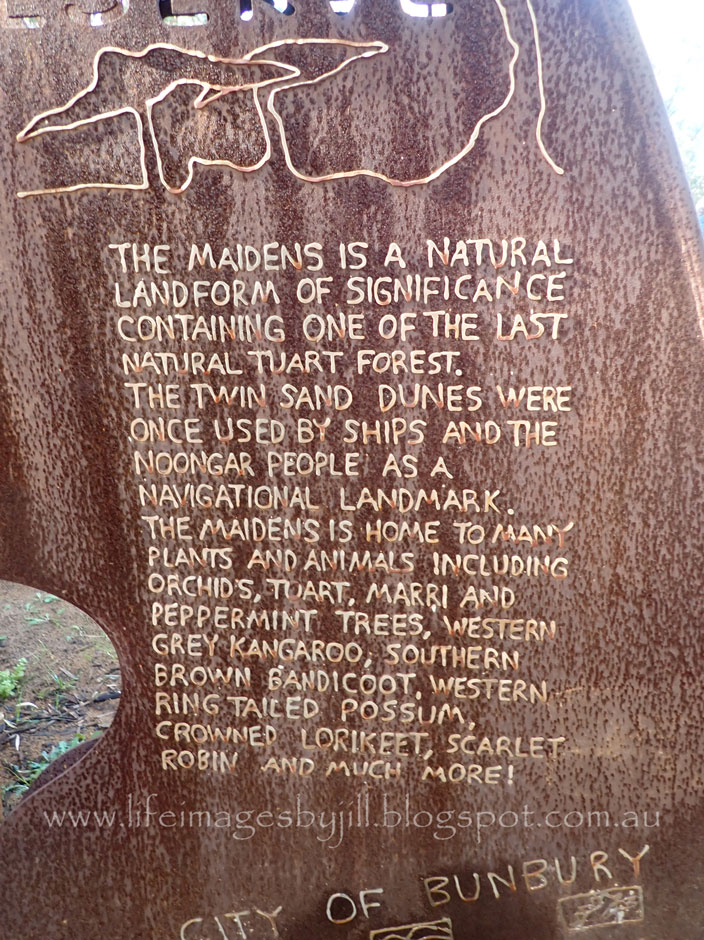
Last weekend we took advantage of a cool fine day to explore the new Maidens Reserve lookout. Maidens Reserve is a coastal nature reserve featuring lookouts, hiking and walking trails, and picnic and play spaces on the edge of Bunbury, bordering the Indian Ocean. 

The new walk paths and lookouts, designed by the Department of Biodiversity, Conservation and Attractions, recently took home the Australian Institute of Landscape Architects Western Australia highest honour - the WA Medal - for one of the best designed regional landscape architectures. They also won an award of excellence in the category of parks and open space, and a regional achievement award in the tourism category. Read more at: Bunbury Herald-Maidens Reserve Award

The judges said that as well as a powerful connection to place resulting from their collaboration with traditional owners, the rest points, ramped lookout, and improved pathways extended the reserve's reach to include families, wheelchair users and older people. 

We hadn't been out to the Maiden's Reserve for a few years, as it is not one of our close-to-home usual walking tracks, and our previous visits had been along the original sand tracks, so we decided it was time to make a return visit. 


You will find the carpark and playground off Ocean Drive in Glen Padden. 


The walk trails to the two lookouts, which give panoramic
 views over the Indian ocean and Bunbury townsite, start from here. Make sure you read the information boards before you set out, and decide which is the best walk for you. 

There is a 670 metre concrete pathway that is suitable for assisted wheelchair access, and which takes you to the 45 metre high lower lookout, and then 153 steps which take you up to the 67 metre high upper lookout. Alternatively you can climb steps all the way from the carpark to the top. 

As well as the walks to the lookout there are three longer distance and more challenging walk trails ranging from 1.2 kms to 3.5 kms.  

Please note that dogs must be kept on a lead at all times. 


Laying the in Kalgulup Regional Park, a Noongar word meaning 'place of fire', his area has been frequented by Noongar people for thousands of years. 


The Kalgulup motif represents the woody nut and leaves of the mungite - bull banksia - Banksia grandis - which typically grows in jarrah forest. The Noongar people made a sweet drink or sucked the flowers of the banksia, and the woody nuts were used as a fire stick to carry fire from one camp to another. The wavy lines on the left hand side of the motif represent fire. 


You can see the trail options on the map below - the blue line is the concrete wheelchair friendly path, or you can go straight up the 305 steps to the upper lookout - the straight yellow line upwards from the You Are Here sign on the map below - great for fitness enthusiasts! Beware - there are no hand-rails on these steps. 


We chose the concrete easier trail winding through the trees with stopping points and views over the city along the way. 


There are conveniently placed seats, and notice boards telling you about local plants.


When you reach the lower lookout there are seats and views over the city. Then stairs up to the upper lookout. In the lower right photo you can see a stopping point half way up the climb from the lower lookout to the upper lookout. I wish I had taken more photos but there were people on the lookout with children, and then we met someone we knew and photos were forgotten! 


From the upper lookout there are 360 views to the Indian Ocean. Here there were plaques describing the indigenous and white-man history of the area. One plaque showed Noongar place names, many of which we use today. 


From here you can continue on in a big loop down to the beach and then back along the sand / limestone track to the parking area (the yellow loop trail on the map above).  


or return the way you have come - which is what we did. 


Remember safety whenever you go trail walking - let someone know where you are going, stay on the path, and be aware of snakes


There wasn't much flowering when we walked the trail, but it was interesting reading the information plaques, and the uses that Noongar people made of the various plants of the area - nature's pharmacy. However, don't be attempted to sample anything unless you are with an experienced person. We will have to go back in spring to see the wildflowers. 


I hope you have enjoyed this little look at the Maidens Reserve lookouts walk trails today. 
For more information:

Do you have a favourite walk trail? Perhaps you would like to tell us about it in your comments. 

You might also like these walks near where I live:

Thank you so much for stopping by. I value your comments and look forward to hearing from you. I will try to visit your blogs in return. Have a wonderful week. 
I am linking up to the link-ups below. Please click on the links to see fabulous contributions from around the world - virtual touring at its best!

If you are looking for a translate button - it's there near the top on the right hand side. 
   

Hello there! I love reading your comments. If you scroll down to the bottom you can comment too! I would love to hear from you.
Until then, enjoy your day...Life only comes around once, so do what makes you happy and be with people who make you smile. 

Monday, 26 May 2025

Pelicans & the Denmark Dragon Boat Regatta, Western Australia

 Hi all, I hope you and yours are doing well. We have drought here in southern parts of Australia, and floods in other parts that have devastated and swept away towns, businesses, homes and people in New South Wales on our eastern coastline, with lives lost, and more challenging weather forecast. 

But for us here in the south west of Western Australia, we have finally been enjoying some most welcome light rainfall this last week. 

Last weekend however we enjoyed beautiful weather when we travelled to Denmark on our south coast for the inaugural Wings on the Water dragon boat regatta, hosted by the Denmark Dragon Boat Club on the Denmark River right in the centre of town. 

Congratulations Denmark on ordering perfect weather and hosting a very enjoyable regatta. Clubs travelled to Denmark from Perth, Bunbury (our Bunbury club - the Forza Dragon Boat Club), Mandurah and Albany for the event which was two boat sprint match racing heats over 200 metres. Winner determined by the quickest time over the heats. Mandurah Vikings Dragon Boat Club took out the inaugural Dragon Fly cup. The day was followed by dinner at the Denmark Riverside Club. 

Mirror perfect water and looked spectacular coming down through the karri trees along the river. How perfect for Denmark training here every week! 


We stayed in our caravan at the Rivermouth Caravan Park only a few kilometres from Denmark town. Bordered by the Wilson Inlet, the Denmark River and the forest, it is a lovely quiet location, and an easy walk into town. We had a lovely spot just a short walk down the bank to the inlet. 


From here you can follow walk trails in a couple of different directions. We took the Mokare trail from the river mouth into town, and then back along the the Karri walk trail. The Mokare Heritage Trail is less than 3 kilometres return and an easy walk. Look out for the little houses! 


Then through the forest along the Karri walk - karris are one of my favourite trees. They can grow up to 90 metres tall. More about them later. 


And past the old carriages, remainders of the #3 railway station built in 1927, before arriving back at the caravan park. 

The Noognar aboriginal people have been around Denmark for 40,000 years. The Dutch explored the coast in 1624, and a British outpost was set up in Albany (54 kms to the east) in 1826. The Denmark region was first explored by European Dr. Thomas Braidwood Wilson, a surgeon, in 1829, and he named the town after his colleague Alexander Denmark.  The first white settlers arrived in 1895 - The Miller brothers who obtained a logging lease and set up a mill. 

Aboriginal people refer to Denmark as Koorabup, which translates to "place of the Black Swan"


There are many other walks - All Trails - Best river trails in Denmark


And yes the pelicans - daily they cruise out on the inlet and along the river and hang about at the fish cleaning shed at the river mouth hoping for a handout. There are squabbles if pickings are lean. 


And a few evening scenes which I took along the waterfront just down from our caravan. The water was mirror flat. 


That's it from me today. I hope you have enjoyed this little look at Denmark. We have been visiting Denmark every year for over 50 years as we have family there. I love it, though it has changed a lot over the years. It has grown and is very busy during the summer tourist months, and house and land prices have skyrocketed. But it is beautiful any time of year - just bring a raincoat and warm clothes!  

I hope to be back next week with some more from Denmark. 

For further reading - 

Denmark history

I have blogged about Denmark before - 

Denmark - Where the Forest Meets the Sea - 2016 

Denmark weekend - 2014

Thank you so much for stopping by. I value your comments and look forward to hearing from you. I will try to visit your blogs in return. Have a wonderful week. 
I am linking up to the link-ups below. Please click on the links to see fabulous contributions from around the world - virtual touring at its best!

If you are looking for a translate button - it's there near the top on the right hand side. 


Hello there! I love reading your comments. If you scroll down to the bottom you can comment too! I would love to hear from you.
Until then, enjoy your day...Life only comes around once, be kind, do what makes you happy and be with people who make you smile.