Welcome to Life Images by Jill

Welcome to Life Images by Jill.........Stepping into the light and bringing together the images and stories of our world. I am a photographer, writer and multi-media artist.
Focussing mainly on Western Australia and Australia, I am seeking to preserve images and memories of the beautiful world in which we live and the people in it.

Welcome!

Welcome!
PLEASE CLICK ON THE IMAGE TO GO TO MY RED BUBBLE STORE.
Showing posts with label Western Australian wheatbelt. Show all posts

Sunday, 30 June 2024

Beringbooding Rock Water Tank, eastern wheatbelt, Western Australia

Built by sustenance labour, the largest rock water catchment tank in Australia gives us a glimpse into the past.

Hello everyone. I hope you and yours are doing well. Today I am taking  you away from the coast and up to the north-eastern wheatbelt, to Beringbooding Rock, one of the many granite outcrops found throughout the Western Australian wheatbelt.

Walls hewn from the rock surround the rock channelling the water

Beringbooding is dominated by a ten and a quarter million litre water tank built during 1937-38 for the farming community. It is the largest rock water catchment tank in Australia.  The concrete tank and catchment was built by sustenance labour. This scheme provided employment during the Great Depression. About 100 men were employed at Beringbooding at a cost of 10,000 pounds. One weeks work was given to each man for each child – for example four children equalled four weeks work. Those doing sustenance work had an extra 20 shillings per week added to their Government paid sustenance payment, which was seven shillings a day for up to five children with a maximum of 49 shillings a week.  They were brought by rail to nearby Bonnie Rock from Perth and lived in tents. These men were often unaccustomed to hard manual labour.

You can only marvel at the engineering and manpower that constructed this water catchment, and wonder about the first impressions of these city men when they were deposited in this far corner of the wheatbelt, beyond which lies uninhabited scrubland.

The tank is fed by a seven hectare catchment area. Rock walls hewn from the rock itself encircle the rock and channel the rain water via a concrete aqueduct into the tank. Big fires were lit on the granite and allowed to burn all night making the rock red hot. Water was then poured over the rock and the granite exploded in big layers. These slabs were sledged away, stood on their sides and cemented together to form the rock walls up to a metre high.

Over the years the corrugated iron roof covering the concrete tank started to come adrift through age and strong winds, creating a safety hazard, and has now been removed. However without a covering, water has been evaporating, and due to the significant amount of algae in the tank, the water has been deemed unfit for crop spraying, watering stock, or firefighting. Latest reports indicate the Shire of Mukinbudin has received funding to install a temporary cover and is committed to secure funding for a new permanent tin roof.

Camping area at Beringbooding Rock

The picnic and free camping area is conveniently located at the base of the rock. A 2.3 kilometre walk trail starts at the gate at the base of the tank and takes you over the rock to a variety of natural features

Rock cairn at the highest point, erected by HS King

I suggest you take a photo of the information map and allow a minimum of one and a half hours. The rock cairn at the highest point was erected in 1889 by surveyor and early explorer HS King.  You can enjoy spectacular 360 degree views over grain-growing farmland to the south and west, and virgin bushland to the north and east.

Gnamma hole surrounded by rock wall. The tank can be seen in the background.

Features include a huge balancing boulder that seems to defy gravity, a sheer rock face where the forces of nature have been at work, and gnamma holes: rock depressions which collect water during rain, providing an important water source for early Aboriginal people, settlers and animals. On the north eastern side of the rock you will find the “Kangaroo Hole”, a deep water natural pool. During October and November you will see the red Kunzia pulchella flowering next to the pool. It is amazing how plants can grow in small crevices in the rock.

Balancing rocks

Kangaroo Pool with flowering Kunzia in the foreground

The surrounding bushland includes salmon gums, sandalwood, melaleuca, acacia, grevillea, Ti-tree, hakea, cassia, kunzia, quandongs, and native orchids. Many birds inhabit the area.

Exploring the rock gardens

Clockwise from top left - Kunzia, wild orchids, quandongs, and Waitzia 

Throughout the wheatbelt you can see other similar rock catchment walls and dams. They make great places to stop and explore. You will also find evidence of other sustenance scheme projects throughout Western Australia.

FACTS BOX

Location :  Located 357km from Perth, near the intersection of Beringbooding and Cunderin Roads, about 65 kilometres north east of Mukinbudin and 13 kilometres east of the Bonnie Rock wheat bin in the Western Australian north-eastern wheatbelt. You might get a bit of an idea from this map below. The red dot is Beringbooding Rock, with our capital city Perth on the coast. 

Facilities:

There are several partly shaded compacted gravel hard standing sites suitable for caravans and camper trailers. Facilities include picnic tables, fire pits and an eco flushing toilet.  Non-potable water is available from a 60,000 litre water tank fed with piped water. Please bring your own firewood, and beware of fire restrictions and take away your rubbish.

The 2.3 km walk trail is suitable for those with a moderate level of fitness. Please take the usual bushwalking precautions. The rock can be slippery when wet.

Useful Information: 

Wheatbelt Tourism - https://www.wheatbelttourism.com/granite-outcrops-in-the-wheatbelt/

The Wheatbelt Way - https://wheatbeltway.com.au/

Shire of Mukinbudin - https://www.mukinbudin.wa.gov.au/

Ornate Dragon Lizard

Thank you so much for stopping by. I hope you have enjoyed learning a little of our history. My article about Beringbooding Rock was published recently in Caravan World magazine, June 2024 edition. 

I value your comments and look forward to hearing from you. I will try to visit your blogs in return. Have a wonderful week.

I am linking up to the link-ups below. Please click on the links to see fabulous contributions from around the world - virtual touring at its best!

Monday, 9 April 2018

Camping out in the Western Australian wheatbelt - Kwolyin free camp

The Western Australian Wheatbelt has very few opportunities for bush camping, but one I can recommend is the Kwolyin campground located on the Bruce Rock-Quairading Road, only seven kilometres west of Shackleton, and 229kms (about 3 hours) east of Perth. And the added bonus is that it is FREE to camp here!

We camped at Kwolyin over the Easter weekend with our family and thoroughly enjoyed being away from the hustle and bustle of Easter in the city.  We hadn't camped here before, but it is a favourite with our son and grandsons as it is close to the rock climbs of Kokerbin Rock.

 The Kwolyin campground was created by the Shire of Bruce Rock on the site of the old Kwolyin townsite in the last few years to replace the former Kokerbin Rock campsite, nine kilometres to the north, which, as locals put it, had been “loved to death”. Since then it has become a very popular campsite particularly on long weekends and school holidays. 

Monday, 2 November 2015

Camping in the Dryandra Woodland, Western Australian wheatbelt


Wattle at Dryandra
Firstly, I want to say thank you to all my lovely readers who took the time to comment on my last post Finding myself 50 plus plus. I think I struck a cord with many and your thoughful comments really helped my realise that I was not alone. Thank you. 

So today something more bright and cheerful!

In late September-early October we took a wildflower drive out through the eastern wheatbelt and beyond to the Great Western Woodland south of the Kalgoorlie goldfields. 
I brought you some images of spring in the wheatbelt here - Spring in the Western Australian wheatbelt


I promised to bring you more, so today I am backtracking to the start of that trip and our first night in the Dryandra woodland 22 kilometres north-west of Narrogin. As it is only about two hours drive from home we finished packing on Saturday morning, and left home after an early lunch. 

We reached Dryandra about 3pm after stopping along the way a couple of times to take photos of wildflowers - well we were on a wildflower drive after all :) 

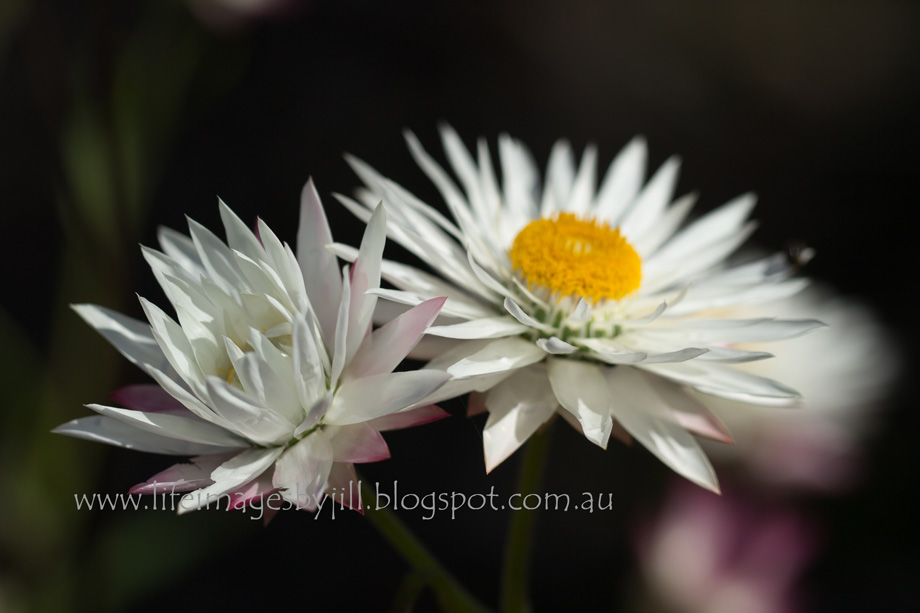
Everlastings

Monday, 6 April 2015

Lunar Eclipse, Western Australia, 4 April 2015

On Saturday night 4 April during the Easter period I was thrilled to be able to photograph the lunar eclipse.  We were out in the central Western Australian wheatbelt visiting my family who farm in the area, so conditions were going to be perfect with absolutely no ambient light from towns, highways, factories etc. 

The total eclipse was due to be at its peak around 8pm. Early in the evening the clouds started to roll in, but I was able to get some photos during the early phases of the eclipse.  In simple terms the lunar eclipse occurs when the earth passes between the moon and sun creating what they call "the blood moon".


 Please click on "read more" to keep reading.

Wednesday, 25 February 2015

A forest of sunflowers

Today I have some creative writing for you - a writing group exercise this week.
My grandmother did have a huge vegetable garden, and there was a man that lived over the lane we used to visit, but I don't remember his name, and I don't remember any sunflowers, so this story is partly true and partly fictional.

A Forest of Sunflowers

There is a forest of sunflowers at the bottom of my grandmother’s garden, up against the back picket fence between the chook pen and the outhouse under the weeping trees.

The sunflowers are so tall that when we stand amongst them we can only just see over the top. We crouch down on the dusty dry red dirt amongst their stiff scratchy stalks. The sunflower heads are so big they form a canopy shading us from the hot sun and casting a yellow glow over us. Sometimes we take a book with us and read it sitting amongst the sunflowers. It’s our secret world where anything is possible.  As we doze in the sun the world of the Faraway Tree comes to life under the sunflowers.

Please click on "read more" to keep reading!

Tuesday, 22 April 2014

Peace in a country church - Mourambine, Western Australia

There is a peace and calm that seems to surround small country churches. They are a place of sanctuary. A place to sit in quiet contemplation.

Over the Easter weekend we visited the St Patricks Anglican church in Mourambine during our return drive home from a few days staying with our family in the central Western Australian wheatbelt.

This church holds a place in our family history.

It sits on a small rise overlooking undulating grain fields which are drying golden in summer and sprouting green and fresh in winter.


The town of Mourambine developed around 1860 and the townsite gazetted in 1884, but it has disappeared over the years - it's fate sealed when the railway line came to nearby Pingelly in 1889. All that remains of Mourambine now is the church and its small cemetery, the rectory (now a farmer's home), the old inn (also now a home) and the house where my father lived between 1939 and 1942. He has told us many stories of his life there. 

 To keep reading and see more pics, please click on "read more" .....


Tuesday, 3 December 2013

Bilbarin morning

Life has been frantic the last couple of weeks, so this week I am trying to pace life a little better. I am sharing a little piece of creative writing with you that I wrote a few months ago for my writing group, South Side Quills.  

Bilbarin is a tiny wheatbelt siding town, where my mother spent her early years. All that remains is the town hall, but I am continually drawn to Bilbarin and the life and history of my mother and my grandmother. 

Perhaps today I am being drawn more to Bilbarin because my father will be there today when he visits the last resting place of my mother.   Or perhaps it is because it is nearly Christmas and this will be our second Christmas without my mother at our table.


Bilbarin Morning

A wild wind whips across the yard scattering leaves in devilish dance, battering a loose piece of tin on the roof and whistling through a crack in the sapling walls of the hut. 

Tendrils of golden morning light seep thinly through the trailing branches of the peppermint trees.  It bursts through the door as we tumble out onto the verandah in a blur of coats and scarves. Icy water baubles clinging in wait for us on the eaves release themselves as we bound down the steps. The ground crunches nosily under our boots like a military tattoo.  The gate clatters behind us. 


Daisy stamps impatiently in her stall. Her hot breath swirls around her like a smoky wreath. She thrusts her head into the stream of grain spilling into the feed bin.

Dry wheat stalks whip against our legs as we run across the stubble paddock.  Through the stringy gimlet trees, jumping the gurgling water in the gully, pushing our way through the scrub.  A kangaroo bounds away into the mist. 

Red gum flowers are bursting from their cups and we stop to pick a spray for Miss.

The clanging bell calls out to us across the dusty school yard. The welcoming warmth of the fire in the stove as we slide into our desks and pull out our books.   


Miss smiles at us, absorbing the perfume of the bush as she arranges the flowers in a jar on the window sill. 

                                                  ...................................................


and a couple of images from Bilbarin. A beautiful old gum tree near where my mother once lived, and the old railway siding.
You might enjoy this post from last year when I took you there for a visit - From beach to wheatbelt


Thanks for stopping by. I hope you enjoyed this little story. I look forward to hearing from you. Have a wonderful week.

I am linking up to Mosaic Monday, Travel Photos Monday, Our World Tuesday, Tuesday Around the World, Travel Photo Thursday, What's It Wednesday, and Oh the Places I've Been. Please click on the links to see fabulous contributions from around the world - virtual touring at its best!

Mosaic Monday
Travel Photo Mondays
Our World Tuesday
Wednesday Around the World  
What's It Wednesday
Travel Photo Thursday
 Oh The Places I've Been