Welcome to Life Images by Jill

Welcome to Life Images by Jill.........Stepping into the light and bringing together the images and stories of our world. I am a photographer, writer and multi-media artist.
Focussing mainly on Western Australia and Australia, I am seeking to preserve images and memories of the beautiful world in which we live and the people in it.

Welcome!

Welcome!
PLEASE CLICK ON THE IMAGE TO GO TO MY RED BUBBLE STORE.
Showing posts with label church. Show all posts

Tuesday, 10 October 2023

150th Anniversary of the Mourambine Church, 1873-2023 - Western Australia

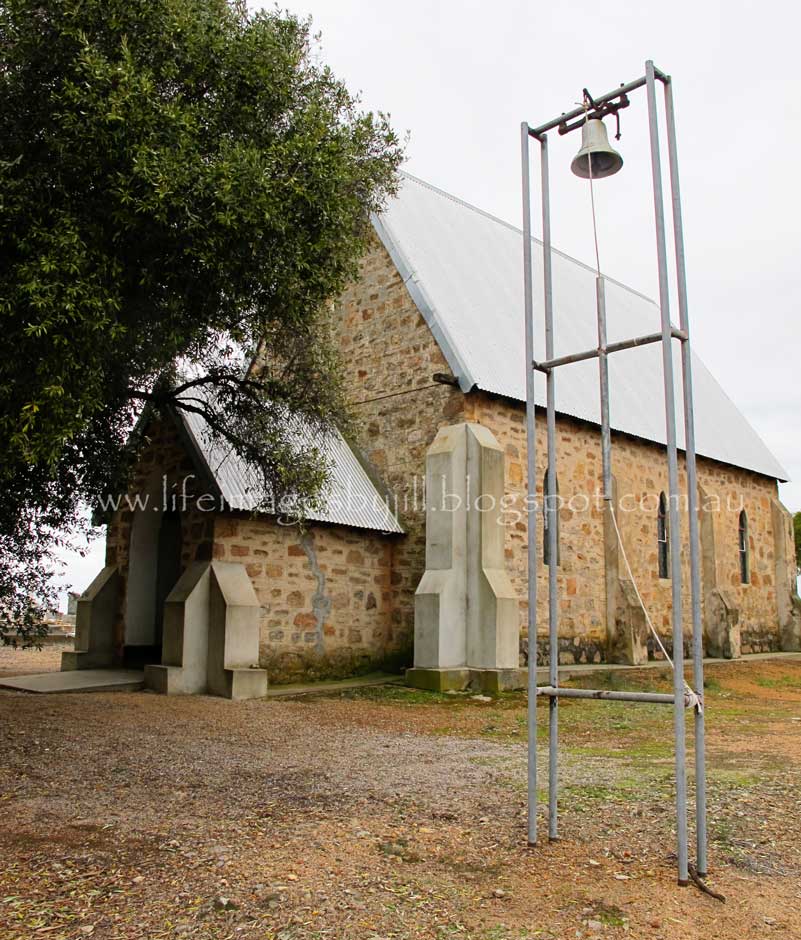
On the 24th September this year we were priviledged to attend a church service to celebrate the 150th Year of the Consecration of St Patrick's church in the tiny town of Mourambine near Pingelly in Western Australia's wheatbelt. 

I know 150 years is not a lot in terms of the history of some countries, but for Australia it is. To put it in perspective, the first European settlement in Western Australia was at Albany in 1826, followed by our capital city, Perth, in 1829. Settlement of inland Western Australia didn't happen immediately. 

The tiny church at Mourambine and its church yard, sits on a small rise overlooking undulating grain fields, and holds a special place in my family history. 

I first wrote about it in 2014 - you can see the post here - Peace in a country church


My Dad lived just down the road from the church during some of his boyhood and he often spoke about Mourambine. We visited several times with my father in his latter years, and if we are going this way we stop to lay flowers on family graves. 

My grandparents - my father's father and mother - Bob and Roma Clayden (nee Fairhead), my Great-grandparents on Roma's side - George Valentine and Florence Fairhead (nee McBurney), and my Great-great-grandparents - James and Mary Fairhead (nee Welsh). Along with other family members, including 2 small babies. They all had large families who are now scattered across Australia. I have recently made contact with the daughter of one of Roma's brothers, and I am hoping to learn more family history. 

The unnamed grave on the bottom right here is baby Alex Fairhead son of George and Florence, and twin of Bernard. I finally found out his name when we were there in September. Alex died at 2 and a half months old in 1920.


James Fairhead was the first to come to Australia arriving on 30 April 1853 as convict # 1863 on the ship Pyrenees. He was immediately given ticket-of-leave on 1 May 1853 on arrival in Fremantle and given a Conditional Pardoned on 15 September 1855. He married Mary Welsh on 1 December 1859 and they bought land in Beverley in the wheatbelt. They had twelve children in twenty years.
Below is a photo of James Fairhead.

I am yet to find a photo of Mary or any of the details of how she came to be Western Australia. I made a couple of new contacts at the anniversary celebration but my search still continues for a photo and details of Mary. I think I will need to go to the Battye Library in Perth to search.


The 150th commemoration service was conducted by
The Right Reverend Dr. Ian Coutts Bishop of the Anglican church in Bunbury. Over 150 people attended the service. As the tiny church only holds 50 people, the elderly were given first preferance and the remainder sat outside. We could hear the service through a two way microphone. Thankfully the sprinkling of rain earlier held off while we were there.


After the service the Bishop planted a commemorative olive tree in keeping with the olive trees that are growing along the path leading to the church. I enjoyed meeting Bishop Ian. 

At the old Atkins house down the road from the church is a large olive tree said to have been planted by Benedictine monks from New Norcia when they passed through the district around 1873. I am wondering if this was where the olive trees at the church also came from. 


A little short history of the church - (with thanks to the 150th celebration committee) 

Settlers arrived in the district around 1846 and the townsite of Mourambine was declared in 1884. Years later the railway bypassed the town and Pingelly (7 kilometres to the west) became the centre of the district. 

The Reverand F Lynch from Gilgering held a monthly service in Mourambine from 1869 onwards. Two blocks of land, each of 50 acres were gazetted. Originally the church was going to be built from timber, but the carefully selected timber was burnt in a bushfire before building could begin. The residents then decided to build a stone church from local stone. The church was built by William Atkins, a stone mason, under the supervision of John Shaddick, Edward Robinson and John Seabrook Jr who were responsible for its erection. 

It was orginally roofed with hand-split she-oak shingles but these were later covered with corrugated iron roofing, the building having no ceiling. The seats in the church were made at the 'Establishment' in York by convict labour. The building was consecrated in the presence of 45 people by Bishop Hale on Sunday 18 May 1873, costing 89 pounds to erect. 


After the celebrations at the church we were treated to a delicious lunch at the Pingelly Recreation and Cultural Center put on by the Pingelly Shire. 

For more about the church - Western Australian Heritage Council
And an interesting article from Trove where you an search newspapers and gazettes - Trove - 1886 letter to the Editor
And also from Trove - Notes from Mourambine
A list of graves - Ozburials

Thank you so much for stopping by. Do you have a church yard that holds significant value to your family? 

I value your comments and look forward to hearing from you. I will try to visit your blogs in return. Have a wonderful week. 
I am linking up to the link-ups below. 

Please click on the links to see fabulous contributions from around the world - virtual touring at its best!


   Mosaic Monday @ Soul & Mind & So On

Monday, 12 September 2016

Sacred Heart Church, Beagle Bay, Western Australia


I love small country churches. There is something so special about them. You can feel the community's heart especially when they have a long history and the community have been involved in the building of the church.  Whatever your religion or belief, places of worship are quiet sanctuaries to sit and feel peace settling over you. 

On our recent trip to the Kimberley we went camping up along the Dampier Peninsular north of Broome with local friends. On the way they took us to visit the Sacred Heart Church at Beagle Bay, 170 kilometres north of Broome via the dirt Cape Leveque Road. We had never visited this church before, so I was very glad we were able to take this short side trip on our way north.


Beagle Bay is the traditional home of the aboriginal Nyul Nyul people, who call the area Ngarlun Burr, Place Surrounded by Springs. 

European connection to Beagle Bay began in 1838 when Her Majesty's ship, "The Beagle" was used to make a survey of the north west coast of Australia. JC Wickham, the surveyor, named the bay Beagle Bay.

Central to the Beagle Bay community is the heritage listed Sacred Heart Church.  Beautifully decorated inside with pearl shells, the church is an amazing fusion of traditional aboriginal and Christian symbols, local materials and European techniques.


The first church in Beagle Bay was built by French Trappist Monks from bush timber, paperbark and iron sheets.  In 1917 the German Pallottine Missionaries, brothers and local people, under the guidance of Father Thomas Bachmair, began to build the present church, modelled on a photograph of a German village church.  Officially opened on 15 August 1918, Fr Bachmair died two weeks later from septicemia. 

The missionaries experimented with different clay mixtures to achieve the correct proportions of white clay and black mud to make the 60,000 bricks for the church and 30,000 bricks for the bell tower.  They were unable to obtain cement, so lime for the mortar and plastering was extracted from seashells gathered from the beach in bullock carts and fired in the kiln. 


Fr. Droste worked with a team of local women to decorate the inside of the church. The main altar is decorated with mother-of-pearl and coloured shells embedded into the plaster. Cowrie shells were used to frame the tabernacle. Shells are used for decoration throughout the church, along the alter rail, around the window frames and along the central isle. The result truly is unique and beautiful and the detail and crafting is exquisite.


The original ceiling over the sanctuary was constructed from strips of mangrove wood plastered with lime.  The plaster was painted dark blue and inlaid with mother-of-pearl shells to represent the stars. Unfortunately white ants attacked this ceiling and it eventually collapsed. The ceiling was replaced with flattened kerosene tins. 

There are three bells in the twelve metre bell tower. The smallest is the original French bell which came with the French Trappist Monks. The other two bells were a gift from a German parish.  

Cyclones, white ants, heat and damp have taken their toll on the church. Over recent years preservation work has been carried out including rebuilding the bell tower which collapsed in 2001. 


The French Trappist Monks came to Beagle Bay in 1890. In 1900 the monks left their Australian missions and were replaced at Beagle Bay by Pallottine Missionaries from Germany.  The German missionaries were placed under internment at Beagle Bay during World War 1. In 1907 the Sisters of St John of God arrived from Ireland. They dedicated themselves to teaching and caring for the Stolen Generation children brought to Beagle Bay under government orders. 

The Beagle Bay community became independent from the Church in 1970 and became self-governing, however the Sacred Heart Church remains the centre of the Dampier Peninsula Parish.

The Sacred Heart Church is not a museum, but you are able to visit. Please leave a donation to help them with their ongoing work. 

Beagle Bay Church and school

 Where is it:  Beagle Bay is on the Dampier Peninsula, north west Western Australia, 170 kms north Broome via the dirt Cape Leveque Road. 4WD recommended. You can see a view of the road below. Please reduce tyre pressures and drive to the conditions. Allow 5-6 hours return. 

The Cape Leveque Road - reduce your tyre pressures and drive to the conditions.


Two more churches you might like to visit with me:

Thank you so much for stopping by. I hope you have enjoyed this little look at the Sacred Heart Church at Beagle Bay. Do you have a favourite country church? 

 I value your comments and look forward to hearing from you. I will try to visit your blogs in return. Have a wonderful week.

I am linking up to the link-ups below. Please click on the links to see fabulous contributions from around the world - virtual touring at its best!


Seen at Beagle Bay
Mosaic Monday 
Life Thru the Lens 

Lifestyle Fifty Monday Linkup 
Our World Tuesday

Through My Lens 
Image-in-ing
Wednesday Around the World at Communal Global
Worth Casing Wednesday
Travel Photo Thursday

The Weekly Postcard

Tuesday, 22 April 2014

Peace in a country church - Mourambine, Western Australia

There is a peace and calm that seems to surround small country churches. They are a place of sanctuary. A place to sit in quiet contemplation.

Over the Easter weekend we visited the St Patricks Anglican church in Mourambine during our return drive home from a few days staying with our family in the central Western Australian wheatbelt.

This church holds a place in our family history.

It sits on a small rise overlooking undulating grain fields which are drying golden in summer and sprouting green and fresh in winter.


The town of Mourambine developed around 1860 and the townsite gazetted in 1884, but it has disappeared over the years - it's fate sealed when the railway line came to nearby Pingelly in 1889. All that remains of Mourambine now is the church and its small cemetery, the rectory (now a farmer's home), the old inn (also now a home) and the house where my father lived between 1939 and 1942. He has told us many stories of his life there. 

 To keep reading and see more pics, please click on "read more" .....