Welcome to Life Images by Jill

Welcome to Life Images by Jill.........Stepping into the light and bringing together the images and stories of our world. I am a photographer, writer and multi-media artist.
Focussing mainly on Western Australia and Australia, I am seeking to preserve images and memories of the beautiful world in which we live and the people in it.

Welcome!

Welcome!
PLEASE CLICK ON THE IMAGE TO GO TO MY RED BUBBLE STORE.
Showing posts with label WW1. Show all posts

Saturday, 25 April 2026

Anakie Railway Station and Historic Bottle Tree, Queensland, Australia

Hi everyone, I hope you and yours are doing well. 

One of the joys of travels is coming across something totally unexpected but so historically interesting it alights your imagination. The bottle tree at the Anakie railway station in Queensland was one of these.  And as you read you might realise why I have decided to post this for my 25th April Anzac Day post this year.  

On our Queensland trip in 2023, we went on a day trip from Emerald to the Sapphire Gemfields, and took a side trip into the tiny town of Anakie, after reading about it in our guide book. (not to be confused with the town of Anakie in Victoria) 

Located just off the Capricorn Highway east of Emerald, Anakie is the oldest town on the Sapphire Gemfields. Anakie’s European history dates back to 1884 when the railway line was being extended into western Queensland. In 1885 the town was declared and a school was opened with sixteen students.

The railway station was built in 1884 and a six metre dam constructed to service the trains’ steam engines. Dug by hand with pick and shovel, and the dirt carried away by horse drawn drays, today the dam is used for recreation and bird-watching. In the photo above can you see the bottle tree just beyond the left hand side roof line of the railway station? 

Next to the neatly kept cream weatherboard railway station is a Queensland bottle tree (Brachychiton rupestris) believed to have been planted around 1880.  Brachychiton rupestris is a tree in the family Malvaceae, endemic to the Australian state of Queensland.

What is interesting about the tree are the initials carved into its trunk. Anakie was a departure point for local men going to World War 1. While waiting to catch the train, soldiers carved their initials and those of their sweethearts into the tree. The tradition continued in World War 2. The tree has grown so tall over the intervening years you need to look up high to see the initials.  Standing under the tree I could imagine the throng of young local men, farmers and miners, at the station eager to depart on their big adventure – slapping each other on the back, hugging girlfriends and mothers, the buzz of activity. 

The tree remains as a living commemoration to these young men, many of whom never returned. The Anakie War Memorial tells the story.

Anakie War Memorial - photo from Monument Australia website 

Archibald John Richardson is believed to be the first to discover sapphires at Retreat Creek in the 1873. The Anakie sapphire fields were proclaimed a mining area in 1902. Export of blue sapphires to Europe began around 1905, however markets to Germany and Russia were shattered due to the onset of WW1 and the 1917 Russian Revolution. Exports to England and France continued but during the Depression the Sapphire Gemfields went into decline.  Today the gemfields encompass an area of 900 square kilometres and is popular with tourists and fossickers.  

There are several designated fossicking areas, including Glenalva and Willows gemfields. You will need a fossicking license.

There is plenty to explore around the Sapphire Gemfields – fossicking, underground mine tours, gem shops, interpretive trails and bushwalking.

In Roma the Heroes Avenue of 93 Queensland bottle trees remembers the men of Roma who died in WWI.

Where is Anakie?

Anakie is located 45 kms west of Emerald on the Capricorn Highway. Turn south at the Sapphire Reflections art piece at the junction of the Capricorn Highway and the Anakie-Sapphire Road.

The Sapphire Gemfield towns of Sapphire and Rubyvale are 11km and 18km to the north.

The Spirit of the Outback train will stop at Anakie if pre-booked. 

This article was published in Curious Australis, On The Road magazine, Autumn 2024. 

For more information: 

Monument Australia-Anakie-War-Memorial

Sapphire Gemfields visitor information

Queensland-Anakie

Thank you so much for stopping by. I value your comments and look forward to hearing from you. I will try to visit your blogs in return. Have a wonderful week.

You might also like - The Western Australian Boab Tree 

I am linking up to the link-ups below. Please click on the links to see fabulous contributions from around the world - virtual touring at its best!

If you are looking for a translate button - it's there near the top on the right hand side. 
   

Hello there! I love reading your comments. If you scroll down to the bottom you can comment too! I would love to hear from you.
Until then, enjoy your day...Life only comes around once, so do what makes you happy, be kind, and be with people who make you smile. 

Sunday, 27 April 2025

ANZAC Day - 25th April - 110th Anniversary

 Last Friday, 25th April, across the world, Australians and New Zealanders commemorated ANZAC Day - our national day born from the World War One 1915 landing on the Gallipoli Peninsula in Türkiye ** and remembered the supreme sacrifice of so many across far too many wars. Not only those killed during the wars, but those whom came home broken in body and spirit. 

Below is a group portrait of all the original officers and men of the 11th Battalion, 3rd Brigade, AIF (Australian Imperial Force). The group of over 685 soldiers are spread over the side of the Great Pyramid of Khufu (Cheops) near Mena camp was originally lent to the Australian War Memorial in the 1930s by Colonel K McLennan MBEAustralian War Memorial collection

On this day I remember my great-uncle Norman Albert Clayden who was killed at Gallipoli only two days after the landing. Last year on 11 November - Remembrance Day - I wrote the following piece from a prompt from my writer's group. I thought I would share it with you today. 

Home Writing – 11 November 2024

Prompt - The sun was preparing itself on the horizon – (quote from David Pollock's book – Wooleen Way)

 The sun was preparing itself on the horizon. Muffled oars dipped. Men pulled their great-coats closer around them and adjusted the straps of their packs. Cold hands clung to their weapons. Hearts thumped. They didn’t marvel at the soft golden fingers of dawn creeping towards them.

Lance Corporal Norman Albert Clayden of the 11th Battalion felt every muscle tense. His eyes strained to see the beach, from where he could hear the unmistakable sound of gunfire coming across the water.  Nothing had prepared him for this.

The boat ran aground and at the order the men jumped over the gunnels into waist deep water, struggled to get a firm foot hold, and waded through the wash as it pulled and dragged at their legs. A bombardment of bullets struck the water all around them. Men fell. Blood stained the water. 

Norman’s breath rasped in his throat as he stumbled up the beach, soaking wet and weighed down by his rifle and sodden pack. He threw himself onto the sand as bullets rained down. Chaos. Orders were tossed into the air.

"Get up Clayden! Get moving!"

Ahead of him men were already clambering up the cliff, grabbing at bushes, dragging boxes of ammunition, digging their bayonets into the earth as they climbed under the constant unrelenting gunfire. Impossible. A world away from where Norman had enlisted only seven months before in rural Western Australia.

At dawn on 27th April, pinned down by enemy fire in a pothole on his way to reinforce an outpost in Wire Gully, Norman was shot in the head. He was 19. He has no known grave. His name is engraved on the war memorial at the Lone Pine Cemetery at Gallipoli. 

Australian War Memorial collection - showing hospital in the foreground


We know from birth records that Norman was 19 when he was killed, although his enlistment papers show his age as 22. During the First World War, the minimum enlistment age was 21 years, or 18 years with the permission of a parent or guardian. Therefore we assume that his parents didn't know he had enlisted, or hadn't given their permission for him to enlist. 

It was a common practise. On the Australian War Memorial web site is a list of boy soldiers who died before their 18th birthday during World War 1. Australian War Memorial - Boy Soldiers

** While English speakers have historically referred to the country as Turkey, it has been spelled and pronounced Türkiye (Tur-kee-yeah) in Turkish since the establishment of the modern Turkish republic in 1923.  Ref: sbs.com.au

We also today think about my husband's uncle Richard Ramsden who died in a prisoner of war camp in Myanmar (Burma) on 29th October 1943 in World War 2 - aged 23 - buried at Thanbyuzayat War Cemetery, Mynanma - a place where his family have never been able to visit as it is in a restricted zone.

I have many more posts about ANZAC Day. Here are just a few: 

ANZAC Day 2024

Remote Sunrise Reminders - ANZAC Day 2023

ANZAC Day dawn service - 2022

View from Lone Pine Cemetery, Gallipoli - photo taken by my sister Jen Shearing

A beautiful sunrise as we left the Dawn Service on ANZAC Day. 

Thank you so much for stopping by. I value your comments and look forward to hearing from you. I will try to visit your blogs in return. Have a wonderful week. 

I am linking up to the link-ups below. Please click on the links to see fabulous contributions from around the world - virtual touring at its best!

my sister at Lone Pine memorial
If you are looking for a translate button - it's there near the top on the right hand side. 
   

Hello there! I love reading your comments. If you scroll down to the bottom you can comment too! I would love to hear from you.
Until then, enjoy your day...Life only comes around once, so do what makes you happy and be with people who make you smile. 

Monday, 29 January 2024

Australia Day - I am, You Are, We Are Australian


Friday 26 January was Australia Day -
Australia Day is the official national day of Australia. Observed annually on 26 January, it marks the 1788 landing of the First Fleet and the raising of the Union Flag of Great Britain by Captain Arthur Phillip at Sydney Cove, a small bay on the southern shore of Sydney Harbour.

In present-day Australia, the government Australia Day Council organises events that seeks to recognise the contributions of Australians to the nation, while also encouraging reflection on past wrongs including towards Indigenous Australians and also giving respect and celebrating the diversity and achievements of Australian society past and present                 wikipedia.org/wiki/Australia_Day

There has been a great deal of controvosy, discussions and protests over the last few years about whether we should be celebrating on 26 January - the indiginous people of Australia claiming it to be "Ïnvasion Day" and wanting to change the date.

I won't buy into this debate here. I am proudly fourth generation Australian on both sides of my family - both early free settlers and convicts, those who fought and died for their country, battled the Depression, cleared and farmed the land, worked hard for what we have. No matter what colour, religion, or nationality we are, we are all an important part of what makes this country a wonderful place to live. We should celebrate this.


Instead I will share of song with you, which I think says it all.

Aunt Stella Floyed, possibly at the time of Federation

I am, you are, we are all Australian.
I AM AUSTRALIAN.
(1987 - by Bruce Woodley, The Seekers and Dobe Newton, The Bushwackers)
I came from the dreamtime from the dusty red soil plains I am the ancient heart, the keeper of the flame I stood upon the rocky shore I watched the tall ships come For forty thousand years I'd been the first Australian.
I came upon the prison ship bowed down by iron chains.
.I cleared the land, endured the lash
and waited for the rains.
Great Great Grandfather James Fairhead
arrived Australia 1853
I'm a settler. I'm a farmer's wife on a dry and barren run,
A convict then a free man
I became Australian.

I'm the daughter of a digger
who sought the mother lode, The girl became a woman on the long and dusty road

I'm a child of the depression
I saw the good times come I'm a bushy, I'm a battler I am Australian

Great Grandmother & Grandfather Floyed 1887
Great Grandfather born in Australia 1858 


[chorus] We are one, but we are many And from all the lands on earth we come
We share a dream and sing with one voice: I am, you are, we are Australian I am, you are, we are Australian.

I'm a teller of the stories
I'm a singer of the songs
I am Albert Namatjira I paint the ghostly gums


Great Uncle Norman Clayden, died Gallipoli, WW1
I am Clancy on his horse I'm Ned Kelly on the run I'm the one who waltzed Matilda I am Australian.

I'm the hot wind from the desert I'm the black soil of the plains I'm the mountains and the valleys I'm the drought and flooding rains.
I am the rock, I am the sky The rivers when they run The spirit of this great land I am Australian
[chorus] We are one, but we are many And from all the lands on earth we come We share a dream and sing with one voice: I am, you are, we are Australian I am, you are, we are Australian.

And below from You Tube an inspiring rendition of this song.


You might also like -


Thank you so much for stopping by. I value your comments and look forward to hearing from you. I will try to visit your blogs in return. Have a wonderful week. 
I am linking up to the link-ups below. Please click on the links to see fabulous contributions from around the world - virtual touring at its best!

Australia Day Fireworks

Monday, 24 April 2023

Remote Sunrise Reminders - 25th April Anzac Day 2023

The 25th April marks an important national day in Australia's and New Zealand's calendar. And the Dawn Service is a vital part of that day - for it was a dawn that the Allied servicemen landed at Gallipoli on 25 April 1915. 

In cities and towns all across Australia you will find war memorials to remember those who have made the supreme sacrifice in war. Some like the Australian War Memorial in Canberra require a two day visit to fully absorb it all. In Western Australia three of our most significant examples are the Kings Park War Memorial overlooking Perth and the Swan River, the Desert Mounted Corps Memorial in Albany, and the HMAS Sydney Memorial in Geraldton.

You can see them below - clockwise from left - Geraldton, Perth, Albany. 

On our travels around Western Australia we often stop at town war memorials and read the names inscribed there.  In small towns there might be just a simple stone column with only a few names. Despite their size they are a significant part of the town and district’s history.

We have found the simplicity of some memorials really stir the emotions.

Not many sunrise locations in Western Australia look east over the ocean. The ANZAC WAR MEMORIAL in the Onslow Memorial Park at Beadon Point in Onslow takes advantage of this. Unveiled at sunrise on Anzac Day 2008, the memorial was designed by internationally acclaimed artists Joan Walsh-Smith and Charlie Smith.

The Corten steel sculpture is a stylized interpretation of the Australian Defence Force’s Rising Sun insignia badge, and is geographically positioned so that the sun rising over the bay shines directly through the arch at dawn on Anzac Day. The inscription simply says “We will remember them”.

The Smith’s say is was a surprisingly difficult feat of astrophysics to calculate exactly where the sun would rise on the 25th of April, to ensure the sun would be exactly central within the six metre high arch. This was achieved with the assistance of the surveying skills of Shire Engineer, Jeffery Breen.

“Our difficulty was the fact that we would be installing the memorial months before Anzac Day.” There must have been a huge sigh of relief when the sun rose that first Anzac morning.

Even though our stay in Onslow wasn’t in April, I was so enthralled by the atmosphere surrounding the memorial, I visited it at sunrise every morning of our stay. It is easily accessed along the path from the caravan park.

The Onslow War memorial was dedicated on the 15th September 2008, by Reverend Steve Cloudsdale, Chaplain to the Pilbara Regiment and attended by the Federal Minister for Veterans’ Affairs, the Hon Alan Griffin MP. The ceremony also marked the 65th anniversary of the bombing of Onslow by enemy aircraft. Pilots from 2 FTS RAAF Pearce performed a fly past.

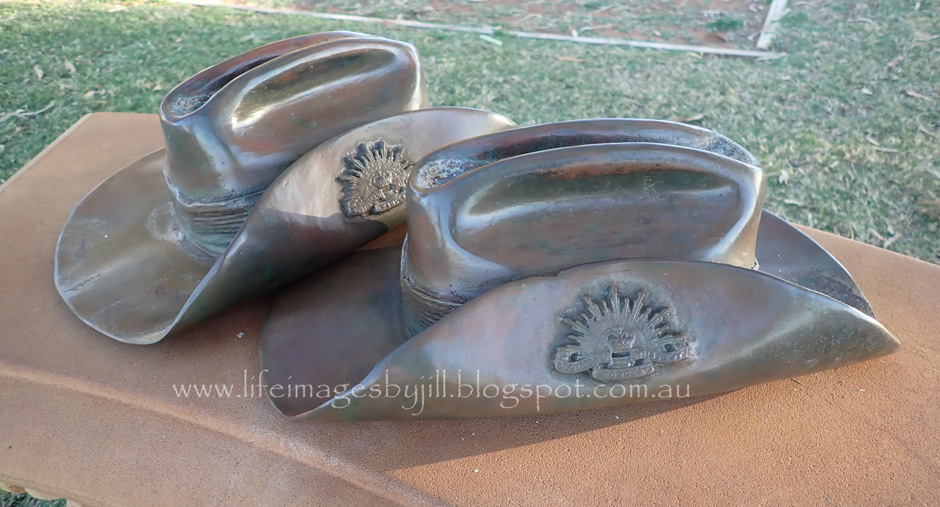
Nearby two brass slouch hats also created by Smith Sculptors and dedicated to the Onslow Volunteer Defence Corp, rest on a concrete bench. Soldiers wear their slouch hats with a khaki hatband, known as a 'puggaree', with the Rising Sun badge on the left-hand side.

The Navy used the Onslow jetty for refuelling during World War II and the RAAF operated a radar station at Onslow. The town was bombed on the night of 15 May 1943 when Japanese planes dropped three bombs on what they thought was the airstrip, but was actually a claypan. There were no casualties or damage.

Following the success of the Onslow memorial, the Shire of Ashburton was approached by Swansea RSL in New South Wales and the Smith’s agreed to build a replica at Swansea. The Swansea RSL Rising Sun Anzac Memorial was completed in 2015.

Joan and Charlie and their team at Smith’s Sculptors in Perth also designed and built the HMAS Sydney memorial in Geraldton, as well as many other commemorative and public artworks, including the National Memorial to the Australian Army on Anzac Parade in Canberra.

 Location: Onslow Memorial Park, Beadon Point, Second Avenue, Onslow.


                                            ***********

 On a trip through the wheatbelt in 2022 we visited the LIGHT HORSE MEMORIAL, on Yeerakine Rock, near Kondinin, after reading about it in our tourist brochure.

Overlooking wheatfields and facing the rising sun on the eastern summit of Yeerakine Rock, a three and a half metre high corton steel silhouette cutout sculpture depicts a Light Horseman on his horse. Designed and created by artisans from Arforms in Bilbra Lake, Perth, the sculpture is layered and embossed to add realism and detail. Funded in part by more than $1000 from community fundraising, the memorial was officially unveiled on 25 April 2015 to commemorate the Anzac Centenary.

The sculpture is dedicated to the many men and horses from the Kondinin district who served in World War 1 in the 10th Light Horse Regiment, as well as other service personnel. Recorded on a plaque are the names of locals who lost their lives in WWI and WWII, shattering the small community.

The 10th Australian Light Horse Regiment AIF (Australian Imperial Force) was the only AIF light horse regiment recruited in Western Australia during the WW1. The regiment began in October 1914 when it became apparent that Western Australia could provide more than a single squadron of mounted soldiers.

The regiment joined the 3rd Light Horse Brigade in Egypt and served dismounted at Gallipoli. The regiment's most notable actions were the charge at the Nek on the Gallipoli Peninsula on 7 August 1915, and Hill 60 on 29-30 August 1915 which was the last major assault of the Gallipoli Campaign. The Light Horse regiments were noted for their plume of emu feathers on their slouch hats.

Used by indigenous people for thousands of years as a water source and elevated lookout, the rock was first sighted by Europeans by Surveyor General John Septimus Roe when he camped there on 22 September 1848. A water catchment was built in 1927 to provide water for Kondinin. There are two walk trails through the sheoak woodlands, one leading to the summit to see the memorial and expansive views. There are interpretative panels along the way.

My only regret was that I wasn’t there at sunrise to see the sculpture silhouetted against the rising sun.  Please wear suitable walking footwear and a hat. If walking at sunrise, please take a torch.

In Kondinin itself you can visit the Kondinin War Memorial and the Memorial Garden located on the corner of Jones Street and Gordon Street. On Anzac Day transport will be available from the rock’s first carpark for the drive up for those unable to walk. Contact the Kondinin Shire Office for details.

Location: Sloan Road, Yeerakine Rock, located 13km south of Kondinin via the Williams-Kondinin Road

                                           ************

The simple wooden cross of the VIETNAM VETS MEMORIAL in the 80 Mile Beach Caravan Park south of Broome, draws people every April and August.

Located at the edge of the caravan park just below the sand dunes and surrounded by a low white picket fence, it was built by Vietnam Veterans who stay at the caravan park annually. It remembers those who have lost their lives in the various conflicts in which Australia has been involved. 

Vietnam Veteran, Ray Miles from Wongan Hills, later in life stayed at the Caravan Park for a few months each year. It was here he conceived the idea for the memorial. With the help of others he raised the funds for the materials and the caravan park owners set aside a space for the construction and committed to its maintenance.  For all those involved and others, it is a special place to remember mates lost in Vietnam.

The memorial was officially opened and blessed by the Rev Judy Knowling of Frontier Services on 18th August 2010. This simple white cross is made the more poignant by its remote location, and yet hundreds attend the services annually on Anzac Day 25 April and Vietnam Veterans Day 18 August, on the anniversary of the Battle of Long Tan in 1966.

The design of the cross is the same as the Long Tan Cross, designed by ‘Pioneers’ from the 6RAR-NZ Anzac Battalion’s Assault Pioneer Platoon and constructed in the 6RAR-NZ lines at Nui Dat in Vietnam on the third anniversary of the battle, on 18 August 1969.

Australia's military involvement in the Vietnam War from August 1962 to April 1975 was the second longest in duration of any war in Australia's history.

Eighty Mile Beach Caravan Park is popular with people travelling north. Long stretches of beach, popular for fishing and beach combing, 80 Mile Beach is the longest uninterrupted beach in Western Australia extending 220km. It is classified as an important bird area for shorebirds.

Location: 80 Mile Beach Caravan Park, Wallal Downs, via Great Northern Highway and Eighty Mile Beach Road (unsealed), 375km south of Broome.


Recently during our little Easter weekend trip through some of the Western Australian wheatbelt we visited the town of Pingelly which looms large in my father's family history. I went into their Memorial gardens and found on the wall there the name of my great uncle Norman Albert Clayden who died at the age of 19 on 27 April 2015 at Gallipoli. I had seen his name on the war memorial in Perth and Canberra, but somehow seeing it on this local memorial made it seem more real. He was in the 11th Battalion. I have blogged about him before. He has an unmarked grave at Gallipoli. 

A couple of weeks ago I found a discrepency in the date of his death. It was not the 2 May as reported in the official records, but it was actually 27 April only two days after the Allied landing at Gallipoli. Such a terrible waste of young life. I actually have some more research to do after going to a historical writer's talk the other day. He said the descrepency could have come about between the date of his death, and the date it was reported to the command post. 


When you travel around, I hope you take the time to visit our war memorials, and learn something about our history and the men and women who gave their lives.

My article, Remote Sunrise Reminders was published in April 2023 edition of On The Road magazine. 


You might also be interested in:
Anzac Day Field of Lights - Albany 2019

More information:

Monument Australia: www.monumentaustralia.org.au     

Smith Sculptors: www.smithsculptors.com.au

Things to See and Do in Onslow: www.onslowbeachresort.com.au/in-onslow/

Artforms: www.artforms.com.au

Kondinin Tourism: www.kondinin.wa.gov.au/tourism/attractions/visiting-kondinin  

80 Mile Beach Caravan Park: www.summerstar.com.au/caravan-parks/eighty-mile-beach

The Battle of Long Tan: www.battleoflongtan.com

Thank you so much for stopping by. I value your comments and look forward to hearing from you. I will try to visit your blogs in return. Have a wonderful week. 
I am linking up to the link-ups below. Please click on the links to see fabulous contributions from around the world - virtual touring at its best!