Welcome to Life Images by Jill

Welcome to Life Images by Jill.........Stepping into the light and bringing together the images and stories of our world. I am a photographer, writer and multi-media artist.
Focussing mainly on Western Australia and Australia, I am seeking to preserve images and memories of the beautiful world in which we live and the people in it.

Welcome!

Welcome!
PLEASE CLICK ON THE IMAGE TO GO TO MY RED BUBBLE STORE.
Showing posts with label Queensland. Show all posts

Saturday, 25 April 2026

Anakie Railway Station and Historic Bottle Tree, Queensland, Australia

Hi everyone, I hope you and yours are doing well. 

One of the joys of travels is coming across something totally unexpected but so historically interesting it alights your imagination. The bottle tree at the Anakie railway station in Queensland was one of these.  And as you read you might realise why I have decided to post this for my 25th April Anzac Day post this year.  

On our Queensland trip in 2023, we went on a day trip from Emerald to the Sapphire Gemfields, and took a side trip into the tiny town of Anakie, after reading about it in our guide book. (not to be confused with the town of Anakie in Victoria) 

Located just off the Capricorn Highway east of Emerald, Anakie is the oldest town on the Sapphire Gemfields. Anakie’s European history dates back to 1884 when the railway line was being extended into western Queensland. In 1885 the town was declared and a school was opened with sixteen students.

The railway station was built in 1884 and a six metre dam constructed to service the trains’ steam engines. Dug by hand with pick and shovel, and the dirt carried away by horse drawn drays, today the dam is used for recreation and bird-watching. In the photo above can you see the bottle tree just beyond the left hand side roof line of the railway station? 

Next to the neatly kept cream weatherboard railway station is a Queensland bottle tree (Brachychiton rupestris) believed to have been planted around 1880.  Brachychiton rupestris is a tree in the family Malvaceae, endemic to the Australian state of Queensland.

What is interesting about the tree are the initials carved into its trunk. Anakie was a departure point for local men going to World War 1. While waiting to catch the train, soldiers carved their initials and those of their sweethearts into the tree. The tradition continued in World War 2. The tree has grown so tall over the intervening years you need to look up high to see the initials.  Standing under the tree I could imagine the throng of young local men, farmers and miners, at the station eager to depart on their big adventure – slapping each other on the back, hugging girlfriends and mothers, the buzz of activity. 

The tree remains as a living commemoration to these young men, many of whom never returned. The Anakie War Memorial tells the story.

Anakie War Memorial - photo from Monument Australia website 

Archibald John Richardson is believed to be the first to discover sapphires at Retreat Creek in the 1873. The Anakie sapphire fields were proclaimed a mining area in 1902. Export of blue sapphires to Europe began around 1905, however markets to Germany and Russia were shattered due to the onset of WW1 and the 1917 Russian Revolution. Exports to England and France continued but during the Depression the Sapphire Gemfields went into decline.  Today the gemfields encompass an area of 900 square kilometres and is popular with tourists and fossickers.  

There are several designated fossicking areas, including Glenalva and Willows gemfields. You will need a fossicking license.

There is plenty to explore around the Sapphire Gemfields – fossicking, underground mine tours, gem shops, interpretive trails and bushwalking.

In Roma the Heroes Avenue of 93 Queensland bottle trees remembers the men of Roma who died in WWI.

Where is Anakie?

Anakie is located 45 kms west of Emerald on the Capricorn Highway. Turn south at the Sapphire Reflections art piece at the junction of the Capricorn Highway and the Anakie-Sapphire Road.

The Sapphire Gemfield towns of Sapphire and Rubyvale are 11km and 18km to the north.

The Spirit of the Outback train will stop at Anakie if pre-booked. 

This article was published in Curious Australis, On The Road magazine, Autumn 2024. 

For more information: 

Monument Australia-Anakie-War-Memorial

Sapphire Gemfields visitor information

Queensland-Anakie

Thank you so much for stopping by. I value your comments and look forward to hearing from you. I will try to visit your blogs in return. Have a wonderful week.

You might also like - The Western Australian Boab Tree 

I am linking up to the link-ups below. Please click on the links to see fabulous contributions from around the world - virtual touring at its best!

If you are looking for a translate button - it's there near the top on the right hand side. 
   

Hello there! I love reading your comments. If you scroll down to the bottom you can comment too! I would love to hear from you.
Until then, enjoy your day...Life only comes around once, so do what makes you happy, be kind, and be with people who make you smile. 

Monday, 18 September 2023

McKinlay Queensland, Australia - and Crocodile Dundee

Hi everyone, I hope you and yours are doing well. Last week I introduced you to the Australian Brolga and the first part of our Queensland road trip across Australia. If you missed it you can see it here - Sighting the Australian Brolga.

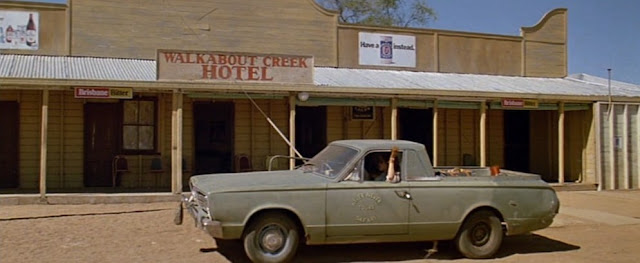
Today I am sharing some more of our trip with something a little different - Walkabout Creek Hotel at McKinlay in Queensland - one of the filming locations for the iconic Australian movie Crocodile Dundee - have you seen it?

Our son loves to see movie locations - and had been talking about Walkabout Creek for a few years - at least ever since we visited the Northern Territory in 2019. 

Finally this year we made it to Queensland, after having to postpone in 2020-21. 

Made famous by the world wide box office hit, Paul Hogan’s 1986 movie, Crocodile Dundee, the main attraction in the tiny town of McKinlay, located 101 kilometres south of Julia Creek, in outback Queensland is the Walkabout Creek Hotel. The pub was on the list of our son’s must does when we travelled through outback Queensland in July-August 2023.

Who could forget Paul Hogan’s iconic Mick Dundee. Paul Byrnes, film critic and journalist, writes, ‘Mick Dundee is all things to all people – self-made man, tough guy, bush philosopher, romantic lead, old-fashioned knight, defender of women, tamer of wild animals, and wandering free spirit.’National Film & Sound Archive of Australia

The hotel, originally named the Federal Hotel, was one of four originally in McKinlay. It was built in 1900, licensed in 1901, and owned by Mrs Kate Machett.

from Filming Locations of Crocodile Dundee - MovieLoci.com

Along came Paul Hogan in 1985 and The Federal Hotel was fitted with a false façade to become the dusty outback Walkabout Creek Hotel for the Crocodile Dundee movie. After the worldwide success of the film, the hotel’s name was officially changed. In 1996 the hotel was relocated about a kilometre around the corner to Kirby Street on the Landsborough Highway, following the redirection of the popular Matilda Way tourist drive. The hotel was renovated, and the interior capitalises on the pub’s association with Crocodile Dundee with photos and memorabilia making it a tourist attraction.  


The movie set for the inside pub scenes was given to them by the film’s producer John Cornell, and can be seen out the back of the hotel. The Never Never Safari truck is parked out front.

The Walkabout Creek hotel movie set from Crocodile Dundee

Paul Hogan’s character Mick Dundee was loosely based on a real life Australian bushman and buffalo hunter, Rod Ansell. However if you want to see more of the Australian movie locations you will need to travel to Kakadu National Park in the Northern Territory, over 1600 kilometres away – there are no crocodiles in McKinlay!  And Charlie the buffalo? He now has pride of place on the bar of the Adelaide River Inn south of Darwin.  

Interestingly - There are two versions of the film: the Australian version, and an international version, which was slightly shorter and had much of the Australian slang replaced with more commonly understood terms. It became Australia’s highest grossing film worldwide.

Here is a little promo movie clip from Youtube


MCKINLAY HISTORY

The European history of McKinlay goes back to 1861 when Scottish born explorer John McKinlay led the
South Australian Burke Relief Expedition from Adelaide to the Gulf of Carpentaria in search of explorers Burke and Wills who had perished during their crossing of Australia. He named the McKinlay River which subsequently gave the town its name.

https://en.wikipedia.org/wiki/John_McKinlay

In 1883 a receiving office was opened, and in 1888 a staging post for Cobb and Co Coaches was established, and McKinlay became gathering point for local graziers.  Water for stock was an issue until the first artesian bore was put down in 1884. The railway line from Richmond reached Julia Creek, 101 kilometres north of McKinlay, in 1908, and Julia Creek was established as a maintenance town for the railway line. The McKinlay Shire Council offices, originally located in McKinlay, were moved to Julia Creek by wagon in 1930.

flat cattle grazing country around McKinlay

After Qantas was formed in 1920 there were two air services per week in McKinlay. On one occasion a plane piloted by Lester Brian hit a fence and the top wire tangled around the axle pulling the plane over. It is said that a lady passenger was travelling with her pet cockatoo which kept up a constant stream of chatter.

The McKinlay school which opened in 1897, closed in 1985 and by 1986 there were very few buildings left in McKinlay. Population of the town is now only between 10 to 15 residents. 

Take a wander around the streets to see the few remaining buildings including Queensland’s smallest library. Used as Never Never Safari Tours office in Crocodile Dundee, the library is not sadly not currently operating. The McKinlay war memorial and John McKinlay’s statue, unveiled in 2012, are located across from Centenary Park, where there is a playground for the kids to burn off some energy. The storyboards at the park share some interesting historical information.

In June the McKinlay Races attracts people with horse racing, foot races, tug of war, fashions on the field, and family friendly events, as well as live music at the pub. 

99 kilometres south west of McKinlay is Combo Waterhole on the Diamantina River at Kynuna. It is said to have inspired Banjo Paterson’s Waltzing Matilda based on an incident believed to have happened there in the 1890s.

During our visit we saw that the Walkabout Creek Hotel is up for sale if you are wanting to buy a slice of Australian movie history. They have regular events at the pub. Drop in any time and say hi and buy a drink.

FACTS  BOX

WHERE IS IT? McKinlay is located 1,597 km from Brisbane via Longreach and the Landsborough Highway. It is 101 km south of Julia Creek and 240 km north west of Winton. The arrow points to it on this map. 

Walkabout Creek Hotel has 18 single workers rooms, and a caravan park with powered and unpowered sites.  Counter lunches and dinners are served seven days during the busy period from March to September.

The At The Creek Visitor Information Centre is located at 34 Burke Street, Julia Creek

www.facebook.com/walkaboutcreekhotel

www.mckinlay.qld.gov.au

Julia Creek Visitor Information Centre – www.atthecreek.com.au

Thank you so much for stopping by. Do you llike visiting movie locations? Perhaps you would like to rell us about it in your comments. 

I value your comments and look forward to hearing from you. I will try to visit your blogs in return. Have a wonderful week. 


I am linking up to the link-ups below. Please click on the links to see fabulous contributions from around the world - virtual touring at its best!
   

Sunday, 3 September 2023

Sighting the Australian Brolga

 We have been away on a long caravan trip around Australia for the last nine weeks. 15,561.9 kilometres in 9 weeks - a long way. Our destination was Queensland on the eastern side of Australia, but regardless if you go over the top of Australia to get there from the south west corner of Western Australia (where I live), or choose to go across the bottom, it is about 5,500 kilometres just to get to Queensland... which is probably why this was our first trip to Queensland. 

Here is a map with the red line showing our track to give you a bit of an idea. We live near the coast in the south west corner. 

Over the next few weeks I plan to share a few pics and experiences. 

Today the Australian Brolga -  Antigone rubicunda - a member of the crane family, and native to northern Australia, and New Guinea.  The Brolga is one of the largest flying birds, standing between 1 and 1.3 m tall (3ft 2”- 4ft 2”). Their wingspans are between 1.7 and 2.4 m (5ft 5” – 7ft 8”). Males are often larger than females. 

I was lucky to get this image below - taken in the caravan park in Longreach in Queensland. I think someone had put down some grain for them. We saw them often around the caravan park - they seemed to be very used to people. We also saw them walking in the street in Longreach! 

When we were in Queensland it was wonderful to see many more Brolgas than we had ever seen before. Previously we had only seen a few birds in the Kimberley and Pardoo in Western Australia. The photo below was taken at Pardoo on the Western Australian Pilbara coast.

When we were in Queensland we saw 100s of them picking in the burnt road verge just south of Normanton near the Gulf of Carpentaria, and also in Longreach, Winton and Charleville. We often saw them in groups of three. I learnt they mate for life and it is usual for a pair to be seen with one or two juveniles.

The plumage of male and female is the same, but juviniles have a paler head.

They have an elegant walk and I learnt that when you point a camera towards them they will turn their back and walk away. Unfortunately I don't have a long birding lens and couldn't always park off the road when we saw them. Here they are walking away.....

Brolgas have an elegant and elaborate courting dance (we were lucky to see this at Pardoo a few years ago). They mate for life, both build the nest, incubate the eggs and care for the young, which stay with them for about a year.

They can live for about 30 years in the wild, but loss of habitat and preditors such as the fox, are a threat.

Brolgas don't migrate but they do move areas based on rainfall. They form large groups following the breeding season.

Here is an image I took at Pardoo of a brolga courting his lady.


We also saw the Sarus Crane - Antigone antigone - at the Mutton Holes Wetland Reserve near Normanton. The Sarus Crane is very similar to the Brolga with a few differences - see the pics below. The red on the head of the Sarus crane extends further down the neck, and the Brolga has a dark dewlap under the chin. The legs of the Brolga are grey to black and the Sarus Crane has pinkish legs. The Sarus crane is a slightly bigger bird.

Unfortunately I don't have a birding lens, and we couldn't always stop on the side of the road when we saw them, so I apologise for the quality of these images. The close up was taken in the caravan park at Longreach. I think someone had put down some grain for them.

For more information on the Brolga you can click below. The link also has a short video. Operation Migration - The Brolga Ultimate Guide

Brolga artpiece - Karumba 

I hope you have enjoyed this little look at the Brolga. I hope to return with more from our trip over the coming weeks.

Thank you so much for stopping by. I value your comments and look forward to hearing from you. I will try to visit your blogs in return. Have a wonderful week. 
I am linking up to the link-ups below. Please click on the links to see fabulous contributions from around the world - virtual touring at its best!