Welcome to Life Images by Jill

Welcome to Life Images by Jill.........Stepping into the light and bringing together the images and stories of our world. I am a photographer, writer and multi-media artist.
Focussing mainly on Western Australia and Australia, I am seeking to preserve images and memories of the beautiful world in which we live and the people in it.

Welcome!

Welcome!
PLEASE CLICK ON THE IMAGE TO GO TO MY RED BUBBLE STORE.
Showing posts with label Australian War Memorial. Show all posts

Sunday, 27 April 2025

ANZAC Day - 25th April - 110th Anniversary

 Last Friday, 25th April, across the world, Australians and New Zealanders commemorated ANZAC Day - our national day born from the World War One 1915 landing on the Gallipoli Peninsula in Türkiye ** and remembered the supreme sacrifice of so many across far too many wars. Not only those killed during the wars, but those whom came home broken in body and spirit. 

Below is a group portrait of all the original officers and men of the 11th Battalion, 3rd Brigade, AIF (Australian Imperial Force). The group of over 685 soldiers are spread over the side of the Great Pyramid of Khufu (Cheops) near Mena camp was originally lent to the Australian War Memorial in the 1930s by Colonel K McLennan MBEAustralian War Memorial collection

On this day I remember my great-uncle Norman Albert Clayden who was killed at Gallipoli only two days after the landing. Last year on 11 November - Remembrance Day - I wrote the following piece from a prompt from my writer's group. I thought I would share it with you today. 

Home Writing – 11 November 2024

Prompt - The sun was preparing itself on the horizon – (quote from David Pollock's book – Wooleen Way)

 The sun was preparing itself on the horizon. Muffled oars dipped. Men pulled their great-coats closer around them and adjusted the straps of their packs. Cold hands clung to their weapons. Hearts thumped. They didn’t marvel at the soft golden fingers of dawn creeping towards them.

Lance Corporal Norman Albert Clayden of the 11th Battalion felt every muscle tense. His eyes strained to see the beach, from where he could hear the unmistakable sound of gunfire coming across the water.  Nothing had prepared him for this.

The boat ran aground and at the order the men jumped over the gunnels into waist deep water, struggled to get a firm foot hold, and waded through the wash as it pulled and dragged at their legs. A bombardment of bullets struck the water all around them. Men fell. Blood stained the water. 

Norman’s breath rasped in his throat as he stumbled up the beach, soaking wet and weighed down by his rifle and sodden pack. He threw himself onto the sand as bullets rained down. Chaos. Orders were tossed into the air.

"Get up Clayden! Get moving!"

Ahead of him men were already clambering up the cliff, grabbing at bushes, dragging boxes of ammunition, digging their bayonets into the earth as they climbed under the constant unrelenting gunfire. Impossible. A world away from where Norman had enlisted only seven months before in rural Western Australia.

At dawn on 27th April, pinned down by enemy fire in a pothole on his way to reinforce an outpost in Wire Gully, Norman was shot in the head. He was 19. He has no known grave. His name is engraved on the war memorial at the Lone Pine Cemetery at Gallipoli. 

Australian War Memorial collection - showing hospital in the foreground


We know from birth records that Norman was 19 when he was killed, although his enlistment papers show his age as 22. During the First World War, the minimum enlistment age was 21 years, or 18 years with the permission of a parent or guardian. Therefore we assume that his parents didn't know he had enlisted, or hadn't given their permission for him to enlist. 

It was a common practise. On the Australian War Memorial web site is a list of boy soldiers who died before their 18th birthday during World War 1. Australian War Memorial - Boy Soldiers

** While English speakers have historically referred to the country as Turkey, it has been spelled and pronounced Türkiye (Tur-kee-yeah) in Turkish since the establishment of the modern Turkish republic in 1923.  Ref: sbs.com.au

We also today think about my husband's uncle Richard Ramsden who died in a prisoner of war camp in Myanmar (Burma) on 29th October 1943 in World War 2 - aged 23 - buried at Thanbyuzayat War Cemetery, Mynanma - a place where his family have never been able to visit as it is in a restricted zone.

I have many more posts about ANZAC Day. Here are just a few: 

ANZAC Day 2024

Remote Sunrise Reminders - ANZAC Day 2023

ANZAC Day dawn service - 2022

View from Lone Pine Cemetery, Gallipoli - photo taken by my sister Jen Shearing

A beautiful sunrise as we left the Dawn Service on ANZAC Day. 

Thank you so much for stopping by. I value your comments and look forward to hearing from you. I will try to visit your blogs in return. Have a wonderful week. 

I am linking up to the link-ups below. Please click on the links to see fabulous contributions from around the world - virtual touring at its best!

my sister at Lone Pine memorial
If you are looking for a translate button - it's there near the top on the right hand side. 
   

Hello there! I love reading your comments. If you scroll down to the bottom you can comment too! I would love to hear from you.
Until then, enjoy your day...Life only comes around once, so do what makes you happy and be with people who make you smile. 

Sunday, 11 November 2018

Remembrance Day 11 November and the Red Poppy


In Flanders fields the poppies blow
Between the crosses, row on row,
That mark our place; and in the sky
The larks, still bravely singing, fly
Scarce heard amid the guns below.

We are the Dead. Short days ago
We lived, felt dawn, saw sunset glow,
Loved and were loved, and now we lie
In Flanders fields.

Take up our quarrel with the foe:
To you from failing hands we throw
The torch; be yours to hold it high.
If ye break faith with us who die
We shall not sleep, though poppies grow
In Flanders fields.

   by John McCrae, May 1915

Poppies in Malta
At the chiming of the 11th hour on the 11th day of the 11th month, November, we pause for one minutes silence to remember those who have died in conflicts. It is Remembrance Day (also known as Armistice Day), an important date on the Australian calendar.  The 11th of November 1918 was the day that the fighting ended on the Western Front in Europe signalling the end of World War 1. 

Following the war the allied nations chose this day and time for the commemoration of their war dead and so we observe this each year to remember those who died or suffered in all wars and armed conflicts.  You can read more here - Commemoration Remembrance Day - Australian War Memorial


From its association with poppies flowering on the First World War battlefields of Belgium, France and Gallipoli, the red poppy has become associated with remembering the loss of life and the destruction.  

"In soldiers’ folklore, the vivid red of the poppy came from the blood of their fallen comrades which had soaked the ground. The poppy flower grew rapidly and in large numbers across the graves of thousands of soldiers, leading it to become a symbol of sacrifice and loss."

In the photo above you can see one of two remembrance walls at the Australian War Memorial in our capital city Canberra, where are recorded on bronze panels the names of over 102,000 Australians who have died in conflicts. On one of these two walls you can find the name of your family member and place a poppy beside their name, as we did when we visited. This is the closest we can come to the burial place of my great uncle who died in WW1 and my husband's uncle in WW2, so it was a moving experience to be able to do this. 

This year a display of 62,000 handcrafted red poppies are being displayed in the Australian War Memorial's grounds symbolically representing Australian lives lost in the First World War.  You might like to view this short video about 62,000 poppies symbolising  62,000 lives lost.....


 In other places around Australia too, community groups have made their own poppy displays, on this year 2018, 100 years since the ending of World War 1. 

In Western Australia the Returned Service's League, also have a 62,000 poppy project to be displayed in the ground's surrounding the State War Memorial in Perth. Many thanks to  RSLWA on Facebook for sharing this image.


But I wonder, as conflicts continue around the world, have we learnt anything from the death and maiming of so many thousands, soldiers and innocents, and those that came home broken in body and spirit. 


 When we were in Spain, Malta and Italy in May this year we saw lots of poppies, in fields and along roadsides.
More often than not we were zooming by in the tour bus, and there was no stopping to take photos. But on a couple of occasions we saw them where I could take photos.  Below here are poppies near the The Colosseum in Rome, and in Pompei. 


On Sunday 11 November, I will be thinking of my Great Uncle Norman who died in the first few days of the Gallipoli campaign. He was only 19.  I never knew him, but the memory of him, and the loss of his young life, always brings me to tears at times like Remembrance Day and Anzac Day.

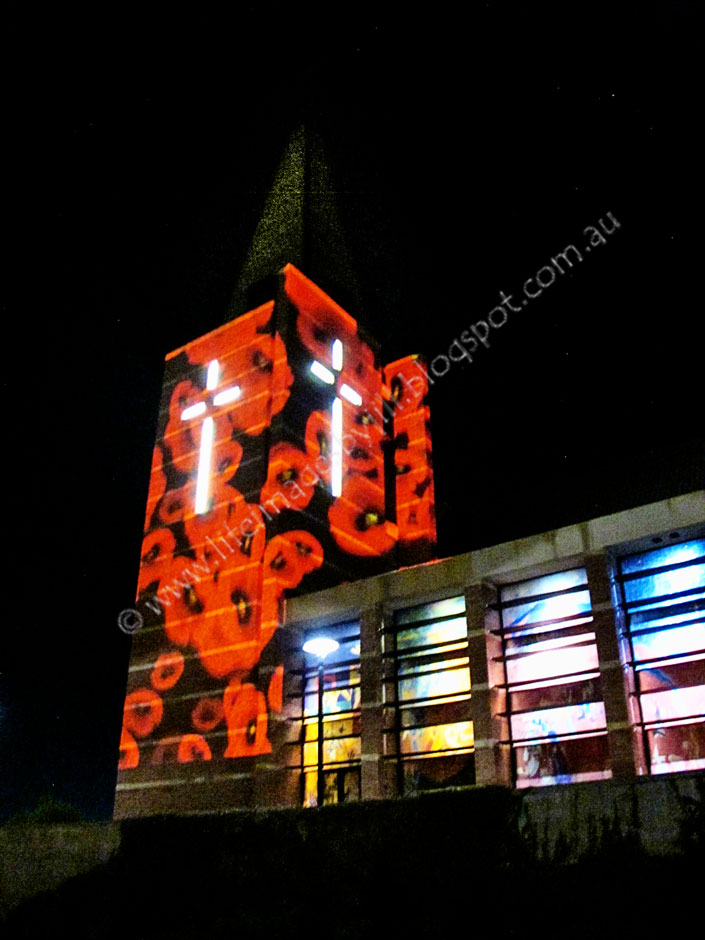
 In Western Australia where I live, the Department of Communities has contracted Perth company Impact Communications to conduct a cascading poppy lightshow. 
Places where it has been displayed are:  Exmouth's Vlamingh Head Lighthouse, Geraldton Museum, Kalgoorlie Town Hall, Albany Town Hall, Bunbury's St Patrick's Cathedral, Fremantle's WA Maritime Museum, finishing with Perth's St George's Cathedral on Sunday evening. 
 Below you can see the display at St Patrick's Cathedral in Bunbury. It really was beautiful.


 A river of hand-made poppies flowing over rocks at Peppermnt Lane Lodge in the Ferguson Valley where we held a small ceremony on Sunday at 11am. 


Please click on the links to read the story behind the poem In Flanders Fields and The red remembrance poppy
The Australian War Memorial and 62,000 poppies.  

Thank you so much for stopping by.  Do you have a day like Remembrance Day in your country? Perhaps you would like to tell us about it in your comments. I value your comments and look forward to hearing from you. I will try to visit your blogs in return. Have a wonderful week.  

You might also like:  
25th April - Anzac Day - when we remember them
Anzac Day - 25th April
On the 11th hour, of the 11th day, of the 11th month - Armistice
 
I am linking up to the link-ups below. Please click on the links to see fabulous contributions from around the world - virtual touring at its best!
Life in Reflection

Hello there! I love reading your comments. If you scroll down to the bottom you can comment too! I would love to hear from you.

If you are a blogger you can link up to Wednesday Around the World at Communal Global right here! - 


Monday, 23 April 2018

25th April - Anzac Day - when we remember them

"At the going down of the sun and in the morning
We will remember them."


These words are said every Anzac Day across Australia and New Zealand, and wherever Australians and New Zealanders gather for services on 25 April. 
(The Australian and New Zealand Army Corps (ANZAC) )

The words come from the poem For the Fallen, written by the English poet and writer Robert Laurence Binyon in mid September 1914, a few weeks after the outbreak of the First World War. It was published in London in The Times on 21 September 1914 and a couple of months later in the "Winnowing Fan; Poems of the Great War" in 1914. 


Sunday, 24 April 2016

Anzac Day - we will remember them

25 April is an important day on the Australian calendar. It is the day that Australians and New Zealanders across the world commemorate Anzac Day at dawn services, marches, vigils, commemorative services, by visiting grave sites and getting together with friends and family.  Not to glorify war but to remember those who served their country in wars or who lost their lives and gave the ultimate sacrifice.

The words below are from The Ode -   from the poem For the Fallen, by the English poet and writer Laurence Binyo. Please click here to learn more Traditions - the Ode

 "They shall grow not old, as we that are left grow old;
Age shall not weary them, nor the years condemn.
At the going down of the sun and in the morning
We will remember them."


Every year we go to the Dawn Service at our town War Memorial, and each year I have noticed the numbers attending grow.  Those of us who were born in the 1950s were brought up with the stories of the World War Two years as our parents, uncles, aunts, grandparents had lived through that era.  We heard about life on the home front and about their family members who served through WW2. My husband's uncle died as a prisoner of war in Burma, and my father's uncle died in the first days of the Gallipoli campaign in WW1. After going to our Australian War Memorial in Canberra a few years ago, and putting a red poppy next to their names these two young men became more real to me, and every year at the Dawn Service I shed some tears.


  This morning's Anzac Day dawn service was no different. As we stood amongst the crowd in silence in the drizzling rain and watched the returned servicemen march down the street to the war memorial, listened to the speeches, songs, the single rifle shot, and the bugle playing the last post, my tears fell. This combined consciousness as we stood with bowed heads in silence as the rain fell was a powerful feeling.

Not only should we remember those that gave their lives, but also those who have returned home broken in body and spirit. Today there is a new generation of returned servicemen and women, battling their memories of what they have seen and experienced on modern day war fronts.

You can read more about this here - ABC Net- Young Diggers share their PTSD struggle
and The Bravery Trust


Today there is also a new generation of children who are learning about the Anzac tradition, through more recent conflicts like Vietnam, Afghanistan, the Middle East, and the ongoing war against terror. I think it is important that they learn about this history and the sacrifices that are made. Not to glorify it, but hopefully to learn about the futility and tragedies of war. Perhaps they will strive for a better way to solve international conflicts.


There are many books written about the war years. Recently I picked up two books about Anzac Day for children in our school library - 


Anzac Biscuits by Phil Cummings, with illustrations by Owen Swan, is about a little girl who makes Anzac Biscuits to send to her father on the war front. 

This is a touching story of a family torn apart by war but brought together through the powerful simplicity of Anzac biscuits as it delicately entwines the desolation of life on the frontline of war with the tenderness of life on the home front. 


And 
Reflection - Remembering Those Who Serve In War by Rebecka Sharpe Shelberg and illustrated by Robin Cowcher 

"Left! Left! Left! Right! Left! We make our way in the dark. A family journeys through the early morning darkness... A group of young men huddle in a cold muddy trench."


 This picture book is a great way to introduce children to the history of Australia and its role in various conflicts around the globe as readers connect to the story as the family attend a dawn service and Anzac Day march.


When we packed up my mother and father's house a couple of years ago, I found a tin box in my mother's bedside drawer containing letters from her brothers and a friend who served in WW2.  There are letters marked "In Active Service". Letters which have a sticker to say they have been opened by the Censor, and letters marked "Privileged" which were not opened by the sensor but the writer had to sign to say that the letter only contained private and family matters. In their letters home service men and women could not talk about where they were, where they were going, or what conflicts they had been involved in.

My mother's friend who was in the RAF based in England had handwriting which was very difficult to read, so most of it is illegible to me, but I did read at the beginning of one letter that he apologised for his hand writing and saying there was no typewriter he could use. I also noted that it took at least two months for letters to be sent from England to Australia. So a four month turn around from when the sender in Australia received a return letter.  In these days of instant communication can you imagine waiting for four months to receive a letter from your loved one? So much would have happened in that time. I know letters from home meant a lot to those serving overseas. These letters must have also meant a lot to my mother for her to have kept them all these years. 


On Sunday we went to an open day at the South West Rail and Heritage Centre Boyanup There were various people demonstrating traditional crafts such as blacksmithing, spinning, and book binding.  We saw a demonstration of Morse Code. It was fascinating to see one man transmitting messages on the Morse Code machine, and another man on the other side of the room typing the messages on a typewriter. 
This method of communication was very important throughout the two world wars.


 Morse code is a method for encoding text into a series of dashes and dots, that can be sent (transmitted) by means of sound, light or radio waves, and that can be decoded be a skilled listener without special equipment. The system is named after the American artist Samuel Finley Breese Morse who co-developed an electrical telegraph system at the beginning of 1836 . From: Cryptomuseum

Below you can see the Morse Code alphabet. If you look on the Cryptomuseum website, you can see how this alphabet was devised. (see second image below here). It really is amazing how people can learn and use this system at speed and very often under extreme circumstances. 
Can you work out the code for SOS ? 


Will you be attending an Anzac Day Service this year? Perhaps you would like to tell us about your Anzac Day in the comments.

For more information:
Australian Army - Anzac Day Tradition
Australian War Memorial 
Cryptomuseum - Morse Code
Reflection - Rebecka Sharpe Shelberg
Anzac Biscuits - Phil Cummings and Phil Cummings
 South West Rail and Heritage Centre, Boyanup
  
 Thank you so much for stopping by. I value your comments and look forward to hearing from you. I will try to visit your blogs in return. Have a wonderful week.

I am linking up to the link-ups below. Please click on the links to see fabulous contributions from around the world - virtual touring at its best!

Mosaic Monday 

Life Thru the Lens 

Lifestyle Fifty Monday Linkup 
Our World Tuesday

Through My Lens 
Image-in-ing
Wednesday Around the World at Communal Global
Worth Casing Wednesday
Travel Photo Thursday

The Weekly Postcard

You might also like: 

Anzac Day 2015 - 100 years 
Anzac Day goes beyond the landing in Gallipoli 
Making Anzac Biscuits