

I have just finished reading The Dictionary of Lost Words by Pip Williams. Have you read it?

This is a fascinating history about the production of the first Oxford Dictionary by Dr Murray and his lexicographers in a corrugated iron shed, the Scriptorium, in Dr Murray's garden in Oxford. Published in separate parts, fascicles, A-Ant was published in 1884, with the last section V-Z published in 1928. The dictionary eventually contained around 400,000 words, definitions and phrases demonstrating their usage.
Into her book, Pip has skilfully woven real and fictional characters with a background of historical fact like the Women's Suffrage Movement in England and the onset of World War 1.
I was interested to learn that women in South Australia were granted the right to vote in 1884 and could be elected to Parliament, although it wasn't until 1902 when white women were given the right to vote in Australian Federal elections.
Postscript.... I have just been alerted to the fact that... on 9th September 1893 New Zealand became the first self governing country in the world to give women the right to vote.
Whereas women were not granted voting rights in the UK until 1928. White women in the USA were given the right to vote in 1920. In all cases, for people of colour and ethic background, the right to vote was granted much later than this.

Who was this girl? She is Esme and her father, who she refers to as Da, is one of the lexicographers. Esme's mother has died, and Dr Murray's housemaid and Esme's minder Lizzie, and her aunt, "Ditte" (Edith Thompson) are major characters in Esme's life.
As a young child Esme sat under the sorting table at the Scriptorium to keep out of the way while her father worked. Esme steals a discarded word that has fallen to the floor. The word is Bondmaid. She hides the word in a trunk underneath Lizzie's bed. Many more words are added to the trunk over the years and Esme eventually becomes a lexicographer - a person who compiles dictionaries.
Edith Thompson actually wrote the History of England for schools in 1881. Edith and her sister Elizabeth Thompson provided 15,000 quotations for A & B, and continued to provided quotations and editorial assistance until the last word was published.
Pip says that The Dictionary of Lost Words was her attempt to understand how the way we define language might define us. Pip asks Do words mean different things to men and women?
The first dictionary was defined by men, ....older, white, Victorian-era men....with women cast in minor or supporting roles. In addition to Edith & Elizabeth Thompson, there was also Hilda, Elsie and Rosfrith Murray who worked in the Scriptorium to support their father. Eleanor Bradley worked at the Old Ashmolean as part of her father's team of assistants. Countless women sent in quotations for words. The women who wrote novels, biographies and poetry that were considered as evidence for the use of particular words.
The Scriptorium stored the words - written on a slip of paper the size of a postcard. Volunteers mailed them from all over the world. They were kept in bundles in hundreds of pigeon holes that lined the shed walls, with examples of their usage attached as proof.
The word Bondmaid was discovered missing from the dictionary in 1901 following a letter from the member of the public.
Bondmaid is not the kind of word people drop during conversation anymore, and that’s for the best: It means “a slave girl.” The word was most popular in the 16th century. Murray’s file for bondmaid, however, reached back even further: It included quotations as old as William Tyndale’s 1526 translation of the Bible....
However all was not lost for the lost word.....In 1933, bondmaid made its Oxford dictionary debut. It had taken nearly five decades to make the correction. The Time the Oxford Dictionary Forgot a Word

Today the dictionary archives, original slips and proofs are held at the Oxford University Press in Oxford.
Below you can see Dr Murray in the Scriptorium, and in the group photo, Dr Murray with some of the staff, including his two daughters Elsie and Rosfrith.


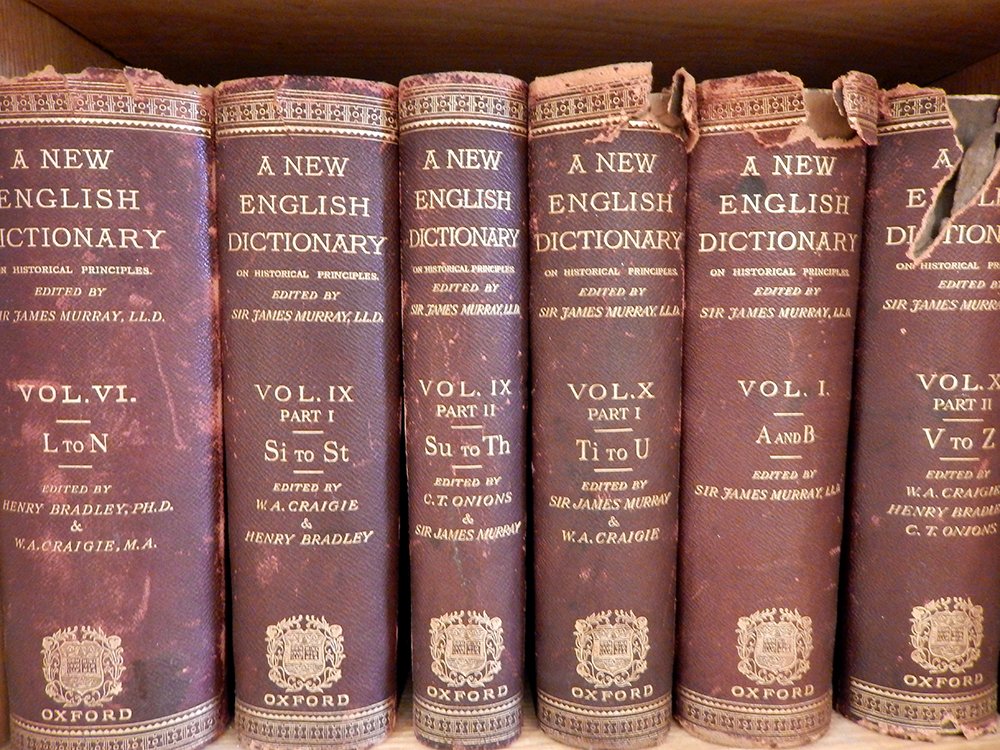
At over $1000 Australian Dollars obviously a local library is not going to house all these volumes! I wonder if our State Library might. The Dictionary of Lost Words has really sparked my interest in the Oxford Dictionary and the origin of words.


Thank you to the sites from where I have borrowed photos and information.
Lynda Mugglestone - Lost for Words
Peter Gilliver - The Making of the Oxford English Dictionary
Oxford English Dictionery on line
History of the Oxford English Dictionery
Oxford English Dictionary blog
wikiwand.com/en/Oxford_English_Dictionary
Book review - Publishing Arts Hub
Mental Floss.com - The Time the Oxford Dictionary Forgot a Word
and 13 Facts about the Oxford English Dictionary
Wikipedia.org - Oxford_English_Dictionary
I hope you have enjoyed my look at the Oxford English Dictionary. The more I research the more interesting it becomes.
I love curling up with a good book. Don't you? What have you been reading lately? Perhaps you would like to tell us in your comments.

Below is a pic of my old school dictionary. I just noticed it was published in 1941! No I am not that old! It actually belonged to my sister originally and then passed to me. It still has her name in it. Perhaps I should give it back to her.
Thank you so much for stopping by. I hope you and yours are doing well.
 |
| My old school dictionary |
I am linking up to the link-ups below. Please click on the links to see fabulous contributions from around the world - virtual touring at its best!
Hello there! I love reading your comments. If you scroll down to the bottom you can comment too! I would love to hear from you.


