Welcome to Life Images by Jill

Welcome to Life Images by Jill.........Stepping into the light and bringing together the images and stories of our world. I am a photographer, writer and multi-media artist.
Focussing mainly on Western Australia and Australia, I am seeking to preserve images and memories of the beautiful world in which we live and the people in it.

Welcome!

Welcome!
PLEASE CLICK ON THE IMAGE TO GO TO MY RED BUBBLE STORE.
Showing posts with label travel Australia. Show all posts

Sunday, 10 November 2024

Midwest Goldfields Wildflower Trundle - Part 4 - Yalgoo and Sandstone

 Hi all, I hope you and yours are doing well. Today we continue with Part 4 of our Midwest Goldfields Wildflower trundle. 

After our stay at Wooleen Station, we returned south to Mullewa and then turned east on the Geraldton Mt Magnet Road. I thought at this point I should show you the map again. The next part of our journey is Mullewa to Sandstone - 396km.


There were lots of mining trucks on the road going east. You really need to be careful on the road, especially if wanting to overtake. We reached Yalgoo around 10am


and visited another one of Monsignor Hawes' churches - the Dominican Chapel of St Hyacinth Holy Trinity Church built during 1920-22 for the Dominican Sisters who were brought to Yalgoo to run a school. The chapel was the smallest church designed by Hawes. It was restored by Shire of Yalgoo in 1980. Unfortunately you can only view the church from the outside. The chapel is a small and simple structure in Inter-War Romanesque style, with a terracotta roof and masonry and timber framed bell tower, and is all that remains of a larger complex of buildings. The chapel contains examples of Hawes’s handmade arts and crafts influenced artworks.

Local carpenter Hendry Jermy built the convent school. Most of the materials came from the old convent in the near-derelict town of Day Dawn near Cue. The school opened in February 1922 with 23 students and ran till 1950. Two stone chimneys which you can see in the foreground are all that remain of the school which was dismantled and used to construct a shearing shed on a nearby property. 


After having lunch and fuelling up in Mt Magnet, we continued east towards Sandstone. Along the way we stopped to take photos of the magnificent Royal Mulla Mulla - ptilotus rotundifolius which grows from 60cm to 2 metres and has huge fluffy flowers.  It occurs naturally in the drier regions of Carnarvon, Gascoyne, Little Sandy Desert, Murchison and the Pilbara in Western Australia.


There were still lots of mining trucks on the road. We arrived in Sandstone late afternoon and booked into the Alice Atkinson caravan park. We have stayed here before - it is very quiet and well presented. We were hoping the hotel would be open for dinner, but sadly it is closed down. The community wanted to buy it but the asking price was too much. However the cafĂ© located in the old post office and telegraph building is open for breakfast and lunch. 


We had two nights in Sandstone - so we made the next day our exploring day. After pancakes for breakfast and doing the washing and a bit of cleaning in the van we explored the Heritage Drive, which only takes half a day. We had visited the Visitor Centre the day before and picked up maps and information. 

Prior to the arrival of Europeans the area was the home to the Wongi and Yamagee peoples. The first European into the area was John Forrest in 1869. The goldrushes of the 1880s led to the opening up of the Murchison area. In 1894 prospector Ernest Shillington discovered gold about 20km south of the present day Sandstone. The town was officially gazetted in 1906. Between 1906-1912 the town had a population of between 6000-8000, and the town had 4 hotels and 2 banks. The railway line reached town in 1910. The town's decline coincided with the outbreak of WW1 in Europe. Many miners left to serve overseas. Many never returned and others, seeing the declining fortune of mines, drifted away from the area. By 1919 the population was only 200. 

Today it is a small centre for the surrounding pastoral leases and stopover for tourists and gold prospectors.   (info with thanks from the Sandstone Visitor Centre) 

The heritage Trail includes locations around town, as well as a leisurely 18km marked self-guided Heritage Drive. Head out of town on the Paynes Find Road and then turn onto Menzies Road. 

First stop is Contradiction Well, built by the State Government during the gold rush years around 1900. Sunk by hand to 100 metres, and water brought to the surface by windlass and bucket, it produced good drinking water for many years. 


Next stop is the former State Battery which is listed on the State Register of Heritage Places. The battery operated between 1908 and 1982, providing an invaluable service to small mines and prospectors in the area. 


Next stop is London Bridge, a weathered basalt ridge thought to be 350 million years old. The bridge is the result of different rates of erosion in hard and soft rock. The underlying rocks of the Sandstone area are thought to be 2 billion years old. A popular picnic place for locals, the bridge is growing thinner and may eventually collapse, so people are asked not to climb the bridge. 

The wildflower you see in the foreground of the above collage is one of the mulla-mulla varieties - Silver Mulla Mulla Ptilotus obovatus


Overnight camping is not permitted, but they do have ingenious BBQs


Next stop is the Old Brewery, constructed by Irishman JV Kearney in 1907. The main building was on top of a breakaway about 1015 metres high. Water from a well was pumped to an elevated tank and from there gravitated to the coolers and down to the brew vats. The beer then flowed via pipes to the cellar built into a tunnel driven into the face of the breakaway. The underground cellar kept remarkedly cool even in the hottest weather by means of a winze - a hole bored through the ceiling of the rock. The brewery continued until 1910 when beer was brought to Sandstone by rail from Mt Magnet. 


From here the trail takes you back to Agnew Road and back into town. Our next stop was the old cemetery on Meekatharra Road. The first burial was in March 1908, a 10-month old baby named Horace Mahood. The last burial was Samuel Ure who died when the Oraya Mine collapsed on 25 April 1932. However his body was not recovered until the mine reopened in 1995, and he was laid to rest in the cemetery on 1 October 1995. 

There are 141 known grace sites in the cemetery. What we found very interesting was that volunteers from Outback Graves.org have put plaques with names and details onto many of the graves, making it very interesting, especially the cause of death. You can find a lot of very interesting information on their site. You can find out a lot visiting old cemeteries. 


Back in town we had lunch at the Sandstone Old Post Office Cafe (I recommend you stop by for a cuppa or a meal) and looked at their interesting historic displays, viewed a historic photo exhibition in the Town Hall, spoke to the ladies at the local craft group, visited the Heritage Museum in the Visitor Centre, got a key so we could go into the Black Range Chapel to see their stained glass windows depicting flora and fauna, visited the war memorial, looked at the old Police Station lockup, checked out the painted water tanks, and viewed from the street the National Hotel - sadly now closed - we had dinner here last time we were in Sandstone. 


If you are a golfer you can hire golf clubs from the Visitor Centre. You can also visit the Gold and Wool Interpretive Park and learn about mining and pastoral history. 

Sandstone has an Astrodome located in the old school grounds, and viewings are conducted between April and October at 7.30pm subject to the weather. Bookings essential from the Visitor Centre. 

I hope you have enjoyed this little tour of Yalgoo and Sandstone. It is a relaxed and interesting stop over for a day or two. Next time I will be back with the next part of our journey. Thankyou to the Shire of Sandstone for the information in this blog post. 

Sandstone is located 742 km north east of Perth via the Great Northern Highway and then the Geraldton Mt Magnet Road. The Shire of Sandstone covers an area of 32,605 square kilometres with a population of around 116. But it has a huge community spirit. 

More information at: sandstone.wa.gov.au  and Yalgoo 

and Monsignor Hawes churches

Thank you so much for stopping by. I value your comments and look forward to hearing from you. I will try to visit your blogs in return. Have a wonderful week. 
I am linking up to the link-ups below. Please click on the links to see fabulous contributions from around the world - virtual touring at its best!
   

Sunday, 17 November 2013

South Austalia-Part 5 - Woomera, Coober Pedy & the Painted Desert

Welcome back for Part 4 of our trip through South Australia. If you missed the first three parts, please scroll down to the bottom of this post to go to the links.  Here is the link to the quick overview - On the road through South Australia.

Today we leave Port Augusta and the coast and travel up the Stuart Highway to Woomera, Coober Pedy, Arckaringa Station and the Painted Desert.  The blue line of this map shows an approximation of our route - 

The Stuart Highway runs for 3000 kilometres between Port Augusta up through central Australia to Darwin on the north coast. The Highway was named after explorer John McDouall Stuart who was the first European explorer to achieve the crossing in 1861-62, although the highway doesn't follow his exact route. His exploration to Darwin opened up the north and resulted in both the Overland Telegraph line and the Great Northern Railway. 

Travel along the Highway today is vastly different to what Stuart and his party would have experienced in 1861.  


 Please click on "Read more" to keep reading - there are lots more pics!


Monday, 28 October 2013

Part 3 - South Australia trip - Crossing Australia - The Eyre Highway and the Nullabor

Welcome back. A couple of weeks ago I gave you a brief overview of our recent trip to South Australia. Last week I brought you the first part – the Hyden to Norseman Road in Western Australia. 
If you missed it, and the AMAZING wildflowers, please click here – Across the Woodlines - Hyden to Norseman, Western Australia


Today I bring you part 2 – Eyre Highway and the Nullarbor.  The journey from Norseman in Western Australia to Ceduna in South Australia (which is classed as being the 'Nullarbor' experience) is approximately 1,200 kilometres. Are you ready? - please fill up your water bottles, pack your tent, fasten your seat belts, and make sure you have your camera ready. 

 Being far from bare as the word “Nullarbor” or this collage might imply, there is plenty to explore. Oh my goodness, there is a push-bike rider on the Eyre Highway!


As we drove across the Eyre Highway and the Nullarbor we thought about the first Europeans to cross here – it certainly wasn’t as easy as it is today.  

Aboriginal people, belonging to a number of different language groups, have lived in this vast area of southern Australia for over 35,000 years. There are signs of their heritage in 60 known archaeological sites. 

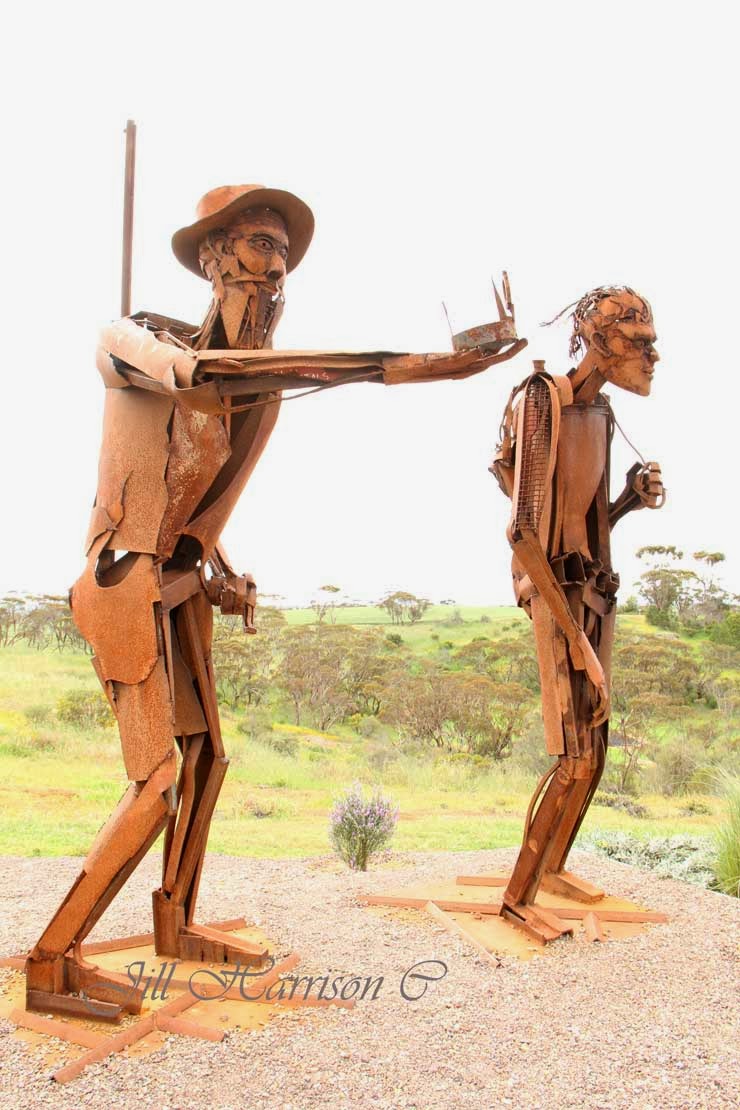
The crossing by Edward John Eyre and his aboriginal companion Wylie in 1840-41 is one of the most remarkable feats of endurance in Australian exploration history.  You can see various monuments throughout this part of Australia, including this sculpture dedicated to Eyre and Wylie at Kimba at the top of the Eyre Peninsular....

 It was another 30 years before anyone attempted the journey again.  An overland telegraph line between Perth and Adelaide (2,425 kilometres and 19,470 poles) was built in 1877 and the first track followed this line. In 1942 a graded road was constructed and the final bituminisation was completed in 1976.

Here is a map showing the Eyre Highway and this part of our trip - the dark blue thick line...


The lack of water was always a problem, and large corrugated iron roofs were erected along the highway to collect run off into tanks. You can still see some of these today - but don't rely on them for water! bring your own! 
 
The ruins of the Eucla Telegraph Station on the border of Western Australia and Adelaide is today being engulfed by shifting sand. Only the ruins of the station master’s residence remain. It is a fascinating place to visit. ……


It takes a few days to cross the Eyre Highway, especially if you are going to stop and look at the sights.  There are no towns, but road houses with motels and caravan parks will make the trip easier. There are also a number of free over night rest areas. You can find out about them by going to the Western Australian Main Roads site, click here -  Mainroads WA Rest Areas or by purchasing one of the Australian camping guide books. 

From the west coast it took us three and a half days and three nights bush camping to reach Streaky Bay in South Australia.
Below you can see them......Newman Rocks, Yalata (don't forget the flyspray and the insect repellent!), Moonera (our camp on our way back), and Jilah Rockhole. The bottom two pics show a typical roadside rest area, and our billy on the boil for that hot chocolate!


One of the best things about bush camping is the sunsets and sunrises that light up the sky….


Along the road there are trucks and other "big things" (a big kangaroo??). Take care when overtaking - the trucks I mean....  You will be amazed at what you might see….the bottom RH pic is of a burnt out truck that came to an unfortunate end in a truck bay. Hopefully the driver was unhurt. 


Signs to make sure you know where you are ….. like this one warning to be on the lookout for camels, wombats, and kangaroos. Wombats! We never saw any but you certainly wouldn’t want to run into one. The camels are feral herds which have been increasing to huge numbers since the days of the Afghan cameleers trains carting goods across outback Australia. Also be sure to don’t leave anything laying about your camp, particularly food, or you might find a dingo wanders in – and certainly don’t feed them. 


And even Royal Flying Doctor landing strips….yes, there are several of them along the highway - they actually use the highway as their airstrip.….well it is a straight piece of road!…..It is a quick way to assist people in medical trouble out here.


There is the longest stretch of straight road in Australia…… and the vastness of the southern Nullarbor Plain - and a sign to tell you when you get there….. 


 The Nullarbor Plain is the world’s largest limestone karst landscape covering an area of 270,000 square km, extending 2000 km between Norseman and Ceduna. Two thirds of the Nullarbor is within Western Australia and one third is in South Australia.The spectacular Bunda Cliffs and the Great Australian Bight border the area to the south and the northern border is the Great Victoria Desert.

In 1866 E. Alfred Delisser surveyed the Nullarbor Plain and noted a marked absence of trees. Contrary to some popular opinions the word Nullarbor is not of Aboriginal origins. In fact the local Mirning people referred to the area as "Oondiri" which is said to mean "the waterless". Delisser derived the term Nullarbor from the Latin "nulla" for no, and "arbor" for tree. Hence the term "Nullarbor" meaning “no trees”. 

However the plain is covered with bluebush and saltbush plants, hardy shrubs that are drought-resistant and salt-tolerant, with Myall acacia woodlands at the other edges. 


There are no towns between Norseman and Eucla, but there are Road Houses to fuel up your vehicle and you….however expect to pay high prices for fuel and food. You can also buy a shower.  Make sure your vehicle is reliable before crossing the Nullarbor as mechanical repairs will be expensive and time consuming - especially if parts have to be freighted in.


 There are cliffs and whales…….The Great Australian Bight Marine Park is a significant breeding and calving area at the Head of the Bight for the Southern Right Whale, and for sea lion colonies along the Bunda Cliffs. Whale watching at the Head of the Bight between June and October is a must for Nullarbor travellers. The access to the Head of the Bight lookout is 11km east of Nullarbor Roadhouse (please note you have to pay to go out on the Head of the Bight lookout).  Between Eucla and the Head of the Bight the Eyre Highway runs quite close to the cliff edge and there are various lookouts (don't climb over the railings). This is the Southern Ocean - next stop is Antarctica.


  At Border Village (on the border of WA & SA) you go through the Quaratine Station (if travelling east to west)……don’t carry any fresh fruit or vegetables (travelling west to east the quarantine station is at Ceduna). Please check the website and know what you can and can’t carry, it is easier that way….click on the link for an easy chart.... Australian domestic quarantine


There is even the Nullarbor Golf Links. This unique 18-hole par 72 golf course spans 1,365 kilometres from Kalgoorlie in Western Australia to Ceduna in South Australia. A single hole can be played in each participating town or roadhouse along the Eyre Highway, each featuring a green, a tee and a fairway of rugged outback natural terrain. ……make sure you allow more time for your trip if you intend playing all the holes, and collect your certificate when you sign up and complete the 18 holes. My son played the Links when he travelled across here a couple of years ago……click on the link to read more - Nullarbor Links
Oh and look out for giant "kangaroos" at the Border Village Link. LOL 


At Penong, on the western edge of the South Australian wheatbelt, you will see a cluster of community windmills in a paddock on the edge of the Eyre Highway. Known as "Windmill Flat" the 26 windmills are each privately owned supplying water for domestic and stock use. Being on the edge of the Nullarbor Plain it is not surprising that water is an issue for Penong. Wells were first sunk between 1868 and 1884 and windmill bores were later sunk to pump water from the Anjutabie Water Basin.  Penong still relies on rainfall as their main water source, with additional water carted by tankers from the Todd River pipeline, plus water pumped by the windmills. 


We thought is was an unusual sight so I took some pics - and just as well - as my story about Penong's windmills appeared in "Curious Australis" in the February 2014 edition of On The Road Magazine Australia.


At Fowlers Bay you can learn more about Matthew Flinders who named Fowlers Bay in 1802, and Edward John Eyre and his expedition which left here for the crossing of the Nullarbor on 25 February 1841. In the collage below you can see the jetty, a memorial to Flinders, a new hotel, the old telegraph station (now a private residence), and sandhills and salt lake at the edge of town. ….. I really like the way they have converted the old rail cart into a table and seats.


And at the end of it all you will reach Ceduna and the start of the next part of our journey. If you are travelling from west to east the Quarantine Station is here…..


I hope you have enjoyed Part 3 of our tour. I will be back next week when we go across the top of the Eyre Peninsula, through the Gawler Ranges where we see the amazing “Organ Pipes” rocks, and a stay in Port Augusta before turning north up the Stuart Highway and through outback South Australia. 

I am linking up to Mosaic Monday, Travel Photos Monday, Our World Tuesday, Tuesday Around the World, Travel Photo Thursday, What's It Wednesday, and Oh the Places I've Been. Please click on the links to see fabulous contributions from around the world - virtual touring at its best!


Mosaic Monday
Travel Photo Mondays
Our World Tuesday
Tuesday Around the World  
What's It Wednesday
Travel Photo Thursday
 Oh The Places I've Been


You might also like - 
On the road through South Australia
Across the woodlines - Hyden to Norseman, Western Australia
Dehydrating food for camping