

Welcome!

PLEASE CLICK ON THE IMAGE TO GO TO MY RED BUBBLE STORE.
Showing posts with label photographing wildflowers. Show all posts
Showing posts with label photographing wildflowers. Show all posts
Sunday, 13 October 2019
Hunting for wild orchids, Western Australia
It seems to be a shame to miss the wild orchid season while I keep you in the Northern Territory on my half lap of Australia so for this week I am going to drag you away from my travels and back to the south west of Western Australia where the wildflowers are blooming. If you missed it, I did share a few local wildflowers back in September.


Sunday, 15 September 2019
September wildflowers in Western Australia
 I love September because it is the time for wildflowers in my corner of the world - the south west of Western Australia. I always say there is always something flowering in the Australia bush, which is true, but in spring in September the bush really comes alive with colour and an array of unique wildflowers found nowhere else in the world.
 I know I promised last week to bring you more of my recent travels - half lap of Australia, but because we have been on three wildflower short walks this past week in my area, I just had to share.
Opposite is Western Australia's floral emblem - the green and red Mangles Kangaroo Paw - Anigozanthos manglesii
Monday, 17 September 2018
Wildflower hunting - and taking time out
Hi everyone, as I mentioned last week I took a short break from social media, blogging and internet for a couple of weeks, but I am now back home and back to my computer. My post a couple of weeks ago would have given you a hint - Gather Around the Campfire - that I went camping.
We travelled up through the Western Australian midwest to some of the old gold mining regions and towns, across some country new to us, and other places we have visited before and enjoy returning to. We travelled on outback roads, watched amazing sunsets, visited old towns with interesting history and fascinating stories, camped under the stars, climbed huge granite outcrops and at the end of the day baked damper and toasted marshmallows over the campfire.

The added bonus and the reason we chose early September is because spring has sprung in Western Australia and September is the perfect time to travel, particularly to our mid-west region, to see the wildflowers. Before we left reports had been coming in about the amazing wildflower season Western Australia was having, so I was keen to get out on the road to see some of them.
And we were ankle deep in everlasting wildflowers, by late afternoon on our first day. The carpets of everlastings sprawling through the seemingly dry bushland is amazing to see.


Boasting up to 12,000 known species, the Western Australian wildflower season spreads over several months starting from July in the far north till November in the south and I feel blessed to be able to travel over parts of our state during wildflower season to photograph some of them. Over the next couple of weeks I will bring you more images and stories from our trip.


But more than this, one of the things I enjoyed most about our trip was getting away from our everyday life in suburbia, and away from phones, internet, social media and, dare I whisper, blogging. The peace and calm I feel walking through the bush with my camera is wonderful and food for the soul.
The new spring season for me is a good time to slow down and celebrate the beauty around us and to feel grateful.

I took several opportunities when the sky was clear, to get up early and go walking with my camera. A lot is written about "mindfulness" these days, and I guess this is what I was doing - being immersed in the environment, looking at the light and seeing where and how it fell, observing the shapes and colours. Feeling the breeze on my cheeks and the feel of the gravel under my boots. Hearing the early morning bird song. Being alone to wander at will and absorb all the gifts around me.

You might even see a kangaroo or two. Sadly I can't claim credit for this photo. It was taken by my husband.

One last thing - bocce is a great game to take bush camping! .... or is it boules? Either way, this set only cost us $10 and gave us lots of fun in camp in the late afternoon and will be a must on our camping list from now on.

It is difficult to return to life after this, but return we must. But I have my photos to look back on, and many stories to share with you over the next few weeks. I hope you will join me.
Until then, I hope you have enjoyed this little introduction. How do you celebrate the change in seasons? Perhaps you'd like to tell us in your comments. Thank you so much for stopping by. I value your comments and look forward to hearing from you. I will try to visit your blogs in return. Have a wonderful week.
You might also enjoy:
Photographing wildflowers
The wildflower hunter

I am linking up to the link-ups below. Please click on the links to see fabulous contributions from around the world - virtual touring at its best!
Hello there! I love reading your comments. If you scroll down to the bottom you can comment too! I would love to hear from you.
We travelled up through the Western Australian midwest to some of the old gold mining regions and towns, across some country new to us, and other places we have visited before and enjoy returning to. We travelled on outback roads, watched amazing sunsets, visited old towns with interesting history and fascinating stories, camped under the stars, climbed huge granite outcrops and at the end of the day baked damper and toasted marshmallows over the campfire.

The added bonus and the reason we chose early September is because spring has sprung in Western Australia and September is the perfect time to travel, particularly to our mid-west region, to see the wildflowers. Before we left reports had been coming in about the amazing wildflower season Western Australia was having, so I was keen to get out on the road to see some of them.
And we were ankle deep in everlasting wildflowers, by late afternoon on our first day. The carpets of everlastings sprawling through the seemingly dry bushland is amazing to see.


Boasting up to 12,000 known species, the Western Australian wildflower season spreads over several months starting from July in the far north till November in the south and I feel blessed to be able to travel over parts of our state during wildflower season to photograph some of them. Over the next couple of weeks I will bring you more images and stories from our trip.


But more than this, one of the things I enjoyed most about our trip was getting away from our everyday life in suburbia, and away from phones, internet, social media and, dare I whisper, blogging. The peace and calm I feel walking through the bush with my camera is wonderful and food for the soul.
The new spring season for me is a good time to slow down and celebrate the beauty around us and to feel grateful.

I took several opportunities when the sky was clear, to get up early and go walking with my camera. A lot is written about "mindfulness" these days, and I guess this is what I was doing - being immersed in the environment, looking at the light and seeing where and how it fell, observing the shapes and colours. Feeling the breeze on my cheeks and the feel of the gravel under my boots. Hearing the early morning bird song. Being alone to wander at will and absorb all the gifts around me.

You might even see a kangaroo or two. Sadly I can't claim credit for this photo. It was taken by my husband.

One last thing - bocce is a great game to take bush camping! .... or is it boules? Either way, this set only cost us $10 and gave us lots of fun in camp in the late afternoon and will be a must on our camping list from now on.

It is difficult to return to life after this, but return we must. But I have my photos to look back on, and many stories to share with you over the next few weeks. I hope you will join me.
Until then, I hope you have enjoyed this little introduction. How do you celebrate the change in seasons? Perhaps you'd like to tell us in your comments. Thank you so much for stopping by. I value your comments and look forward to hearing from you. I will try to visit your blogs in return. Have a wonderful week.
You might also enjoy:
Photographing wildflowers
The wildflower hunter

I am linking up to the link-ups below. Please click on the links to see fabulous contributions from around the world - virtual touring at its best!
Image-in-ing
Wednesday Around the World at Communal Global
Travel Photo Thursday
Life in ReflectionWednesday Around the World at Communal Global
Travel Photo Thursday
Hello there! I love reading your comments. If you scroll down to the bottom you can comment too! I would love to hear from you.
Tuesday, 14 June 2016
Photographing Wildflowers

I was stunned that he had discovered me among all the other photographers photographing wildflowers in Australia, and stunned that he considered I was worthy enough. Although I have sold wildflower photos and written a few magazine articles about photographing wildflowers, including one for Australian Photography magazine in January 2008, I didn't consider myself a professional. I think however that Rob was looking for someone who could speak in layman terms to would-be wildflower photographers.
What an amazing opportunity and thrill it was for me to be featured in a national photography magazine.


One of my images was on the opening page. I took this image last year in the Dryandra Woodland Conservation Reserve in Western Australia's wheatbelt. Once again taken in late afternoon light.
Aperture Priority is ideal for photographing wildflowers, and a great place to start when starting out. Set the aperture and the camera will look after the rest. Remember the larger the aperture, ie f2.6, the shallower the depth of field with your subject in focus over a lovely soft blurred background and bokeh (Bokeh has been defined as "the way the lens renders out-of-focus points of light") ie those spots of light in the background you can see in the image below.
With more experience I encourage you to learn how to use full manual controls, setting your ISO, light balance, shutter speed and aperture..... but don't feel overwhelmed, learn about aperture priority first.
 |
| Dryandra, Canon 60D, 100mm macro, f4, ISO 125, 1/400sec |
However it is possible to shoot wildflowers with a compact camera, especially if it has manual settings such as Aperture Priority. Look for the little "flower" symbol on your camera dial. Don't go out and buy an expensive macro lens when you start out. Experiment first with what you have and learn to use your manual camera settings. If you don't have a macro lens, you can use an extension tube or a 'close up' filter which are both less expensive options which work well when you are starting out.
 | |
| Crooked Brook Reserve, Dardanup. Canon EOS 60D, 100mm, ISO 125, f5, 1/500sec |
I also encourage you to use the viewfinder on your camera, not the LCD screen, as physically holding the camera against your face, and tucking your elbows into your sides will steady the camera, and in my opinion you will also have better control over your picture taking.
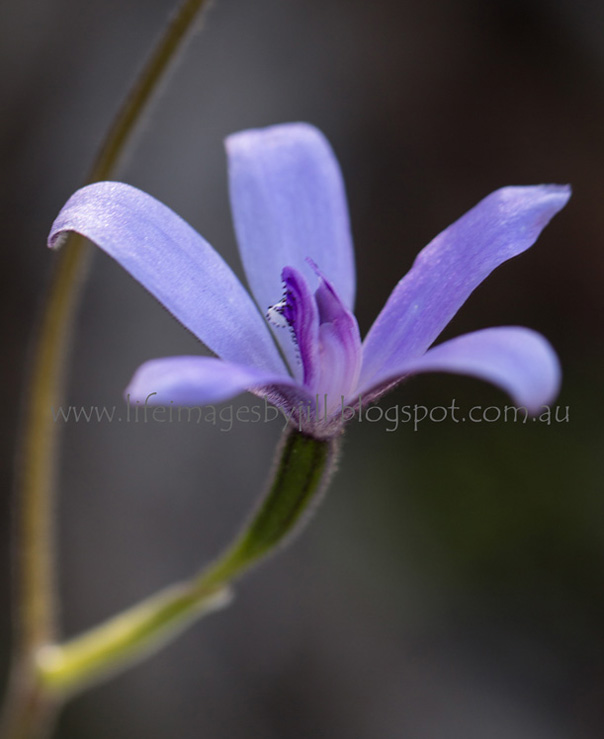 |
| Manea Park, Canon 60D, f5, 1/80 secs, ISO 200 |
I love taking wildflower images, and long for the spring when the wildflowers will be blooming in profusion. It is winter now, but you can still find a few wildflowers in the Australian bush at any time of year. Not able to get out into the bush? Even in our urban environments you can still find wildflowers in nature reserves, bush buffer zones or botanical gardens. Kings Park Botanic Gardens in Perth, Western Australia, is a fabulous place to photograph wildflowers, especially during spring.
Being out in the bush is so rejuvenating and you never know what you might discover.
If I don't have my DSLR with me, my handy little "go everywhere with me" Canon G11 using aperture priority gives an acceptable result when it is my only option, although sometimes I find it difficult to get it to focus where I want it to! I took the photos below with my G11 this morning in our little bushland reserve near our home.


 An important part of my bush walking kit is a good pair of hiking boots, spare batteries, extra memory cards and a good comfortable waterproof backpack with padded areas to protect gear. It is also handy to carry a good map or locally produced guide (wildflower locations can vary seasonally) and a reference book for identifying flowers. If you are in Western Australia a particular guide I have found very useful over the years are Eddy Wajon's set of 4 books - Colour Guide to Spring Wildflowers of Western Australia. These are available at many visitor centres and bookshops or online. The books are split into 4 regions of Western Australia.
 I hope you have enjoyed this little look at wildflower photography. I will blog again later with more tips. In the meantime you might like to look at my previous posts about wildflower photography - How to take great wildflower photos
or go to my Index tab at the top of my blog and scroll down to the Garden and Wildflowers list to find the links.
For more information on wildflowers in Western Australia please click here - Explore Western Australia's wildflowers
 |
| Taken with my Canon G11 compact camera |
Thank you so much for stopping by. Do you enjoy taking wildflower photos? Perhaps you would like to tell us about it in the comments. I value your comments and look forward to hearing from you. I will try to visit your blogs in return. Have a wonderful week.
I am linking up to the link-ups below. Please click on the links to see fabulous contributions from around the world - virtual touring at its best!
Mosaic Monday
Life Thru the Lens
Lifestyle Fifty Monday Linkup
Our World Tuesday
Through My Lens
Image-in-ing
Wednesday Around the World at Communal Global
Worth Casing Wednesday
Travel Photo Thursday
The Weekly Postcard

Saturday, 19 July 2008
Everlasting Magic, Western Australia
 WESTERN AUSTRALIA - September 2005
 is considered to be among the finest in the world, drawing visitors from all over the world every year. The area is also rich in heritage interest.
  wildflower species due to environmental differences such as soil type, fauna, plant systems, geography, and weather. Whilst on the road it is a good idea to visit local visitor centres for the latest information on what is flowering where, as the best locations can vary depending on the season.
To read this complete article see Australian Coast and Country magazine Edition 2, 2008

Subscribe to:
Posts (Atom)