

Hi everyone, I hope you and yours are doing well.
This week I bring you the next part of our Midwest Wildflower Trundle. Leaving Mullewa we headed north to Wooleen Station - where we were booked in for a 4 night stay. This was to be a return visit for us, having visited previously in 2015 with our camper trailer. You can read about that visit here: Murchison River camping at Wooleen
I was keen to visit again and see what advances they had made with their rehabilitation program.
Located 193 kilometres north of Mullewa on the Carnarvon-Mullewa Road, the road to turned to gravel about 80km from Mullewa and then back to bitumen at the Murchison Shire Boundary, then gravel again at the Twin Peaks turnoff - gravel from here to Wooleen.
There were lots of wildflowers along the way, so of course I needed to stop and take some photos. These are mauvy/pink Bachelors Buttons - Centaura Cyanus (one of my favourites) in the foreground with white pom-pom everlastings in the background. We had a burst of summer - 33C at Wooleen when we arrived.

Wooleen Station’s quarter of a million acres of mulga scrublands is located in a 3.6 billion year old landscape, one of 285 pastoral leasehold stations in the 850,000 square kilometres semi-arid Southern Rangelands, in Western Australia’s Murchison region. Wooleen's unique nature based station stay offers a wealth of experiences.

First off - check in at the Milimanmanha Café and reception near the Wooleen homestead. This building, with its barrel-vaulted ceiling was originally the old cookhouse at the Wooleen Woolshed and has been rebuilt at Wooleen homestead. Once listed by the National Trust of Australia (WA), the Woolshed was unfortunately blown away by 150 kilometre winds in 2004. Built in 1922 by Alf Couch, its outstanding feature was the self-supporting curved 80 by 25 metre corrugated iron roof, a technique perfected by Couch because timber was in short supply. This barrel-vaulted roofline became characteristic of sheds in the Murchison area and can be seen in the cookhouse and other sheds at Wooleen.

At the Cafe you can collect a guidebook, maps, and also purchase local products, and buy lunch, drinks, and Wooleen beef. We had a delicious toasted sandwich here on one of the days of our visit. There are toilets and showers near the Café and WIFI and mobile phone connection at the Café and homestead area. Trust me, when you are bush-camping like we were, the hot showers are wonderful. I liked the way that the water from the handwashing fountain ran off into the garden.

To supplement their income from grazing cattle, Wooleen offers fully-catered accommodation in their Australian National Trust listed homestead built in 1918, and two self-catering fully-equipped guesthouses. Further afield there are private camp sites, suitable for caravans, along the Murchison River (where we camped), in mulga scrub and in rocky outcrop country.
You can enjoy marked bushwalking and mountain-bike trails, canoeing in the river, guided tours, and workshops from April to October. Wooleen’s Visitor Guide includes history, conservation strategies, trail guides, and fauna lists.
Below here you can see the homestead, cabins, rocky outcrop and river campsites.

And in the photo below, the homestead in the middle, cabins to the right, and station yards and sheds to the left.

After booking in we drove out to our camp by the river about 16km from the Cafe. Last time we were at Gurulhu (Black Swan) camp, and this time we were at Birdiny (Water Chooky). It was just as we remembered it - quiet and beautiful. All the camps have a firepit - you can pick up wood at the designated wood collecting area on the way out. The track is a sand track and had obviously been a bit boggy during the rains, but we had no problems getting there with our caravan.
We made damper and roasted marshmallows over the campfire. Below you can see our camp, the river, sunset, the damper and the bush toilet - definitely a loo with a view - and it has a polished wooded seat!


Did I tell you about the sunsets?

Next morning I was up early and wandered near our camp taking a few wildflower photos. Unfortunately I haven't identified all these plants as yet - I need to work on it. So far - clockwise from top left - one of the yellow daisies, the red berry is Ruby Saltbush, then one of the ground cover mulla-mullas, then below that one of the blue bush varieties, another yellow button wildflower, the Tall Mulla Mulla, the white one I haven't been able to identify, above that the Large Green Pussy Tail Mulla Mulla, and in the centre one of Cassia family of which I saw several varieties. The larger image below is also one of the Cassia family.
There are many types of mulla-mulla - For the love of mulla mulla


An impressive number of birds, reptiles, mammals, acquatic life, and plants have been recorded at Wooleen. It is easy to see why wildflowers attract visitors during spring.
We drove out to Gradagullya Pool on the Murchison River, sat under the trees and wandered along the river taking photos of birds. Green budgerigars, pink and grey galas and white corellas were nesting along the river. It was lovely to sit and watch them. The galas and corellas were doing a lot of squarking at each other. I particularly enjoyed seeing the budgerigars, as I had never seen them up close like this in the wild before.


Wajarri Yamatji aboriginal people have inhabited Wooleen for tens of thousands of years, and named a soak Weelin. Many Wajarri people who grew up on Wooleen now live at the Pia community on Wooleen's eastern boundary.
Wooleen Station was founded in 1886 by James Sharpe who bought a lease of about 90,000 acres at Yewlands Pool from John Williams. After around a hundred years in the Sharpe family, the station was bought by Peter Burton, before Brett and Helen Pollock bought the property in 1989.
Wooleen’s current owners, David (Brett & Helen's son) and his wife Francis Pollock, are committed to regenerating and preserving Wooleen’s unique ecology, and finding a sustainable way to run stock economically while looking after the environment after decades of over-stocking, crippling droughts, erosion and land degradation typical in the rangelands. Once a sheep grazing area, stations now predominantly graze cattle.
The Pollocks say that traditional grazing practices
are not sustainable in the rangelands where the average rainfall is 200-300mm. “The
rangelands are a renewable resource,
but only if the land is managed so it is able to renew itself and is healthy
enough to withstand the normal cycles of climate.”
The Pollocks periodically rest the landscape to allow it
to recover from grazing, especially during dry times. In 2007 they completely destocked
for four years, turned off all the windmills and watering points to discourage
kangaroos and wild goats who were contributing to over-grazing, and commenced a vegetation re-establishment program. This
was a radical and economically costly move. They now only run cattle in a
rotational grazing pattern for a few months of the year during the wetter
months.
David and Francis at one time installed Envirolls (rolls of wire)in the river and places of erosion in order to slow down the water during flooding and redirect it to spread out over the land. Since then the wire has proved too expensive and now David places dead branches instead.

This photo below which I took on the way out of Wooleen shows how high flood levels can get. This was the 2006 flood. It is hard to imagine water this high spread over a virtually flat landscape.

We joined David’s four hour afternoon small bus tour, and learnt about the importance of perennial arid plants and grasses, the Pollocks’ commitment to land rehabilitation and making Wooleen an ecologically sustainable enterprise, and the role of dingoes to manage kangaroos, goats and foxes numbers, which hasn’t always been a popular theory. (Unfortunately cats are still a problem, particularly with birds and small mammals) The tour finishes with sunset drinks at spectacular Budura Rock.
Below you can see one of the all important perennial blue bush varieties and an area of land that has been rehabilitated on Wooleen. I don't think that when we were at Wooleen previously that I fully understood the implications of overgrazing and degradation of the landscape, and the Pollocks commitment to the land and what they have gone through both personally and economically in an effort to bring Wooleen back from the brink. I congratulate them.
Tourism helps the economics of Wooleen, but it has taken a long time to be allowed by the Government to diversify in this way. The Pollocks believe that education through tourism is vitally important.

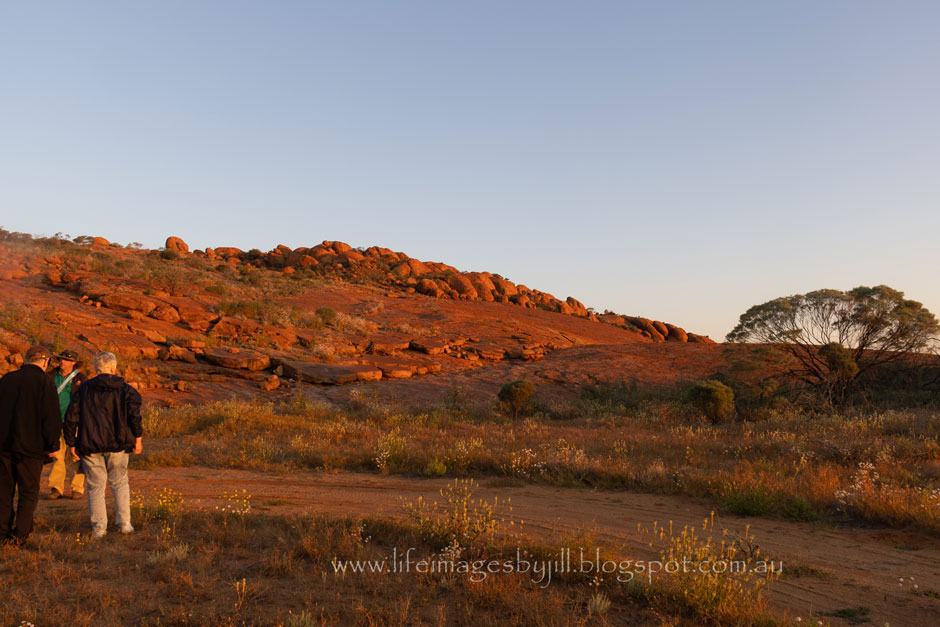
We had sunset drinks on Budura Rock where there is a permanent water source. This is an aboriginal site. You can see where aboriginal people ground ochre for painting and decoration.


At Wooleen you can enjoy marked bushwalking and mountain-bike trails, canoeing in the river, guided tours, and workshops from April to October. Wooleen’s Visitor Guide includes history, conservation strategies, trail guides, and fauna lists.
We walked the 2.3km #1 walk trail from the Café one day. The trail is marked and the guide book describes the sites along the way. I learnt during David's tour that annual flowers may be an energy source after rains, but do not survive drought or summer conditions.

This is one of the Eremophila variety - common in the rangelands


The grasses on Wooleen Lake are a valuable food source for animals. Despite a good wet season Wooleen Lake had no water in it during our visit, however the bottom photo below shows the lake in flood when we visited in 2015.

It was drizzling rain when we visited Yewlands Pool, and it had plenty of water in it, but unfortunately because of the rain, flooding and a shut gate, we were unable to get closer. It is a good place for bird watching.

And a few birds - clockwise from top left - emu, bush bustard, banded plover and black swans.


I was so glad we had visited Wooleen again and learnt more about what they are doing to rehabilitate the rangelands. Since returning home I am learning even more reading David's honest book The Wooleen Way - aptly described as - A remarkable memoir detailing a heroic and unswerving commitment to renew the severely degraded land on Wooleen.
The Pollocks conclude: “It’s not just for Wooleen, it’s about the whole picture. To find a sustainable way to raise cattle in the rangelands. The environment has an extraordinary ability to repair itself, given the chance.”

You might also like:
Wooleen is part of the Wool Wagon Pathway (2017) from Geraldton to Exmouth
Fast Facts:
Wooleen Station is located 700kms north-north east of Perth on the Twin Peaks-Wooleen Road, and 193kms north of Mullewa via a bitumen/gravel road – suitable for all vehicles. 2WD access may not be possible during heavy rain. The Murchison Oasis Roadhouse is 37kms north of Wooleen.
Accommodation: Fully
catered in the homestead, self-catered in the guesthouse cabins, bush camping
(suitable for caravans). Campsites have fire rings and composting toilets.
Collect firewood in designated areas only.
On arrival
check in at the Milimanmanha Café, where you can collect a guidebook, maps, and also
purchase local products, and buy lunch. There
are toilets and showers near the Café. WIFI and mobile phone connection at Café
and homestead area.
Best time to visit: April to October. Wooleen is closed to tourists
over summer.
Dogs not permitted at
the homestead and cabins, and must be kept on a lead along the walk trails.
You can learn more about
Wooleen by reading David’s book – The Wooleen Way.
For more information: www.wooleen.com.au
Thank you so much for stopping by. I hope you have enjoyed joining me on this return to Wooleen Station. I value your comments and look forward to hearing from you. I will try to visit your blogs in return. Have a wonderful week.
I am linking up to the link-ups below. Please click on the links to see fabulous contributions from around the world - virtual touring at its best!


