Welcome to Life Images by Jill

Welcome to Life Images by Jill.........Stepping into the light and bringing together the images and stories of our world. I am a photographer, writer and multi-media artist.
Focussing mainly on Western Australia and Australia, I am seeking to preserve images and memories of the beautiful world in which we live and the people in it.

Welcome!

Welcome!
PLEASE CLICK ON THE IMAGE TO GO TO MY RED BUBBLE STORE.
Showing posts with label Spain. Show all posts

Monday, 18 August 2025

From a writing prompt - Spanish Tango - Granada Spain

 Something a little different this week - a creative writing piece - using a photo as a writing prompt. 

Sometimes the simplest of photos can be a source of inspiration. Observe the details. How does it make you feel? Use your senses. What is happening in the background? Start writing. 

I belong to a writer's group - The South Side Quills. We meet once a month in our town Library. Each month we are set a writing prompt to write from at home for our next meeting. You don't have to stick entirely to the given prompt, as long as it has elements from it. A couple of months ago we were given this prompt - 

He caught her eye. They looked at each other from across the space. He, sitting on the top step of the old post office building, a shopping bag beside him. She, standing still watching him as he held his palm open, grain dripping, to the crowd of pigeons at his feet.

The photo at the top of this blog post I took in Granada in Spain several years ago. On our way to dinner we watched this couple doing a Tango in the plaza. It was mesmerising. I combined this image with the writing prompt we were given and below is what I wrote. 

I also entered the photo in my photography group monthly topic - "Candid" - and I earned a silver. The judge said what made the photo was the couple watching on the right hand side...... And yes he is right. 

The Tango

He catches your eye across the square. He’s sitting on the edge of the wall surrounding the fountain, a shopping bag beside him. He stirs his hand around inside a paper bag, and takes out a handful of grain which he holds out on his open palm. It drips slowly through his fingers to the crowd of pigeons clustering in a flurry of feathers at his feet. They know him. He is here every day.

The heat of summer and the aroma of baguettes and oranges fills the air – intoxicating.

The beat of a Spanish Argentinian Tango filters across the plaza. A couple are dancing. They feel the music through their bodies as it echoes around the plaza. She in a low back bright red dress. Camel coloured heels. A long side split reveals her shapely legs. Silver clips hold back her shoulder length blond hair.

He in a black suit, ruffled hair, a short cropped beard and battered shoes. His right arm and hand across her back securely holds her as they twist and turn their hips and bodies, their legs entwining. He guides her smoothly across the pavement where a black fedora rests upside down waiting.

Their dance is exotic, sensual, a dance of intimacy. Their faces at once a look of concentration and passion. Their movement and the music attracts onlookers walking across the plaza.

Nearby a couple have stopped to watch. Their shopping forgotten as he holds his partner close to him, in an embrace. They watch, mesmerised. He whispers in her ear. She smiles. In their hearts they want to be the dancing couple.

And you? You watch them watching the couple dancing. You watch the man feeding the pigeons. You and he have history. A long ago slow dance.

Here are a few more candid shots. I don't really do street photography - I feel like I am invading privacy. I feel visible with my camera. But for some reason when I am overseas it comes more easily. Perhaps because I am a tourist. Each of these photos tell a story. They can be a great resource for writing prompts. 

There are a number of resources on the net about using pictures as writing prompts. Here is one - www.photory.app/blogs/writing-from-picture-prompts

Thank you so much for stopping by. I value your comments and look forward to hearing from you. I will try to visit your blogs in return. Have a wonderful week. 

I am linking up to the link-ups below. Please click on the links to see fabulous contributions from around the world - virtual touring at its best!

If you are looking for a translate button - it's there near the top on the right hand side. 
   

Hello there! I love reading your comments. If you scroll down to the bottom you can comment too! I would love to hear from you.
Until then, enjoy your day...Life only comes around once, so do what makes you happy, be kind, and be with people who make you smile. 

Monday, 28 March 2022

Written from a writing prompt - inspired by Ukraine

Something a little different from me today, inspired by the heart-renching situation in the Ukraine. One month in from the Ukraine/Russian conflict.  I have never been to Russia or the Ukraine, so the few photos I share today are from other parts of Europe in a happier time.  I really enjoyed taking photos of balconies on our trip to Spain, Malta & Italy in 2018.

This piece I wrote the other day from my writer's group home writing prompt - 

No-one answered the door, so Tina took her mobile phone out of her pocket.

With only a backpack hastily stuffed with a change of clothes and her passport, Tina had travelled all day and all night to get here. First by train, almost empty of other passengers, then hitched a ride in the back of a truck, the weary men looking askance at her. Lastly on foot through the ravaged countryside and deserted streets, hardly recognising her surroundings since her visit last spring.

How could it be that at the end of her journey no-one was here to meet her? Tina looked again at the text message from her sister asking her to come quickly…or was it pleading? She had tried to call her sister several times since leaving home, but couldn’t get through. With each kilometre she had grown more anxious.

Tina stepped back from the heavy wooden door and looked up. Above was an iron balcony and an open door with lace curtains wafting gently in and out. She glanced up and down the street. No-one was out at this early hour but she didn’t want to draw attention to herself by calling out. A lone dog snuffled around a rubbish bin.


Tina blew her warm breath into her hands and then reached for the ornate brass door knocker. The thud echoed dully within. She waited but no-one came.

She pushed on the door and it creaked slowly open. Dry leaves scattered around her feet. Stepping cautiously inside Tina scanned the deserted courtyard strewn with dying plants and broken furniture.

A cat slunk away through an open doorway. She followed and was shocked by the disarray inside. Broken tiles and debris littered the floor and plaster hung limply from the exposed roof beams.

On the gilt framed mirror on the opposite wall was one word scrawled in lipstick or was it blood – “run”


I hope you and yours are doing well. I pray for a peaceful resolution in the Ukraine, and cry for the children and families who are suffering. 

Thank you so much for stopping by. I value your comments and look forward to hearing from you. I will try to visit your blogs in return. Have a wonderful week. 
I am linking up to the link-ups below. Please click on the links to see fabulous contributions from around the world - virtual touring at its best!


Hello there! I love reading your comments. If you scroll down to the bottom you can comment too! I would love to hear from you.


Monday, 2 July 2018

Barcelona - heart of Catalonia

All too soon our visit to Spain was drawing to a close and we arrived in our final city, Barcelona, the capital of Catalonia and Spain’s major Mediterranean port, and commercial centre. Barcelona is famed for its individuality, cultural interest, and physical beauty. 

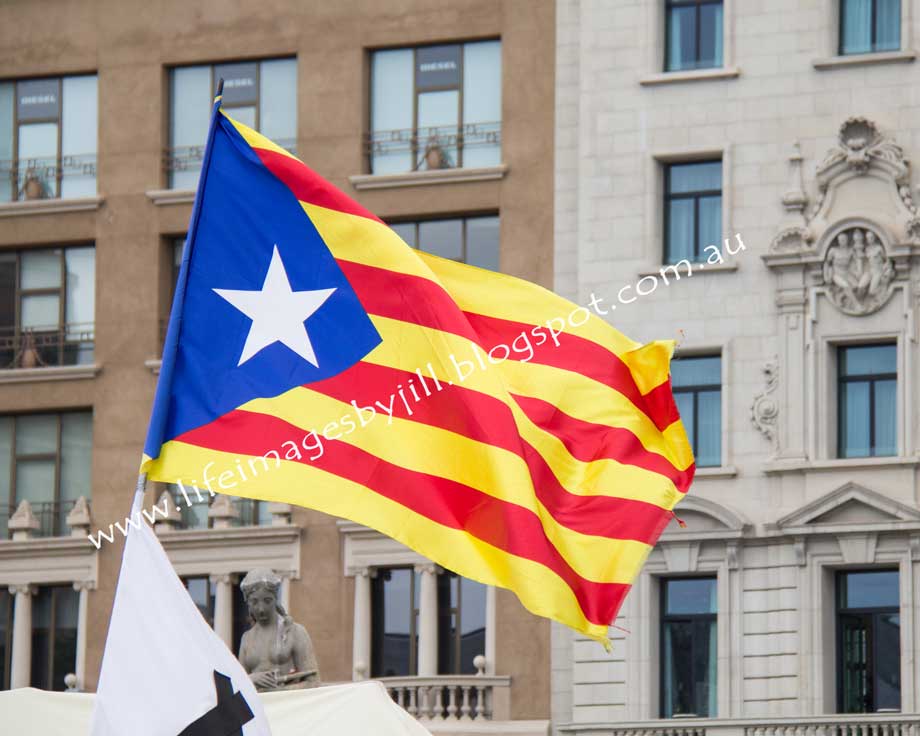
The past six months or so there has been a lot on the media about the bid for Catalonia’s independence from Spain, and while we were in Barcelona we saw a lot of evidence of Catalan pride with Catalan flags displayed prominently from balconies and in public places. Although both have their origins in Latin, the Catalan language is different to the Spanish language – Castilian Spanish. 


The city is an interesting and vibrant mix of modern, gothic and art nouveau architectural styles and has many fine examples of Modernisme - the Catalan/Art Nouveau movement from around 1878 to 1910. The art nouveau style imitates natural forms, examples of which you can see in carved flower decorations on buildings for instance.  


 The most ingenious of the art nouveau architects was Antoni Gaudi (1862-1926).

The most famous of the Gaudi’s buildings is La Sagrada Familia Basilica. Building began in 1882 and is not expected to be completed until 2030 (worked stopped during the 1936-39 Civil War).   


The Basilica was originally a Neo-Gothic church when Gaudi took over the construction in 1883. Gaudi died in 1926 after being knocked down by a tram in the street. At the time of his death only one tower on the Nativity façade had been completed. Gaudi is buried in the crypt. We were told that all his paper plans for the Basilica were destroyed by fire but he had made plaster models of his designs from which the building is now being completed. To date only 8 of the 18 towers have been completed, each topped by Venetian mosaics. Approximately 60 million Euro is collected per year from visitors which goes towards the construction. 


Our local guide took us on a walk around Sagrada Familia. Honestly it defies description. To my eyes, there seems to be several different architectural styles perhaps influenced by the eight different architects who have worked on the project. The detail in the design is intricate and it is difficult to take it all in. You could spend hours walking around the outside and still not see it all. 

This is the front entrance - the carving style is quite different. This facade with its angular figures was completed between 1986-2000 by artist Joseph Maria Subirachs.

 The Nativity Facade has doorways representing Faith, Hope and Charity. Scenes of the Nativity and Christ's childhood contain imagery such as doves, whcih symbolise the congregation. At the time of Gaudi's death only one tower of the facade had been completed. 


 We would have liked to have gone inside but we were unable to buy tickets at a time that fitted with our schedule. I suggest you book tickets ahead. 
Masses are held at the Basilica. Please refer to the web site for times. 

 There are many Gaudi designed buildings in Barcelona and I was disappointed that we didn’t have time to visit more. One we did see on our walking tour was Casa Batlló which is the result of a total restoration in 1904 of an old conventional house built in 1877. Note the unusual balconies in the shape of skulls, it is no surprise it was criticised during construction due to its radical design. You can find out more about Gaudi's buildings here - 10 Gaudi buildings

 We also drove up to the mountain of Montserrat “Serrated Mountain” to visit Catalonia’s holiest place, the Monastery of Montserrat which sits at 2000 feet above sea level. The earliest record of a chapel here dates back to the 9th Century. The monastery was founded in the 11th century but was destroyed in 1811 when the French attached Catalonia in the War of Independence. Rebuilt in 1844 in Renaissance style, Benedictine monks now live here. The famous 'L'Escolania' boys choir studies at the Monastery.
An integral part of the Montserrat Monastery is the worship of the Black Madonna in the Basilica. Carbon dating estimates that this wooden statue was carved around the 12th century.  Historical descriptions indicate that the Madonna has turned black simply by darkening over time, possibly from the smoke of candles.  Thousands of pilgrims visit Montserrat every year. The Madonna sits above the altar behind glass. Her wooden orb protrudes for pilgrims to touch. 

Interestingly Montserrat is a common name in Spain. 

You might like to visit the Montserrat Museum which is an art museum with a wide selection of works dating from the thirteenth century to the present day.
The day we visited thick fog blanked the mountains obliterating our view, but this added to the mystical feel of the Monastery. The views would be spectacular on a clear day.

 Montserrat Mountain was officially declared to be a natural park in 1987. There are five walks that commence at the Monastery and the mountain is also popular with bike riders. There is also a funicular railway. Walking back to the bus we stopped along the market stalls where we were able to try some local produce. 

Click here to find out more about Montserrat -  Montserrat Tourist Guide

The Camino Catilan trail passes through Montserrat to connect with the Camino de Santiago pilgrims trail. 

We had our last morning to ourselves in Barcelona before catching our plane to Malta, so we caught a taxi to La Rambla and then wandered through some of the Gothic Quarter (Barri Gotic), before wandering back to our hotel, stopping off for lunch in a tapas bar along the way. It was a perfect way to finish our Spanish tour.
I had been concerned about visiting the famous Las Ramblas as the terror attack on Las Ramblas in August 2017 (Thirteen people died and dozens were injured when a van ploughed into crowds) happened on the day we booked our trip, and we had been warned about pick-pockets. However we enjoyed our stroll along this tree-lined boulevard and had no problems. There are many stalls selling touristy mementos, cafes, and places to sit and people watch. We even saw a stall selling Australian boomerangs ??


The name Las Ramblas comes from the Arabic rambla meaning the dried-up bed of a seasonal river which used to run along here. The Ramblas is actually made up of five sections.
Here are some images from our last day in Barcelona. Unfortunately we didn't have much of a map, and for a little while we followed a group on a walking tour that we came across. Lucky for us they took us into the Gothic Quarter which I wanted to see.
  A flower shop selling Australian eucalypt!
The Barcelona Cathedral in the Barri Gothic - Gothic Quarter. Begun in 1298 this Gothic cathedral was not completed until the 19th century. An orchestra was tuning up on the front steps, gypsies were touting in the square and a bubble blower was entertaining tourists.
 Market stalls and lunch in a tapas bar.
Oh! I almost forgot - the Montjuic musical fountains Built for the 1929 World's Fair they are a treat for everyone! Refer to the link for dates they are playing.


Thank you so much for stopping by. I hope you have enjoyed my blog post about my visit to Barcelona. Have you been to Barcelona. Have you any suggestions of places to visit? Perhaps you would like to tell us about it in your comments.

I value your comments and look forward to hearing from you. I will try to visit your blogs in return. Have a wonderful week. 


I am linking up to the link-ups below. Please click on the links to see fabulous contributions from around the world - virtual touring at its best!
Life in Reflection

Hello there! I love reading your comments. If you scroll down to the bottom you can comment too! I would love to hear from you.


Monday, 25 June 2018

Exploring Spain - Cordoba, Seville & Granada

The last couple of weeks I have been sharing some of our holiday to Europe. Today I bring you some of the amazing places we visited in Spain on our Spanish Wonders tour with Trafalgar.
 
Clicking on the headings will link you to more information on the web.
As I mentioned last week when you travel with a tour company they do take you to places you might not otherwise have visited, or heard about, and this was certainly true with our tour.  We discovered there are many Moorish influences in the architecture of Spain.  

"The Spanish occupation by the Moors began in 711 AD when an African army, under their leader Tariq ibn-Ziyad, crossed the Strait of Gibraltar from northern Africa and invaded the Iberian peninsula 'Andalus'.

The Moors, who ruled Spain for 800 years, introduced new scientific techniques to Europe, such as an astrolabe, a device for measuring the position of the stars and planets. Scientific progress in Astronomy, Chemistry, Physics, Mathematics, Geography and Philosophy flourished in Moorish Spain" Moors in Spain


On the way to Seville we visited the Mosque-Cathedral in Cordoba. What I thought was truly amazing about the Mosque is the unique combination of Moorish and Christian architectural styles and that the Christians were willing to keep this Moorish architecture when it was consecrated as a Christian Cathedral. 


 The site was originally a Roman temple, became a Visigothic church after the fall of the western Roman empire, before the Umayyad Moors built the Mezquita in 786AD when Córdoba reached its zenith under a new emir, Abd ar-Rahman 111 who is considered to be one of the great rulers of Islamic history.

The 1000 marble columns that support the roof symbolise the palm trees of the Arab states and are constructed from different marbles that expand and contract differently to each other in the heat. 


The Mosque was consecrated as a Christian Catholic Cathedral when Cordoba was re-conquered in 1236. In the centre of the mosque is a Renaissance cathedral which dates back to the early sixteenth century while, to the left is the Capilla de Villaviciosa built by Moorish craftsmen in 1371.


In the garden is the bell tower - the Torre de Alminar - which is 93m high and was built on the site of the original minaret.  Orange trees grow in the courtyard where the faithful washed before prayer.

Meanwhile in the backstreets behind the Mosque life continues. I love exploring backstreets and seeing every day life.


 For more information on the Mosque-Cathedral of Cordoba please visit here - Andalucia.com


This park is a lovely green space in the south of the city of Seville in the grounds of the baroque styled Palacio San Telmo which was built in 1682 as a marine academy. Maria Luisa Fernanda de Bourbon, daughter of King Fernando VII, donated a large part of the palace's extensive private grounds to the city of Seville in 1893. When she died the palace was bequeathed to Seville.

In the gardens you can buy a bag of grain and feed the pigeons. I loved the water lily pond.


3 - Nearby is the Plaza de Espana - Seville 

Plaza de España was built for the Ibero-American Exhibition of 1929 (Expo 29), along with many of the pavilions you can see in and around the Parque Maria Luisa.


 Plaza de España, designed by architect Anibal Gonzalez is a semi-circular brick building, built in Renaissance/neo-Moorish in style. In front of the building, following the curve of its façade, is a 500-metre canal crossed by four bridges, and in the centre of it all is the Plaza itself which is adorned by fountains. The Plaza itself measures 50,000 square metres.

The Plaza has been used over the decades as a location for filming several movies, such as Star Wars, Lawrence of Arabia), and for the  Sasha Baron-Cohen film, El Dictador.  We wish we had know the Star Wars connection when we visited as our son is a movie buff and he would have enjoyed knowing that it was used as Theed Palace on planet Naboo in a scene from Star Wars Episode II: Attack of the Clones.
You can take a horse and carriage ride from here or buy from the many hawkers in the plaza.  


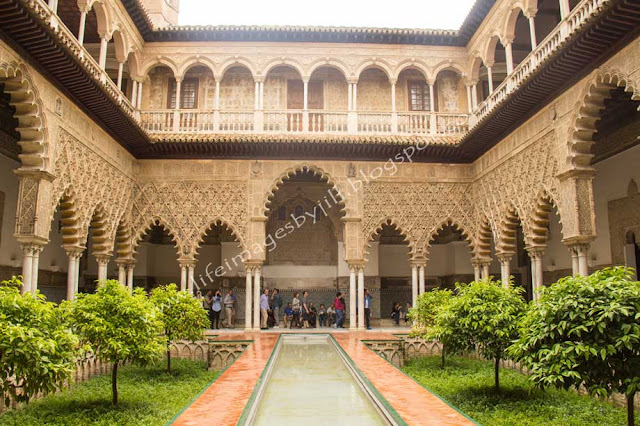
 The Alcazar is divided into sections dating from a succession of eras: Moorish (11th-12th century), Gothic (13th century), Mudejar (14th century), and Renaissance (15th-16th century), the Alcazar offers some of the best surviving examples of Mudejar architecture.

In the 13th Century the Christian king, Pedro the Cruel of Castile embarked upon a complete rebuilding and extending of the palace, employing the finest workmen from Granada and Toledo, and utilising fragments of earlier Moorish buildings in Seville, Cordoba and Valencia.

The detail of the architecture and decorations is amazing and certainly the work of master craftsmen. You can also enjoy the gardens.  
The Alcazar was used for filming some of the scenes for the Game of Thrones series. 


The name Alhambra has its origins in an Arabic word meaning "red castle or vermilion". The Alhambra is located on a rocky hill overlooking Granada, with difficult access, on the banks of the river Darro, protected by the mountains and surrounded by forest.

Created originally for military purposes, the Alhambra was a fortress, a palace and a small medina, all at the same time. Fortification has existed since the 9th century and the Alhambra became the royal residence and court of Granada in the mid-13th century after the establishment of the Nasrid Kingdom and the construction of the first palace by the founding king Mohammed ibn Yusuf Ben Nasr, better known as Alhamar. 

2.5 million people per year - almost 7,000 visitors per day - visit Alhambra.  From here you can also walk to the Summer Palace, but it started to rain as we were walking to the Palace, so we opted to return to our bus, and go on to our hotel. 


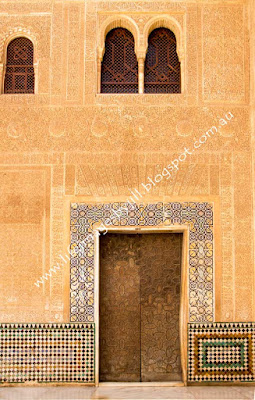
Look at this beautiful detail in the decoration of Alhambra. 

But before our visit to Alhambra we took a walk through the narrow streets and squares of the old town of Albaicin, visited a fruit and vegetable market,  and listened to the flamenco players on a terrace overlooking Granada and Alhambra. Too soon it was time for us to move on.


 Thank you so much for stopping by. I hope you have enjoyed this small look at some of the places we visited in Spain. Next week I will take you to Barcelona.

To find out more about visiting Spain you can click here - Touropia.com-Spain 

I value your comments and look forward to hearing from you. I will try to visit your blogs in return. Have a wonderful week. 
Alhambra

I am linking up to the link-ups below. Please click on the links to see fabulous contributions from around the world - virtual touring at its best!
Life in Reflection

Hello there! I love reading your comments. If you scroll down to the bottom you can comment too! I would love to hear from you.

If you are a blogger you can link up to Wednesday Around the World at Communal Global right here -