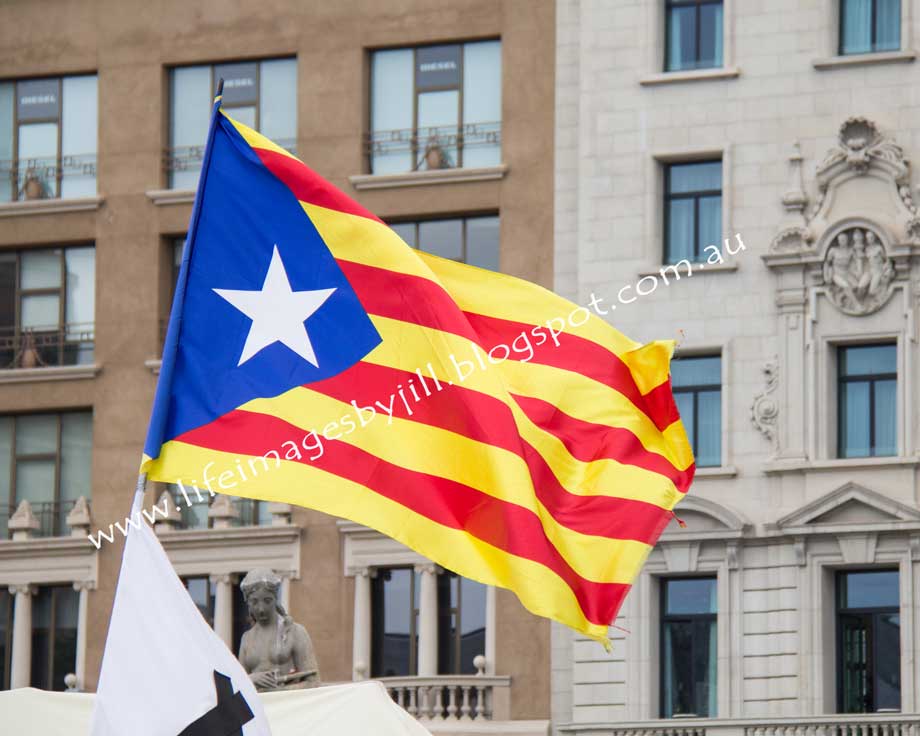
All too soon our visit to Spain was drawing to a close and we arrived in our final city, Barcelona, the capital of Catalonia and Spain’s major Mediterranean port, and commercial centre. Barcelona is famed for its individuality, cultural interest, and physical beauty.
The past six months or so there has been a lot on the media about the bid for Catalonia’s independence from Spain, and while we were in Barcelona we saw a lot of evidence of Catalan pride with Catalan flags displayed prominently from balconies and in public places. Although both have their origins in Latin, the Catalan language is different to the Spanish language – Castilian Spanish.
The city is an interesting and vibrant mix of modern, gothic and art nouveau architectural styles and has many fine examples of Modernisme - the Catalan/Art Nouveau movement from around 1878 to 1910. The art nouveau style imitates natural forms, examples of which you can see in carved flower decorations on buildings for instance.
The most ingenious of the art nouveau architects was Antoni Gaudi (1862-1926).
The most famous of the Gaudi’s buildings is La Sagrada Familia Basilica. Building began in 1882 and is not expected to be completed until 2030 (worked stopped during the 1936-39 Civil War).
The Basilica was originally a Neo-Gothic church when Gaudi took over the construction in 1883. Gaudi died in 1926 after being knocked down by a tram in the street. At the time of his death only one tower on the Nativity façade had been completed. Gaudi is buried in the crypt. We were told that all his paper plans for the Basilica were destroyed by fire but he had made plaster models of his designs from which the building is now being completed. To date only 8 of the 18 towers have been completed, each topped by Venetian mosaics. Approximately 60 million Euro is collected per year from visitors which goes towards the construction.

This is the front entrance - the carving style is quite different. This facade with its angular figures was completed between 1986-2000 by artist Joseph Maria Subirachs.
The Nativity Facade has doorways representing Faith, Hope and Charity. Scenes of the Nativity and Christ's childhood contain imagery such as doves, whcih symbolise the congregation. At the time of Gaudi's death only one tower of the facade had been completed.
We would have liked to have gone inside but we were unable to buy tickets at a time that fitted with our schedule. I suggest you book tickets ahead. Masses are held at the Basilica. Please refer to the web site for times.
There are many Gaudi designed buildings in Barcelona and I was disappointed that we didn’t have time to visit more. One we did see on our walking tour was Casa Batlló which is the result of a total restoration in 1904 of an old conventional house built in 1877. Note the unusual balconies in the shape of skulls, it is no surprise it was criticised during construction due to its radical design. You can find out more about Gaudi's buildings here - 10 Gaudi buildings
We also drove up to the mountain of Montserrat “Serrated Mountain” to visit Catalonia’s holiest place, the Monastery of Montserrat which sits at 2000 feet above sea level. The earliest record of a chapel here dates back to the 9th Century. The monastery was founded in the 11th century but was destroyed in 1811 when the French attached Catalonia in the War of Independence. Rebuilt in 1844 in Renaissance style, Benedictine monks now live here. The famous 'L'Escolania' boys choir studies at the Monastery.
An integral part of the Montserrat Monastery is the worship of the Black Madonna in the Basilica. Carbon dating estimates that this wooden statue was carved around the 12th century. Historical descriptions indicate that the Madonna has turned black simply by darkening over time, possibly from the smoke of candles. Thousands of pilgrims visit Montserrat every year. The Madonna sits above the altar behind glass. Her wooden orb protrudes for pilgrims to touch.
Interestingly Montserrat is a common name in Spain.
You might like to visit the Montserrat Museum which is an art museum with a wide selection of works dating from the thirteenth century to the present day.
The day we visited thick fog blanked the mountains obliterating our view, but this added to the mystical feel of the Monastery. The views would be spectacular on a clear day.
Montserrat Mountain was officially declared to be a natural park in 1987. There are five walks that commence at the Monastery and the mountain is also popular with bike riders. There is also a funicular railway. Walking back to the bus we stopped along the market stalls where we were able to try some local produce.
The Camino Catilan trail passes through Montserrat to connect with the Camino de Santiago pilgrims trail.
We had our last morning to ourselves in Barcelona before catching our plane to Malta, so we caught a taxi to La Rambla and then wandered through some of the Gothic Quarter (Barri Gotic), before wandering back to our hotel, stopping off for lunch in a tapas bar along the way. It was a perfect way to finish our Spanish tour.
I had been concerned about visiting the famous Las Ramblas as the terror attack on Las Ramblas in August 2017 (Thirteen people died and dozens were injured when a van ploughed into crowds) happened on the day we booked our trip, and we had been warned about pick-pockets. However we enjoyed our stroll along this tree-lined boulevard and had no problems. There are many stalls selling touristy mementos, cafes, and places to sit and people watch. We even saw a stall selling Australian boomerangs ??
The name Las Ramblas comes from the Arabic rambla meaning the dried-up bed of a seasonal river which used to run along here. The Ramblas is actually made up of five sections.
Here are some images from our last day in Barcelona. Unfortunately we didn't have much of a map, and for a little while we followed a group on a walking tour that we came across. Lucky for us they took us into the Gothic Quarter which I wanted to see.
A flower shop selling Australian eucalypt!
The Barcelona Cathedral in the Barri Gothic - Gothic Quarter. Begun in 1298 this Gothic cathedral was not completed until the 19th century. An orchestra was tuning up on the front steps, gypsies were touting in the square and a bubble blower was entertaining tourists.
Market stalls and lunch in a tapas bar.
Oh! I almost forgot - the Montjuic musical fountains Built for the 1929 World's Fair they are a treat for everyone! Refer to the link for dates they are playing.
Thank you so much for stopping by. I hope you have enjoyed my blog post about my visit to Barcelona. Have you been to Barcelona. Have you any suggestions of places to visit? Perhaps you would like to tell us about it in your comments.
I value your comments and look forward to hearing from you. I will try to visit your blogs in return. Have a wonderful week.

I am linking up to the link-ups below. Please click on the links to see fabulous contributions from around the world - virtual touring at its best!
Life in Reflection
Hello there! I love reading your comments. If you scroll down to the bottom you can comment too! I would love to hear from you.