Standing on Kokerbin Rock in Western Australia’s central
Wheatbelt, one wonders if explorer John Septimus Row imagined the scene below.
The patchwork of brilliant yellow and vivid green, laced together by ribbons of
gum trees spreading to the horizon would be very different to what he saw when
he travelled through here in the 1830s and 40s as Surveyor General for the
fledgling Swan River settlement.
Pages
Welcome to Life Images by Jill
Welcome to Life Images by Jill.........Stepping into the light and bringing together the images and stories of our world. I am a photographer, writer and multi-media artist.
Focussing mainly on Western Australia and Australia, I am seeking to preserve images and memories of the beautiful world in which we live and the people in it.
Monday, 12 November 2012
Western Australian central Wheatbelt
Below is an excerpt from my latest article "Livin' and Workin' On the Land" published in November issue of Australia's "On the Road" magazine, November 2012 edition.
Sunday, 11 November 2012
Lest we forget - 11 November
On the 11th hour of the 11th day of the 11th month -
"At the going down of the sun, and in the morning, we will remember them"
Thank you for taking the time to remember them
You might also like - please click on the link here - On Anzac Day we will remember them
"At the going down of the sun, and in the morning, we will remember them"
![]() |
| Canberra War Memorial - Tomb of the Unknown Soldier and the Eternal Flame |
![]() |
| Red poppies for remembrance, Canberra War Memorial |
Thank you for taking the time to remember them
You might also like - please click on the link here - On Anzac Day we will remember themSunday, 4 November 2012
Lemons and lemon butter
It is spring and our lemon tree is loaded with lemons.
Lemons are a very versatile fruit - you can drink it, make it into jams and spreads, cook with it - both sweet and savoury, use it for medicinal purposes, and even use it for cleaning! (try it out in your bathroom)
Do you remember as a child writing secret notes with lemon juice that only reveal themselves when heat is applied?
This time of year with our family love lemon butter and lemon meringue pie. Delicious!!
Shall we have fresh baked scones with that lemon butter? And sit out on the patio in the morning sunshine?
First you need lemons - fresh from the tree
Then the ingredients -
Juice of 3 lemons & finely grated rind
500gm (1 lb) white sugar
250gm (1/2 lb) butter
4 eggs, plus 2 yolks, well beaten together.
Place all in a large bowl, standing in pan of boiling water on the stove. Stir constantly until consistency of honey, but do not allow to boil. (about half an hour approx)
Bottle, and keep in fridge.
Then some fresh made scones, and some pretty china, and a nice place to sit.
These colourful little daisies come from a bush in my garden which has flowers on it just about all year round. The lovely little glass jar I have put them in is actually an antique mustard pot from a cruet set that belonged to my grandmother.
And here is the lemon meringue pie - it is a family favourite. I have always loved it. My mother brought me in a piece when I was in hospital when my eldest son was born. It is his favourite, and now his eldest nearly six years old little boy loves it too!
Do you have a lemon tree? Do you make lemon butter? or lemon meringue pie?
Thank you for stopping by. I look forward to hearing from you. Have a wonderful week.
I am linking up to Mary and the other wonderful contributors from across the world at Mosaic Monday - to visit, please click on the link here - Mosaic Monday
You might also like - click on the links to go to -
Lemons are a very versatile fruit - you can drink it, make it into jams and spreads, cook with it - both sweet and savoury, use it for medicinal purposes, and even use it for cleaning! (try it out in your bathroom)
Do you remember as a child writing secret notes with lemon juice that only reveal themselves when heat is applied?
This time of year with our family love lemon butter and lemon meringue pie. Delicious!!
Shall we have fresh baked scones with that lemon butter? And sit out on the patio in the morning sunshine?
First you need lemons - fresh from the tree
Then the ingredients -
Juice of 3 lemons & finely grated rind
500gm (1 lb) white sugar
250gm (1/2 lb) butter
4 eggs, plus 2 yolks, well beaten together.
Place all in a large bowl, standing in pan of boiling water on the stove. Stir constantly until consistency of honey, but do not allow to boil. (about half an hour approx)
Bottle, and keep in fridge.
Then some fresh made scones, and some pretty china, and a nice place to sit.
These colourful little daisies come from a bush in my garden which has flowers on it just about all year round. The lovely little glass jar I have put them in is actually an antique mustard pot from a cruet set that belonged to my grandmother.
And here is the lemon meringue pie - it is a family favourite. I have always loved it. My mother brought me in a piece when I was in hospital when my eldest son was born. It is his favourite, and now his eldest nearly six years old little boy loves it too!
Do you have a lemon tree? Do you make lemon butter? or lemon meringue pie?
Thank you for stopping by. I look forward to hearing from you. Have a wonderful week.
I am linking up to Mary and the other wonderful contributors from across the world at Mosaic Monday - to visit, please click on the link here - Mosaic Monday
You might also like - click on the links to go to -
Lemon tarts
Oranges and lemons
Sunday, 28 October 2012
Artist's trail around Bunbury, Western Australia
Bonjour et bienvenue!
Hello and welcome!
Are we in France?
No! in Western Australia!
I loved this message board which I spied recently at Rustic French in Boyanup..... read on.....
My sister visited us last weekend, and on Sunday afternoon we took a drive around to some galleries and artist studies not far from my home. What wonderful artistic talent we have....you just need to make the time to go and look. We saw only a small selection of the galleries and artists in our area - there are many more still to be visited and enjoyed.
First off was 5th Element Pottery and Glass Studio in Dardanup West. Here you can see and buy the work of artist, Christine Elston who started pottery in 1974. In recent years she has started to work with glass.
Christine says that "the inspiration for my work comes from seeing the magnificent colour of Australia. I have always loved working with colour and the beautiful glass that I use brings it to life".
To buy a beautiful, unique and absolutely affordable piece, including jewellery, you can find 5th Element studio at 40 Galvins Gully Court, Dardanup West.
Please click here to go to Christine's web site - 5th Element
Our next stop was Lyndendale Gallery in the beautiful rolling hills and valleys of Ferguson Valley not far past the Crooked Brook Forest. Located on the property of owner and artist Denise Gillies, Lyndendale Gallery showcases art works by Denise, as well as pieces by members of the South-West Printmakers, along with glass works, pottery, jewellery, textiles, paintings and hand crafted books from selected local artists.
Denise's work displays a variety of styles from representation to abstract. She has a love of the environment and her works often focus on an environmental theme.
Lyndendale Gallery also hosts workshops which include creative and magazine writing, painting, Eco-dying and bound book making. The Gallery was also part of the Dardanup Art Spectacular Art Trail this year.
Lyndendale Gallery is located at 828 Crooked Brook Road Dardanup. To find out more about the gallery and the workshops, please click on the link here - Lyndendale Gallery
By now it was time for coffee, so we headed over to Rustic French Living in Boyanup.
Located in the old Methodist Church, Rustic French offers, along with wonderful coffee and delicious cakes, French style homewares and gifts, linen, jewellery, new and recycled furniture, and unique fashion finds. It is a devine place to brouse and be inspired to bring a little bit of French influence into your decor.
Rustic French can be found at 33 South Western Highway Boyanup. To find out more, please click on the link here - Rustic French Living
Did I mention we had coffee and cake in the garden - you must try the brioche.....
From here we intended to visit Jane at Folios and Fibre at 1201 Bussell Highway, Stratham - but sadly by the time we arrived she had closed for the day. So that will have to wait for another time.
Jane is a textile artist who uses ecologically sustainable dyeing practises using native plants. Jane also hand makes notebooks and journals, and handmade papers as well as creative mixed media artworks. Jane also runs workshops, including at Lyndendale. To go to Jane's Facebook page, please click on the link here - Folios and Fibre
Today we went to the Bunbury Regional Art Gallery to see the beautiful work of local artist Neil Turner. Formerly a WA wheatbelt farmer, and graduate from the Australian School of Wood at Dwellingup, this is Neil's first solo exhibition. The 16-piece exhibition, entitled "Unfolding", features turned and carved pieces, sculpture and art furniture.
The "Unfolding" exhibition runs until 9 December at the Bunbury Regional Art Galleries. Opening times are 10-4 daily and entry is free.
You can see more of Neil's work by clicking on the link here - Neil Turner
While we were at the Art Gallery we also looked at the Iluka Resources annual Iluka Visions high school art exhibition, now in its 21st year, and featuring the work of talent high school students. We certainly have a wealth of up and coming artistic talent.
To learn more about the Bunbury Regional Art Gallery, upcoming exhibitions and classes, please click on the link here - Art Gallery
The quote below was included on one of the fibre art pieces. I rather liked it. Aren't we all a bit like that?
Do you enjoy browsing through galleries. Have you some near you? Are you an artist with pieces in a gallery?
Have a wonderful week, and visit a gallery near you sometime soon.
I am linking up to Mosaic Monday at Little Red House - to see the work of Mary and other wonderful contributors across the world - please click on the link here - Mosaic Monday
You might also like - A weekend of lunch, gardens, music & danceMonday, 22 October 2012
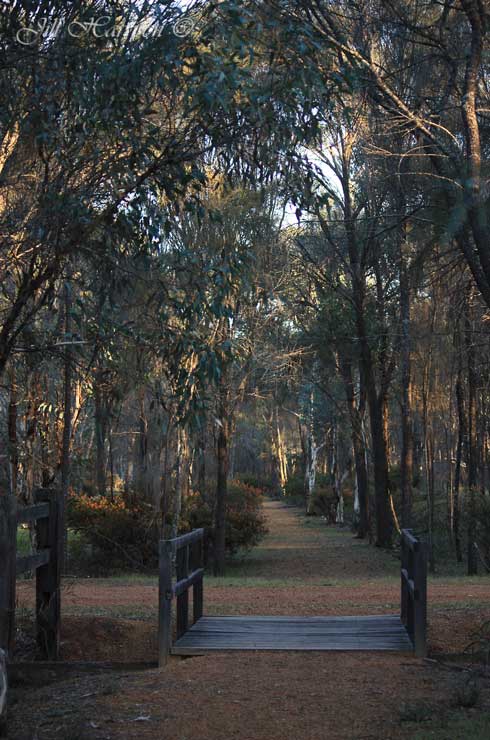
Dryandra woodland in the early morning light, Western Australia
A couple of weeks ago we went camping in the north eastern wheatbelt - an area which we had not visited before. Our first night on the road was at Dryandra Woodland, in the central wheatbelt near Narrogin, only a couple of hours drive from our home. Dryandra is a valuable nature conservation area within the largest remnant of original vegetable in the western wheatbelt.
Dryandra is home to more than 25 mammals, 100 birds and 50 reptiles. The WA Department of Environment and Conservation has developed walk trails ranging from one to 12.4 kilometres, as well as an audio drive trail.
Here is some of the animals you might see - an echidna, a bobtail goanna and a kangaroo with joey in her pouch.
As happens with camping, I tend to wake when the sun comes up, so I was up early and went walking with my camera along the Congelin Siding Walk trail which is adjacent to the camping area. This trail follows the old Pinjarra to Narrogin railway line constructed in 1925. Along the walk you can see some wooden relics from this time.
The early morning light was so beautiful filtering through the trees that I decided to play around with shutter priority mode on my camera. And here are some of the results.
My post wouldn't be complete without a wildflower - this is one of the spider orchid family.
My campsite report about Dryandra was published in On The Road Australia Magazine, June 2013.
Thank you for stopping by. I hope you have enjoyed this little early morning walk at Dryandra. Do you like early morning walks? Have you tried shutter priority mode? - have a go - you can capture some beautiful light. I look forward to hearing from you. Have a wonderful week.
I am linking up to Mosaic Monday at Little Red House. To see the work of Mary and other wonderful contributors across the world, please click on the link here - Mosaic Monday
I am also linking up to Travel Photo Thursday - click on the link here to see the travels of other travellers! - Travel Photo Thursday
You might also like - please click on the link here - Dryandra woodland wonderland
Dryandra is home to more than 25 mammals, 100 birds and 50 reptiles. The WA Department of Environment and Conservation has developed walk trails ranging from one to 12.4 kilometres, as well as an audio drive trail.
Here is some of the animals you might see - an echidna, a bobtail goanna and a kangaroo with joey in her pouch.
As happens with camping, I tend to wake when the sun comes up, so I was up early and went walking with my camera along the Congelin Siding Walk trail which is adjacent to the camping area. This trail follows the old Pinjarra to Narrogin railway line constructed in 1925. Along the walk you can see some wooden relics from this time.
The early morning light was so beautiful filtering through the trees that I decided to play around with shutter priority mode on my camera. And here are some of the results.
My post wouldn't be complete without a wildflower - this is one of the spider orchid family.
Thank you for stopping by. I hope you have enjoyed this little early morning walk at Dryandra. Do you like early morning walks? Have you tried shutter priority mode? - have a go - you can capture some beautiful light. I look forward to hearing from you. Have a wonderful week.
I am linking up to Mosaic Monday at Little Red House. To see the work of Mary and other wonderful contributors across the world, please click on the link here - Mosaic Monday
I am also linking up to Travel Photo Thursday - click on the link here to see the travels of other travellers! - Travel Photo Thursday
You might also like - please click on the link here - Dryandra woodland wonderland Wednesday, 17 October 2012
Bob Cooper - Australian survival expert
A couple of months ago I was privileged to meet and interview Bob Cooper, considered to be one of Australia's leading and most respect desert survival experts and instructors. What a fascinating and interesting man he is to listen to. He has a huge knowledge of outback survival and respect for nature.
Meeting Bob in Perth, I was immediately struck by his quiet confidence that is so different from the Bear Grills’ exuberance that pits man against the environment.
“Nature isn’t cruel, but it is unforgiving. Mother Earth keeps you alive, it gives you everything you need and you shouldn’t be scared of it.”
To read this full article, please read Go Camping Australia magazine, October-November 2012 edition.
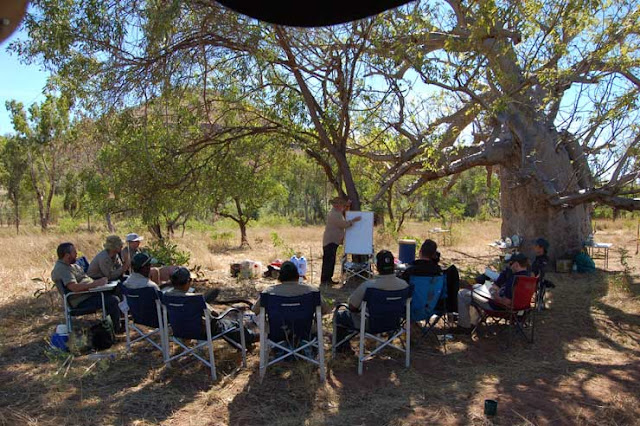
Meeting Bob in Perth, I was immediately struck by his quiet confidence that is so different from the Bear Grills’ exuberance that pits man against the environment.
You can read my report of his interview in the latest edition of Go Camping Australia magazine October-November 2012 edition. Below is a short excerpt....
“Nature isn’t cruel, but it is unforgiving. Mother Earth keeps you alive, it gives you everything you need and you shouldn’t be scared of it.”
Bob’s enormous respect for “Mother Earth” comes from
years of experience, which began during his school days exploring bushland around
the Swan River and Canning Dam. At the age of 17 Bob decided to walk from Perth
to Yanchep with a bag of food, only 2 litres of water and a map torn from the
front of a 1970 street directory. By the end of the first day as he lay thirsty
and sunburnt in the sand hills, he knew he was in trouble, but fate saved him
in the form of a water tank at an abandoned fisherman’s hut.
Bob was also involved in three Mayday situations while working as a commercial fisherman and professional diver, and in 1983 when he had to walk out of the Great Sandy Desert after a forced helicopter landing.
In 1981 Bob was accepted as a civilian to take part in a
SAS survival course. This tough training ground led to his accreditation as an
Australian survival instructor. In 1982 he worked for the WA Museum assisting
with recording aboriginal sites in the Great Sandy Desert with the traditional
elders. Bob was humbled by the “aboriginal people’s knowledge, kindness and
their understanding of nature”, and touched by their spirituality which combines
in a deep respect for the land. He learnt all he could from these traditional desert
people, adding to his knowledge through time spent with the Lakota Sioux in
Dakota, the Texas Parks Service, Kalahari Bushmen in Botswana, and the Orang
Asli in Malaysia
“All those experiences added to my understanding and traditional
knowledge. The key elements were respect, and that is what I try to teach.”
To read this full article, please read Go Camping Australia magazine, October-November 2012 edition.
![]() |
| Bob in his outdoor classroom. Photo courtesy of Bob Cooper. |
According to Bob, the five major wilderness survival priorities are water, warmth, signals, shelter and food. Bob says his two
day Wilderness Survival course, survival kit and his new book, Outback
Survival, are suitable for the average camper, explaining how to satisfy these
basic needs in simple, easy to understand language.
Since 1990 Bob has conducted survival courses world wide, 105 just in Perth, including working with government agencies, mining companies, tour operators, corporate and school groups.
Bob
reiterates the importance of planning and knowledge. Learn all you can, avoid
panic, carry plenty of water, a survival and first aid kit.
“Knowledge
dispels fear. If your knowledge level is low, your fear level is high. The more
you know about a subject your fear level will come down. When it meets in the
middle that’s what I call respect, for yourself as well as an all-encompassing
respect for the people around you and for the environment. If you are not in
control when you have a mishap, who is? When fear is high, it overrides common
sense. The rational side hasn’t got a chance.”
Since 1990 Bob has conducted survival courses world wide, 105 just in Perth, including working with government agencies, mining companies, tour operators, corporate and school groups.
“Preparation is the big one—physically and mentally preparing
yourself for the what-ifs.”
From what plants can you safely obtain water? Can you use a
compass? How would you signal for help? Do you know how to use a compression
bandage for snake bite? Do you know how to light a fire or even how to tie a
knot?
Too many people “have an over-dependency on technology as
well, such as a GPS which should only be a backup for your basic skills. The
first time you use a compass shouldn’t be when you’re lost.”
He stresses and teaches the importance of learning to read
a map and compass, and how to navigate by the sun and stars in case you ever
doubt your compass (although he says compasses are very rarely wrong). When
bush walking, even with a tour group, always be observant, noting physical
features as you walk, for example, a burnt-out tree, distinctive rocks, flowering
plants. Look back every 50-100 metres as everything will look different on the
return walk. And when navigating with a compass, learn to rectify your bearings
as we all have a tendency to walk to the right or left of every object we pass.
(Who knew to do that?)
Water is your most important need. One of the biggest
survival myths is to sip water. A sip is quickly absorbed by food and other
organs, so no water ends up reaching your brain. Not good. It’s best to drink an
entire cup—and not a good idea to drink urine—it only makes your thirst worse.
“When you’re dehydrated, after a few hours your ability to
think clearly and rationally can be diminished by about thirty per cent.
Combine that with fear and you have a recipe for disaster. People have turned
mishaps into tragedies because of dehydration.”
Like those who have died with water still in their vehicles
because they chose to walk for help.
“Your vehicle is a great resource, so stay with it.”
Burning a tyre a day to signal for help; creating the
letters, SOS, on the ground; and learning how to identify toxic
plants so you can collect water with a plastic
bag from safe plants are just a few of the many survival tips in Bob’s
book.
Survival in the Outback is all about staying calm, keeping
hydrated and making a plan of action.
“Nature isn’t cruel, but it is unforgiving. Mother Earth will
keep you alive, if you know how. You shouldn’t be scared of it.”
![]() |
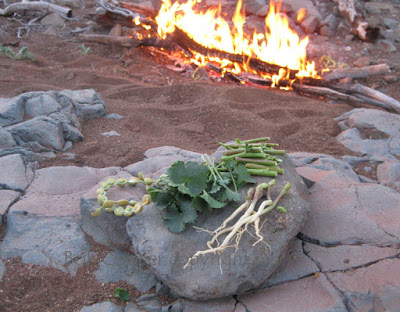
| Bush tucker lunch |
To learn more please go to Bob Cooper's website where you can find out about his survival courses, book and survival kit - please click here on the link - www.bobcoopersurvival.com
Subscribe to:
Posts (Atom)