A couple of months ago I was privileged to meet and interview Bob Cooper, considered to be one of Australia's leading and most respect desert survival experts and instructors. What a fascinating and interesting man he is to listen to. He has a huge knowledge of outback survival and respect for nature.
Meeting Bob in Perth, I was immediately
struck by his quiet confidence that is so different from the Bear Grills’
exuberance that pits man against the environment.
You can read my report of his interview in the latest edition of Go Camping Australia magazine October-November 2012 edition. Below is a short excerpt....
“Nature isn’t cruel, but it is
unforgiving. Mother Earth keeps you alive, it gives you everything you need and
you shouldn’t be scared of it.”
Bob’s enormous respect for “Mother Earth” comes from
years of experience, which began during his school days exploring bushland around
the Swan River and Canning Dam. At the age of 17 Bob decided to walk from Perth
to Yanchep with a bag of food, only 2 litres of water and a map torn from the
front of a 1970 street directory. By the end of the first day as he lay thirsty
and sunburnt in the sand hills, he knew he was in trouble, but fate saved him
in the form of a water tank at an abandoned fisherman’s hut.
Bob was also
involved in three Mayday situations while working as a commercial fisherman and
professional diver, and in 1983 when he had to walk out of the Great Sandy Desert
after a forced helicopter landing.
In 1981 Bob was accepted as a civilian to take part in a
SAS survival course. This tough training ground led to his accreditation as an
Australian survival instructor. In 1982 he worked for the WA Museum assisting
with recording aboriginal sites in the Great Sandy Desert with the traditional
elders. Bob was humbled by the “aboriginal people’s knowledge, kindness and
their understanding of nature”, and touched by their spirituality which combines
in a deep respect for the land. He learnt all he could from these traditional desert
people, adding to his knowledge through time spent with the Lakota Sioux in
Dakota, the Texas Parks Service, Kalahari Bushmen in Botswana, and the Orang
Asli in Malaysia
“All those experiences added to my understanding and traditional
knowledge. The key elements were respect, and that is what I try to teach.”
To read this full article, please read Go Camping Australia magazine, October-November 2012 edition.
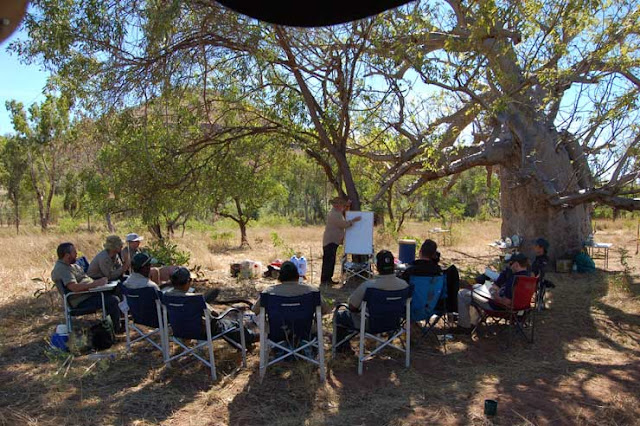 |
| Bob in his outdoor classroom. Photo courtesy of Bob Cooper. |
According to Bob, the five major wilderness survival priorities are water, warmth, signals, shelter and food. Bob says his two
day Wilderness Survival course, survival kit and his new book, Outback
Survival, are suitable for the average camper, explaining how to satisfy these
basic needs in simple, easy to understand language.
“Knowledge
dispels fear. If your knowledge level is low, your fear level is high. The more
you know about a subject your fear level will come down. When it meets in the
middle that’s what I call respect, for yourself as well as an all-encompassing
respect for the people around you and for the environment. If you are not in
control when you have a mishap, who is? When fear is high, it overrides common
sense. The rational side hasn’t got a chance.”
Since
1990 Bob has conducted survival courses world wide, 105 just in Perth,
including working with government agencies, mining companies, tour operators, corporate
and school groups.
Bob
reiterates the importance of planning and knowledge. Learn all you can, avoid
panic, carry plenty of water, a survival and first aid kit.
“Preparation is the big one—physically and mentally preparing
yourself for the what-ifs.”
From what plants can you safely obtain water? Can you use a
compass? How would you signal for help? Do you know how to use a compression
bandage for snake bite? Do you know how to light a fire or even how to tie a
knot?
Too many people “have an over-dependency on technology as
well, such as a GPS which should only be a backup for your basic skills. The
first time you use a compass shouldn’t be when you’re lost.”
He stresses and teaches the importance of learning to read
a map and compass, and how to navigate by the sun and stars in case you ever
doubt your compass (although he says compasses are very rarely wrong). When
bush walking, even with a tour group, always be observant, noting physical
features as you walk, for example, a burnt-out tree, distinctive rocks, flowering
plants. Look back every 50-100 metres as everything will look different on the
return walk. And when navigating with a compass, learn to rectify your bearings
as we all have a tendency to walk to the right or left of every object we pass.
(Who knew to do that?)
Water is your most important need. One of the biggest
survival myths is to sip water. A sip is quickly absorbed by food and other
organs, so no water ends up reaching your brain. Not good. It’s best to drink an
entire cup—and not a good idea to drink urine—it only makes your thirst worse.
“When you’re dehydrated, after a few hours your ability to
think clearly and rationally can be diminished by about thirty per cent.
Combine that with fear and you have a recipe for disaster. People have turned
mishaps into tragedies because of dehydration.”
Like those who have died with water still in their vehicles
because they chose to walk for help.
“Your vehicle is a great resource, so stay with it.”
Burning a tyre a day to signal for help; creating the
letters, SOS, on the ground; and learning how to identify toxic
plants so you can collect water with a plastic
bag from
Survival in the Outback is all about staying calm, keeping
hydrated and making a plan of action.
“Nature isn’t cruel, but it is unforgiving. Mother Earth will
keep you alive, if you know how. You shouldn’t be scared of it.”
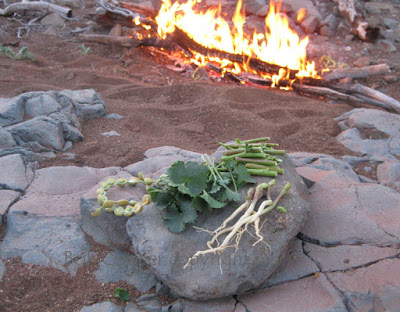 |
| Bush tucker lunch |
To learn more please go to Bob Cooper's website where you can find out about his survival courses, book and survival kit - please click here on the link - www.bobcoopersurvival.com


