Welcome to Life Images by Jill

Welcome to Life Images by Jill.........Stepping into the light and bringing together the images and stories of our world. I am a photographer, writer and multi-media artist.
Focussing mainly on Western Australia and Australia, I am seeking to preserve images and memories of the beautiful world in which we live and the people in it.

Welcome!

Welcome!
PLEASE CLICK ON THE IMAGE TO GO TO MY RED BUBBLE STORE.
Showing posts with label joey. Show all posts

Monday, 23 October 2023

World Kangaroo Day - 24 October 2023

 Hi everyone. I hope you and yours are doing well. 

I learnt yesterday that it is World Kangaroo Day on Tuesday 24 October 2023. The first World Kangaroo Day was held in 2020. 

I know my overseas visitors enjoy seeing my kangaroo pics, especially when I randomly say I come across them when we are out bushwalking. 

Here is one we interrupted having his lunch at Carnarvon Gorge when we visited Queensland on the eastern side of Australia recently - so this would be the Eastern Grey Kangaroo (Macropus giganteus)

This was a male - they are big - you wouldn't want to mess with one. They can be up to 1.5 metres (five foot) tall and weigh about 60kg (132 pounds). Lucky for us these kangaroos near the picnic area at Carnarvon Gorge are quite used to people - but you don't want to approach them - they are wild kangaroos and could be very dangerous if provoked.  


The one below here is the red kangaroo (Macropus rufus) They are the largest living marsupial. An adult male stands over 1.8m tall (5 ft 10 in) and can weigh up to 90kg (198 lb). Red kangaroos live throughout most of central mainland Australia, in areas with low rainfall, prefering open plains, grasslands and deserts. 

This one we saw in a wildlife park near Alice Springs in the Northern Territory, having a snooze in the shade. 


Here are some quick facts about kangaroos -

  • Kangaroos are the largest Marsupials on Earth.- Kangaroos belong to the mammal family  Macropodidae (meaning ‘big feet’).
  • There are about 60 species of kangaroos and wallabies
  • A group of kangaroos is called a mob.
  • Kangaroos' enlarged hind feet, powerful hind legs and strong tail help them hop up to 8 metres (26 foot) in one jump   These adaptations allow some species of kangaroo, such as red and grey kangaroos, reach speeds of over 48 km per hour (30 miles ph).
  • Kangaroos can suspend pregnancy - called emrouonic diapause - until the pouch Is vacant. Females can have up to 3 joeys at different stages of development at any one time. If a joey is lost, they can bring forward the next joey into the pouch without mating again. 
  • A kangaroos long feet and tail prevent them from walking backwards
  • They use their powerful tails as a fifth leg - if you cllick on this link you can see how kangaroos stand up on their tail when they are fighting - you might have heard of boxing kangaroos - echidnawalkabout.com.au/how-kangaroos-fight/
  • They sometimes drown their enemies.
  • It is believed that the name kangaroo comes from the Guugu Yimidhirr indigenous people sharing the word "gangurru" with Camptain James Cook when he landed in eastern Australia in 1770.

Below is a black footed (or black flanked) rock wallaby we saw during a Yardie Creek cruise in the Cape Range National Park in Western Australia.  This is a small and extremely agile marsupial that darts among rocky outcrops and caves in central and Western Australia.


And below is the Western Grey Kangaroo (Macropus fuliginosus) that we see when we are bushwalking over here in the south of Western Australia. In the top two photos you can see joeys (the baby) looking out of the pouch.

The pic bottom right hand side is kangaroos we can see in paddocks not far from where we live - a great place to take overseas visitors to see kangaroos - they are wild living and come down to the paddocks from the bush to graze. You can see more on my blog post here - Paperbark cathedral - Leschenault Estuary
Another place to see them locally is at the Bunbury wildlife park where you can meet kangaroos close up. 

And some red kangaroos in the Western Australian Pilbara region


This photo taken by my husband we believe is the pretty-faced wallaby - also known as the whiptail wallaby ( Notamacropus parryi) We saw this one at Karumba up near the Gulf of Carpentaria in Queensland. Wallabies are much smaller than kangaroos, more suited to living in scrublands. Males weigh from 14 to 26 kg (31 to 57 lb) and stand at a height from 70 to 93 cm (28 to 37 in)

To read more interesting facts about kangaroos - click on the links below....

Goeco.org-10-kangaroo-facts-you-didnt-know/

Treehugger.com/kangaroo-facts

And learn more about World Kangaroo Day here -  - www.worldkangarooday.org/about


Thank you so much for stopping by. I hope you have enjoyed my post about kangaroos.  We certainly have some unusual animals in Australia. 

I value your comments and look forward to hearing from you. I will try to visit your blogs in return. Have a wonderful week. 

With so much blood-shed and heart-break happening in this troubled world. I hope you and your families stay safe. 

I am linking up to the link-ups below. Please click on the links to see fabulous contributions from around the world - virtual touring at its best!
   

Tuesday, 15 December 2020

Summer colour in the south west Western Australian bush - Manea Park

 I have always said that there is always something flowering in the Western Australian bush. And it is true even in summer.

Those of you who follow my blog will know that I am a wildflower hunter, and I feel incredibly lucky to live in Western Australia. 

There are more than 12,000 species of wildflowers in Western Australia, making it the world’s largest collection.....60% of Western Australian wildflowers are found nowhere else on Earth. 

This is Jarrah - Eucalyptus marginata - flowering spring and summer 


We have been making regular visits to Manea Park near where we live over the winter and spring months. I've shared pics of orchids with you from time to time during my Covid Photo a day project. 

There has been an orchid we have been waiting to see come into flower over the last couple of months. And last week we were rewarded. 

When we first saw these leaves in the middle of the year they looked so much like eucalypt leaves we didn't know they were orchids, but the wonderful people at the Wildflower Society of Western Australia on Facebook helped me with identification. 

These are Slipper orchids or Western tongue orchid - Cryptostylis ovata - a summer flowering orchid endemic to Western Australia's south west. They grow in colonies and four to fifteen flowers form on each stem, though not all plants will flower each year. 


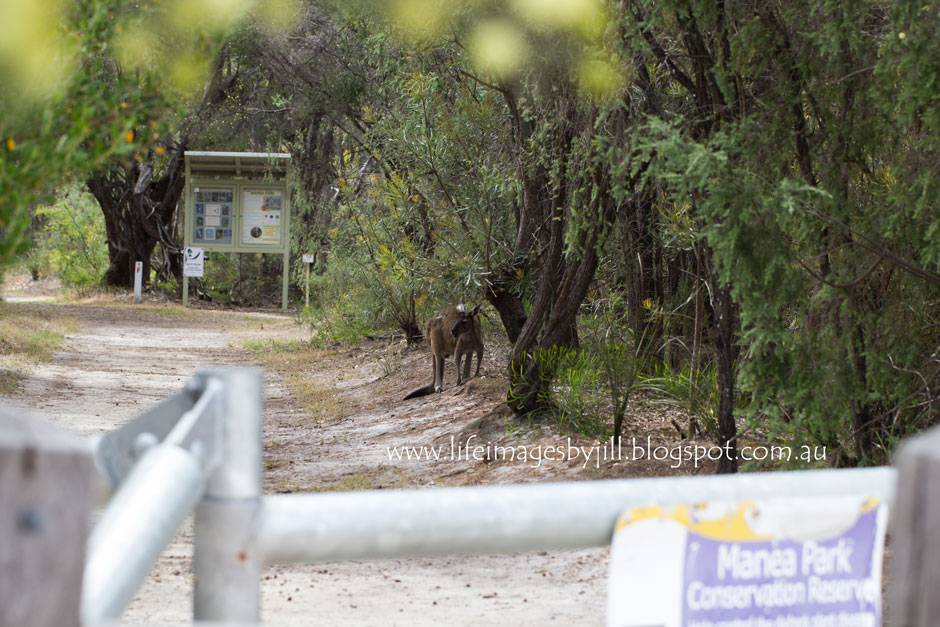
But I have gotten slightly ahead of myself. We had hardly started along the path into
Manea Park when we spied a young kangaroo sitting on the edge of the path. He was unconcerned about us. I think he was last year's joey as sitting just off the path was his mother with this year's joey sticking his head and legs out of her pouch. So cute! These reserves of bush in our cities are so important for the preservation of wildlife and flora. They are good for our well-being too! 


There was not a lot flowering, as it is summer here, but there are still flowers to be seen. I know why I don't frequent this bush block in summer - it was hot! - and probably why there were flowers I hadn't seen before. 

Below here you can see clockwise from top left - Spider smokebush - Conospermum teretifolium, Snotty gobble - Persoonia saccata, JarrahEucalyptus marginata, and one of the pea family 


And here is one of the Fringe Lilys - Thysanotus multiflorus


We had never seen this one before. Yellow starflower - Calytrix angulata. Rather gorgeous don't you think. 


And the Spearwood - Kunzea glabrescens. Evidently it's long straight branches were useful to the indigenous people for making spears. 


And this is the Candlestick Banksia  - Banksia attenuata, also known as slender banksia or biara to the Noongar people. It reminds me so much of giant Christmas candles this time of year. This tree commonly reaches 10 metres tall and the flowers 25cms long. 


You can see it at the different stages of flowering here. I love how the new leaves unfurl - as in the first two photos. The bottom right photo is the hard banksia nut. 
There are many forms of banksia - I have blogged about some of them here - 


The bees love them


Thank you so much for stopping by. I hope you and yours are well and that you have enjoyed my post today. Take care and stay safe. 
I value your comments and look forward to hearing from you. I will try to visit your blogs in return. Have a wonderful week.  

I am linking up to the link-ups below. Please click on the links to see fabulous contributions from around the world - virtual touring at its best!

Hello there! I love reading your comments. If you scroll down to the bottom you can comment too! I would love to hear from you.