Welcome to Life Images by Jill

Welcome to Life Images by Jill.........Stepping into the light and bringing together the images and stories of our world. I am a photographer, writer and multi-media artist.
Focussing mainly on Western Australia and Australia, I am seeking to preserve images and memories of the beautiful world in which we live and the people in it.

Welcome!

Welcome!
PLEASE CLICK ON THE IMAGE TO GO TO MY RED BUBBLE STORE.

Monday, 22 April 2013

Exploring the Western Australian wheatbelt

Every year and sometimes two or three times a year, we take a trip east to the Western Australian wheat-belt - to Bruce Rock to be precise - in the central wheat-belt. My sister's family farm a cropping property there. Our visit has been an annual family trip at Easter for years. Both my father and mother came from the wheatbelt although they moved to the city before my sister and I were born. My sister marrying a Bruce Rock farmer over thirty years ago brought our family back to the wheat-belt. I love its beautiful salmon gum and gimlet trees and its wide open spaces and when I visit I feel in some ways that a part of me is coming home.


 Over the last few trips I have convinced my family that we should travel up by different routes to look at different places along the way, instead of going our usual route - Bunbury, Collie, Williams, Narrogin, Wickepin, Yealearing, Corrigin, Bilbarin, Bruce Rock - a four hour drive. Of course going a different way takes longer, but the journey is what is important don't you think?


This year we toured via York and the Old Goldfields Road.  The York to Goldfields Heritage Trail commences at York, 97km east of Perth and follows as closely as possible the route to the Coolgardie goldfields established by explorer Charles Cooke Hunt. It features some of his dams and wells which Hunt and his party constructed while cutting the trail during four expeditions between 1864 and 1866. For the thousands of gold seekers who trekked to the goldfields, Hunt's track and wells provided an invaluable lifelife. 

Since reading about Hunt a few years ago, I have been fascinated by this man and his work, and over the last few years we have visited a number of his wells. Travelling the Old Goldfields Road would add to my knowledge. (Writing about Hunt will be another story coming soon!)

From Williams we headed north on the Williams to York Road. Near Dryandra Conservation Reserve we found this little fellow - an young echidna - crossing the road.  He tucked his head under himself and bristled his quills. The hard gravel road surface was not providing a hiding place! I took a few quick shots and then let him trundle on his way. 


We stopped for a quick lunch in historic York. Established in 1836, York is now a popular weekend destination and also an alternative community for Perth workers who are happy to commute. There are many historic buildings. In the collage below you can see the Town Hall, the old flour mill, the convent school build in 1873 and the York main street. York could easily take up a whole story on it's own....another time.....


And onto the Old Goldfields Road. In the mosaic below you can see Youndegin Inn - first established as a police outpost in 1866. With the discovery of the Yilgarn goldfields it became the Youndegin Arms Inn and later a staging post for Cobb & Co coaches, declining in the 1890s after the establishment of the railway line 15km to the north. 
Nearby is one of Hunt's wells, constructed between 1864 and 1866. 
You can also see below one of the historical information boards which can be found along the trail, and the picnic area near Hunt's well at Doodlakine.


We continued on to Merredin before turning south to Bruce Rock. Just south of Merredin is another of Hunt's wells at Totadgin Rock.  From the top of the rock you have views over the wheatbelt and there is a marked trail with information panels making it an interesting place for a walk in autumn or spring when it is not too hot. There are gnama holes (natural depressions) on the rock that collect water during rain and which were an important source of water for animals, early residents and explorers. Hunt's well at Totadgin is a good example of dry stone well construction. There are granite rocks like Totadgin scattered all over the wheatbelt.


Bruce Rock is a progressive neat town. They have recently held their Centennial Celebrations and installed a mosaic walk along the main street containing mosaic tiles made by families and groups within their community. The mosaics are a creative, colourful and interesting addition to the town. My sister's mosaic can be seen here in the bottom left hand corner - Shearing & Co.


The farm of course is the highlight for us, for our boys, and now our grandsons. What a great way to spend a morning or late afternoon walking over the paddocks and the big rock at the back of the home-block farm house. When our boys were younger they used to take off with their all-boy cousins and we would only see them at meal times!


 Up on the rock is their collection of old farm equipment - don't you just love rust! The old scarifier made a great climbing frame!


and how about an improvised drum kit for a young man - you can make as much noise as you like out here! I've processed this in Elements to give it a raw rock star look.


Although you might scare off the Pink & Grey Galahs! 


The paddocks may be bare now, but after we left seeding went into full swing, and next time we visit the paddocks will be green growing crops of wheat, barley and canola. 


Thank you for stopping by. I hope you have enjoyed reading a little about the central Western Australian wheatbelt.  I look forward to hearing from you.
Is there a place you visit often - do you travel different ways? 

I am linking up to Mosaic Monday and Our World Tuesday and Travel Photo Thursday.  Please click on the links to see posts from other contributors around the world. 


You might also like to read more about the wheatbelt by clicking on a couple of my other posts here -

Western Australian central wheatbelt
Wheatbelt Central - Bruce Rock Caravan Park Camp food - Western Australian wheatbelt granite outcrops
Drayandra woodland in the early morning light


Sunday, 14 April 2013

Persimmons and pasta - learning manual camera settings

It has been a few weeks since I have posted any food photos - but I have been taking photos! 

I have been doing a photography course for the last eight weeks and learnt the joys of using completely "manual" settings on my camera. Somewhere along the line I have missed out on the "technical" side of photography - and now is the time to learn!Until now for my food photography I have been using Aperture Priority, including setting white balance and ISO. Now I am also setting the "shutter speed". 

Manual settings are a whole new ball game - so much more to think about and consider and juggle to get a correct exposure. Lots to learn! Someone said once you learn to photograph with "manual" settings you will never go back to "automatic" again. I think they are right. (although you can't beat automatic for a quick snap!)

Below are some of my first attempts at food photography with all manual settings.
 
I am sure the ladies in my dance class thought I had gone quite mad when I exclaimed over this clutch of duck eggs and I said I wanted to take them home to photograph them!


How about some pasta photographed from above...........  


and some Quesadillas. Such a simple recipe - Melt some butter in a pan. Put a tortilla in the pan, throw on some grated cheese and chopped spinach leaves and chives. (you can also put chopped onion and chilli if you like) Top with another tortilla. Fry each side 30 seconds or so until lightly browned.  Lift out onto paper towell. Service with guacamole and sweet chilli sauce or salsa.  Easy and yummy!
I was chasing the dappled morning light on my patio for this one. 


And who can resist this persimmons  - here you can see early morning back lighting (top) and side lighting (bottom). Don't you wish you could bottle that gorgeous light!
  

And I have rediscovered my old attachable flash unit which I can use to "bounce" light. It hasn't been out of it's box since my film camera days....I took out the corroded batteries, and my husband cleaned up the bits inside, and hey-presto it worked! 

See here used on Persimmons photographed on my kitchen bench top, and then on a black tile.  Light from the flash bounced onto the ceiling.


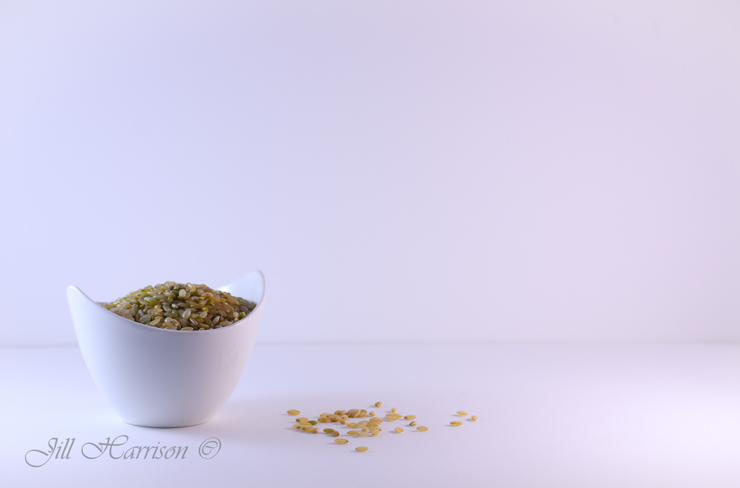
and finally - rice bowl - minimalistic. This year I have joined the Photography Group of Bunbury. Every month there is a theme, and members present images for critique and judging. I won "gold" with this image. Photographed in my light box.


 How about you? Do you use manual camera settings?
If you search for "Digital Photography School" on the net there are lots of great tutorials, including a 4 part series on manual settings - click here to go to part 1 - aperture-priority-and-shutter-priority-exposure-lesson-1

I hope you have enjoyed stopping by. I love hearing from you and look forward to reading your comments. Thank you.
I am linking into Mosaic Monday at Little Red House and Our World Tuesday. Please click on the links to see wonderful images from contributors around the world. 

Have a wonderful, joyous and blessed week, wherever you are and whatever you do.

You might also like - 

 My food photography on Flickr    
Photographing Food on Black 
 Summer is here


Monday, 25 March 2013

On the waterfront, Bunbury, Western Australia

On Friday I went down to Koombana Bay in my lunch hour. It was lovely to get away from the office and go for a walk on the beach with my camera.


 The water was at it's sparkling best, and I wished I could have stayed and enjoyed it longer. In these pics below you can see some of what I saw, clockwise from top left -
A man rowing out to his yacht (lucky him!), a lady with her fishing rod encouraging her dog to have a swim (her dog seemed to be enjoying it), this person was snorkeling along the edge towing a container (he was wearing ear muffs, who knows what he was doing!), moored yachts looking over waterfront restaurants and apartments (beckoning their owners to come and play), the sailing regatta control box (empty today, waiting for the weekend regatta), people at the beach side restaurant (I wonder what they had for lunch), some men measuring something at the beach volley ball ground (measuring what?), a man swimming laps (something I should do), I saved this Dutch visitor from poisoning himself with the huge Nor-West Blowie he had just hooked (lucky I was there when he asked for help, and that I could recognize it! - I must have learnt something along the way), and in the middle a couple enjoying the solitude and sun (hope they eventually remembered the slip, slop, slap, wrap!). 


and a man walking and the seagulls just sitting (perhaps the man was enjoying the beach in his lunch hour too)


At Koombana Bay you can visit the Dolphin Centre or go on a dolphin cruise or be at the beach when the dolphins come in close. Sometimes when we go out in our boat the dolphins swim up around us. So beautiful.


Adjacent to Koombana Bay is the Inner and Outer Harbours. Here are some boats at the marina at the Outer Harbour, dreaming of sailing away some where. You see all sorts of craft from old wooden boats to sleek new cruisers. You can see some of the port facilities in the background of these image. 


Also at the Outer Harbour you can see this three tonne crane that sits at the start of the old timber jetty. It was built in 1911 by Sir William Arrol who designed and constructed amongst other bridges the Tower Bridge in London and the gantry which housed the Titanic during construction. I love photographing these old coggs and wheels.


Sadly the old timber jetty is being dismantled as it has fallen into disrepair and was breaking up despite years of intensive fund raising and lobbying. When Bunbury was first settled goods and passengers had to be transferred between ships and the shore in boats. In 1864 a jetty was built out into the bay and was extended nine times due to silting.  By 1957 it was 1,677 metres in length. As the port became busier and more modern methods were used to load and unload vessels the harbour developed away from the jetty, which ceased to be used commercially in 1982.   


 How about a coffee or lunch at the waterfront cafe


A view over the Outer Harbour from Marlsden Hill.  You can see the old timber jetty to the right, and the land-backed wharf on the left. 


Bunbury is certainly a beautiful place to live, and proudly calls itself the "city of three waters" as it is surrounded on three sides by the Indian Ocean, Koombana Bay and the Leschenault Inlet. To learn more - please click on the link here - Visit Bunbury

Also click here to see more info about Bunbury from travel writer Jo Castro over at Zia-a-zag, and check out her numerous posts about Bunbury - a great read -  Interesting facts about Bunbury

I don't have far to go to enjoy the water during my lunch time. I don't do it often enough. What do you do in your lunch hour? 

Thank you for stopping by and have a wonderful week.
I am linking up with Mosaic Monday and Our World Tuesday and Travel Photo Thursday.  Please click on the links to see the work of other photographers around the world. 

Want to see some more of Bunbury? You might also like - 

A walk around Bunbury's history
Cappaccino at the Grand
 Heritage architect in Bunbury
Bunbury - city surrounded by water 


Monday, 18 March 2013

Can clouds enhance your landscapes?

“So fine was the morning except for a streak of wind here and there that the sea and sky looked all one fabric, as if sails were stuck high up in the sky, or the clouds had dropped down into the sea.”
― Virginia Woolf, To the Lighthouse 

Do you look up at the sky and see the clouds? Do you use them to enhance your landscape images?
This months project for my Photography group is clouds. Clouds can add drama or enhance a scene. And we all know how glorious a sunrise or sunset can be when there are clouds - especially over the sea.

What glorious colours the sky can be - these images in my collage below were taken between lunch time one day, and 5pm the next afternoon. It was an interesting project and the results were quite amazing to see the changes over the two days. 
In the top LH corner lunch time the sky was blue with a few clouds, then that evening there was beautiful pink colours in the late afternoon sky, threatening clouds next morning (middle R), rain at lunch time so all cloud (the lighthouse pic), and the next afternoon driving home, a glorious sunset.
What an ever changing colourful pallet the sky has! And the clouds certainly allow the colours to come through.
These images are all totally straight out of camera.


Blood red sunrise on Anzac Day last April.  When we saw this on our way home from the Anzac Day dawn service last 25 April, I felt like it signified the flowing blood of those who have lost their lives fighting to keep our country and families free.


Sunset at Coral Bay. We had gone to the cliff top to have sunset drinks. The sky was completely clouded so we thought is was going to be a none event. But the evening was beautiful and the view superb - and then this -


Below we see sunset at Denham, Shark Bay, with the colours of the clouds reflecting on the water, sunset at Hopetoun on our south coast, and sunset down the street from my house.  The first one, at Denham, we had rented a beach front cottage and I was standing at the kitchen bench cooking tea, when I saw this sunset, so I dropped everything, and ran down to the beach with my camera, leaving my husband to finishing cooking tea. (he is used to me doing this by now)


Late afternoon at my sister and brother-in-law's farm at Bruce Rock in our central wheatbelt. This is their front paddock. You can see the view from the house looking east. I never tire at looking at this view when we visit. Isn't the tree magnificent! It is a salmon gum.


 I love taking photos of clouds out of airplane windows when we fly. This image I call my Himalaya sunrise - you can see the mountain peaks thrusting up through the clouds. Taken on a flight back from the UK somewhere over Asia.


This one taken at Bluff Knoll in the Stirling Ranges in our south west with the clouds obscuring the view reminds me of Wuthering Heights.


And at days end - I saw this sunset starting to happen when I left work late one afternoon last year. Instead of driving home I went to the beach, took off my shoes, walked down onto the beach and took some shots. The moment was certainly a gift.


Do you look up and take photos of clouds? Do you notice how they change over the day? 
Do you see how the rising or setting sun reflects off the clouds making them glow glorious colours that change every minute? Do you use clouds to enhance your landscape images?

I know I have other cloud photos in my collection. I still can't decide which cloud photo to use for my Photography Group submission next week. What would be your choice?

Have a wonderful week, and thank you for stopping by.

I am linking up with other wonderful contributors at Mosaic Monday - and Our World Tuesday - and -  Travel Photo Thursday    Please click on the links to take a look around the world. 


You might also like - please click on the links - 


Dryandra woodland in early morning light, Western Australia
Flying high with my camera