Welcome to Life Images by Jill

Welcome to Life Images by Jill.........Stepping into the light and bringing together the images and stories of our world. I am a photographer, writer and multi-media artist.
Focussing mainly on Western Australia and Australia, I am seeking to preserve images and memories of the beautiful world in which we live and the people in it.

Welcome!

Welcome!
PLEASE CLICK ON THE IMAGE TO GO TO MY RED BUBBLE STORE.

Monday, 27 November 2023

Art Market in the Garden

 Hi everyone, I hope you and yours are doing well. 

Just a short post from me today. I am winding down from a busy few weeks and weekend. On Sunday I had a market stall at the Stirling Street Art Centre in my hometown. It was there annual Art in the Garden market. A great place to buy products created by local artisans - everything from soap and candles to clothing, art pieces, pottery, wood carvings, garden objects - you name it you could probably buy it at the market. I've been so busy getting products ready for the market. 

I was there with my eco-printing-dyed upcycled-clothing, scarves, prints and greeting cards, along with my photography prints, cushion covers, tote bags and greeting cards, as well as some paper flowers I make for every market and Christmas baubles filled with dried wildflowers.

Above is a pic of me with my stall. Unfortunately it was a hot hot and windy day, with a side serve of flys. Amazingly people weren't put off by the weather and still came to the market. It has been so hot the last couple of weeks - an unseasonly very hot - heat wave - start to summer, with bushfires already raging. It's goig to be a bad summer. 

Below you can see a few samples of my eco-print products. 


Eco-printing on paper


Cyanotype sun prints on paper, Christmas cards, and tote bags

My latest craze - printing with coreopsis flowers from my front garden - the colour of summer


Also I have ecoprinted scarves, upcycle shirts and tote bags


I loved this little white denim mini skirt and lace edge cotton upcylced top printed with ecualyptus leaves - but unfortunately it didn't sell. Maybe next time.


Eucalyptus loves wool - but not all leaves print orange - these are eucalyptus karri leaves I source from a friend in the great southern who has them growing on her property - they love wool. 


I still have so much to learn - I'm off to a 3 day workshop in Albany for summer school early next year.  

Thank you so much for stopping by. I value your comments and look forward to hearing from you. 

You might also like - some more about ecoprinting and cyanotype from past blog posts - 

I am still packing up and sorting out from my weekend, but I will try to visit your blogs in return. Have a wonderful week. 
I am linking up to the link-ups below. Please click on the links to see fabulous contributions from around the world - virtual touring at its best!
   

Saturday, 11 November 2023

Remembrance Day - 11th November

The 11th hour of the 11th day of the 11th month attained a special significance in the post-war years after World War 1 . The moment when hostilities ceased on the Western Front in 1918 became universally associated with the remembrance of those who had died in the war.  On the first anniversary of the Armistice in 1919 two minutes' silence was instituted as part of the main commemorative ceremony at the new Cenotaph in London.


After the end of the Second World War, the Australian and British governments changed the name to Remembrance Day. Australians observe one minute's silence at 11 am on 11 November each year to remember those who died or suffered for Australia's cause in all wars and armed conflicts. 


In Flanders fields the poppies blow
Between the crosses, row on row,
That mark our place; and in the sky
The larks, still bravely singing, fly
Scarce heard amid the guns below.

We are the Dead. Short days ago
We lived, felt dawn, saw sunset glow,
Loved and were loved, and now we lie
In Flanders fields.

   by John McCrae, May 1915


In the photo below you can see one of two remembrance walls at the Australian War Memorial in our capital city Canberra, where are recorded on bronze panels the names of over 102,000 Australians who have died in conflicts. On these two walls you can find the name of your family member and place a poppy beside their name, as we did when we visited. This is the closest we can come to the burial place of my great uncle who died in WW1 at Gallipoli and my husband's uncle in WW2 in Burma, so I was very grateful to be able to do this. 


You can learn more about Remembrance Day and the significance of the poppy here -


Remembrance Day is commemorated in Australia, United Kingdom, New Zealand, United States, Canada, Belgium, France, and the Cayman Islands. However, We have all be affected in one way or another by war, either directly, or through family members or friends. 

A video/musical tribute. 


Do you observe Remembrance Day or similar in your country? Who will you be remembering this Remembrance Day?  

As wars continue to be raged across the globe, I despair that we have learnt nothing from the past. I despair for those who are caught up in these conflicts, for the loss of familes, loved ones, home, community, life as they knew it. And those that return home afflicted physically and mentally. Why can't the powers sit down and find a way through without killing, bombing and destruction. There must be a better way. 


Thank you so much for stopping by. I value your comments and look forward to hearing from you. I will try to visit your blogs in return. Have a wonderful week. 
I am linking up to the link-ups below. Please click on the links to see fabulous contributions from around the world - virtual touring at its best!

Monday, 6 November 2023

Eco-printing and Coreopsis

Hi everyone, I hope you and yours are doing well. 

This time of year - November and December - summer - the Coreopsis in my garden comes alive. I love it.  The bees love them too. 


But as well as making a fantastic bright border plant in my front garden that I have to do nothing to other than cutting off the dead heads, and which comes back year after year - even in winter the green leafy plants are there - coreopsis is fantastic for eco-printing. 


The last few weeks I have been busy getting ready for Art in The Garden artisan markets for Christmas at the Stirling Street art Centre in Bunbury - it's on the last Sunday in November - less than three weeks now - so I don't have long to finish. 

Today and one day last week I have been printing with my coreopsis. Here's a few pics for you to enjoy.

These are on cotton up-cycle shirts - 


They are also fantastic on silk and wool scarves - 


I'm going to make some tote bags - but I haven't finished making them yet so I will have to come back later with those. 

Just a short post from me today - busy busy!

Do you know about eco-printing? I have blogged briefly about it before here - Eco-printing- magical absorbing art. I've learnt a lot more since then. There are some complicated processes, but I like the simplicity of printing with my coreopsis. 

There are lots of websites where you can find out more. too much for me to tell you even the basics here! I've been doing it for a few years now, but still have lots to learn. 

I continue to be heartbroken by the tragedy around the world. My friend has just returned from one of the war zones - thankfully safe. 

Thank you so much for stopping by. I value your comments and look forward to hearing from you. I will try to visit your blogs in return. Have a wonderful week. 

I am linking up to the link-ups below. Please click on the links to see fabulous contributions from around the world - virtual touring at its best!
   

Monday, 23 October 2023

World Kangaroo Day - 24 October 2023

 Hi everyone. I hope you and yours are doing well. 

I learnt yesterday that it is World Kangaroo Day on Tuesday 24 October 2023. The first World Kangaroo Day was held in 2020. 

I know my overseas visitors enjoy seeing my kangaroo pics, especially when I randomly say I come across them when we are out bushwalking. 

Here is one we interrupted having his lunch at Carnarvon Gorge when we visited Queensland on the eastern side of Australia recently - so this would be the Eastern Grey Kangaroo (Macropus giganteus)

This was a male - they are big - you wouldn't want to mess with one. They can be up to 1.5 metres (five foot) tall and weigh about 60kg (132 pounds). Lucky for us these kangaroos near the picnic area at Carnarvon Gorge are quite used to people - but you don't want to approach them - they are wild kangaroos and could be very dangerous if provoked.  


The one below here is the red kangaroo (Macropus rufus) They are the largest living marsupial. An adult male stands over 1.8m tall (5 ft 10 in) and can weigh up to 90kg (198 lb). Red kangaroos live throughout most of central mainland Australia, in areas with low rainfall, prefering open plains, grasslands and deserts. 

This one we saw in a wildlife park near Alice Springs in the Northern Territory, having a snooze in the shade. 


Here are some quick facts about kangaroos -

  • Kangaroos are the largest Marsupials on Earth.- Kangaroos belong to the mammal family  Macropodidae (meaning ‘big feet’).
  • There are about 60 species of kangaroos and wallabies
  • A group of kangaroos is called a mob.
  • Kangaroos' enlarged hind feet, powerful hind legs and strong tail help them hop up to 8 metres (26 foot) in one jump   These adaptations allow some species of kangaroo, such as red and grey kangaroos, reach speeds of over 48 km per hour (30 miles ph).
  • Kangaroos can suspend pregnancy - called emrouonic diapause - until the pouch Is vacant. Females can have up to 3 joeys at different stages of development at any one time. If a joey is lost, they can bring forward the next joey into the pouch without mating again. 
  • A kangaroos long feet and tail prevent them from walking backwards
  • They use their powerful tails as a fifth leg - if you cllick on this link you can see how kangaroos stand up on their tail when they are fighting - you might have heard of boxing kangaroos - echidnawalkabout.com.au/how-kangaroos-fight/
  • They sometimes drown their enemies.
  • It is believed that the name kangaroo comes from the Guugu Yimidhirr indigenous people sharing the word "gangurru" with Camptain James Cook when he landed in eastern Australia in 1770.

Below is a black footed (or black flanked) rock wallaby we saw during a Yardie Creek cruise in the Cape Range National Park in Western Australia.  This is a small and extremely agile marsupial that darts among rocky outcrops and caves in central and Western Australia.


And below is the Western Grey Kangaroo (Macropus fuliginosus) that we see when we are bushwalking over here in the south of Western Australia. In the top two photos you can see joeys (the baby) looking out of the pouch.

The pic bottom right hand side is kangaroos we can see in paddocks not far from where we live - a great place to take overseas visitors to see kangaroos - they are wild living and come down to the paddocks from the bush to graze. You can see more on my blog post here - Paperbark cathedral - Leschenault Estuary
Another place to see them locally is at the Bunbury wildlife park where you can meet kangaroos close up. 

And some red kangaroos in the Western Australian Pilbara region


This photo taken by my husband we believe is the pretty-faced wallaby - also known as the whiptail wallaby ( Notamacropus parryi) We saw this one at Karumba up near the Gulf of Carpentaria in Queensland. Wallabies are much smaller than kangaroos, more suited to living in scrublands. Males weigh from 14 to 26 kg (31 to 57 lb) and stand at a height from 70 to 93 cm (28 to 37 in)

To read more interesting facts about kangaroos - click on the links below....

Goeco.org-10-kangaroo-facts-you-didnt-know/

Treehugger.com/kangaroo-facts

And learn more about World Kangaroo Day here -  - www.worldkangarooday.org/about


Thank you so much for stopping by. I hope you have enjoyed my post about kangaroos.  We certainly have some unusual animals in Australia. 

I value your comments and look forward to hearing from you. I will try to visit your blogs in return. Have a wonderful week. 

With so much blood-shed and heart-break happening in this troubled world. I hope you and your families stay safe. 

I am linking up to the link-ups below. Please click on the links to see fabulous contributions from around the world - virtual touring at its best!
   

Tuesday, 10 October 2023

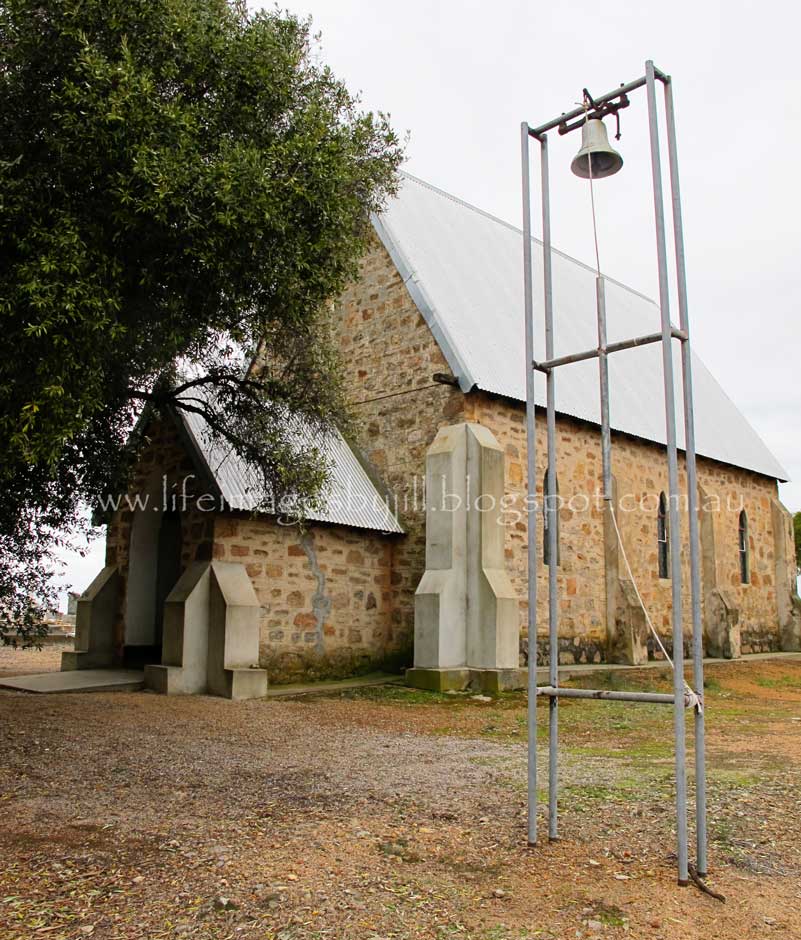
150th Anniversary of the Mourambine Church, 1873-2023 - Western Australia

On the 24th September this year we were priviledged to attend a church service to celebrate the 150th Year of the Consecration of St Patrick's church in the tiny town of Mourambine near Pingelly in Western Australia's wheatbelt. 

I know 150 years is not a lot in terms of the history of some countries, but for Australia it is. To put it in perspective, the first European settlement in Western Australia was at Albany in 1826, followed by our capital city, Perth, in 1829. Settlement of inland Western Australia didn't happen immediately. 

The tiny church at Mourambine and its church yard, sits on a small rise overlooking undulating grain fields, and holds a special place in my family history. 

I first wrote about it in 2014 - you can see the post here - Peace in a country church


My Dad lived just down the road from the church during some of his boyhood and he often spoke about Mourambine. We visited several times with my father in his latter years, and if we are going this way we stop to lay flowers on family graves. 

My grandparents - my father's father and mother - Bob and Roma Clayden (nee Fairhead), my Great-grandparents on Roma's side - George Valentine and Florence Fairhead (nee McBurney), and my Great-great-grandparents - James and Mary Fairhead (nee Welsh). Along with other family members, including 2 small babies. They all had large families who are now scattered across Australia. I have recently made contact with the daughter of one of Roma's brothers, and I am hoping to learn more family history. 

The unnamed grave on the bottom right here is baby Alex Fairhead son of George and Florence, and twin of Bernard. I finally found out his name when we were there in September. Alex died at 2 and a half months old in 1920.


James Fairhead was the first to come to Australia arriving on 30 April 1853 as convict # 1863 on the ship Pyrenees. He was immediately given ticket-of-leave on 1 May 1853 on arrival in Fremantle and given a Conditional Pardoned on 15 September 1855. He married Mary Welsh on 1 December 1859 and they bought land in Beverley in the wheatbelt. They had twelve children in twenty years.
Below is a photo of James Fairhead.

I am yet to find a photo of Mary or any of the details of how she came to be Western Australia. I made a couple of new contacts at the anniversary celebration but my search still continues for a photo and details of Mary. I think I will need to go to the Battye Library in Perth to search.


The 150th commemoration service was conducted by
The Right Reverend Dr. Ian Coutts Bishop of the Anglican church in Bunbury. Over 150 people attended the service. As the tiny church only holds 50 people, the elderly were given first preferance and the remainder sat outside. We could hear the service through a two way microphone. Thankfully the sprinkling of rain earlier held off while we were there.


After the service the Bishop planted a commemorative olive tree in keeping with the olive trees that are growing along the path leading to the church. I enjoyed meeting Bishop Ian. 

At the old Atkins house down the road from the church is a large olive tree said to have been planted by Benedictine monks from New Norcia when they passed through the district around 1873. I am wondering if this was where the olive trees at the church also came from. 


A little short history of the church - (with thanks to the 150th celebration committee) 

Settlers arrived in the district around 1846 and the townsite of Mourambine was declared in 1884. Years later the railway bypassed the town and Pingelly (7 kilometres to the west) became the centre of the district. 

The Reverand F Lynch from Gilgering held a monthly service in Mourambine from 1869 onwards. Two blocks of land, each of 50 acres were gazetted. Originally the church was going to be built from timber, but the carefully selected timber was burnt in a bushfire before building could begin. The residents then decided to build a stone church from local stone. The church was built by William Atkins, a stone mason, under the supervision of John Shaddick, Edward Robinson and John Seabrook Jr who were responsible for its erection. 

It was orginally roofed with hand-split she-oak shingles but these were later covered with corrugated iron roofing, the building having no ceiling. The seats in the church were made at the 'Establishment' in York by convict labour. The building was consecrated in the presence of 45 people by Bishop Hale on Sunday 18 May 1873, costing 89 pounds to erect. 


After the celebrations at the church we were treated to a delicious lunch at the Pingelly Recreation and Cultural Center put on by the Pingelly Shire. 

For more about the church - Western Australian Heritage Council
And an interesting article from Trove where you an search newspapers and gazettes - Trove - 1886 letter to the Editor
And also from Trove - Notes from Mourambine
A list of graves - Ozburials

Thank you so much for stopping by. Do you have a church yard that holds significant value to your family? 

I value your comments and look forward to hearing from you. I will try to visit your blogs in return. Have a wonderful week. 
I am linking up to the link-ups below. 

Please click on the links to see fabulous contributions from around the world - virtual touring at its best!


   Mosaic Monday @ Soul & Mind & So On