Welcome to Life Images by Jill

Welcome to Life Images by Jill.........Stepping into the light and bringing together the images and stories of our world. I am a photographer, writer and multi-media artist.
Focussing mainly on Western Australia and Australia, I am seeking to preserve images and memories of the beautiful world in which we live and the people in it.

Welcome!

Welcome!
PLEASE CLICK ON THE IMAGE TO GO TO MY RED BUBBLE STORE.
Showing posts with label wheatbelt. Show all posts

Sunday, 30 June 2024

Beringbooding Rock Water Tank, eastern wheatbelt, Western Australia

Built by sustenance labour, the largest rock water catchment tank in Australia gives us a glimpse into the past.

Hello everyone. I hope you and yours are doing well. Today I am taking  you away from the coast and up to the north-eastern wheatbelt, to Beringbooding Rock, one of the many granite outcrops found throughout the Western Australian wheatbelt.

Walls hewn from the rock surround the rock channelling the water

Beringbooding is dominated by a ten and a quarter million litre water tank built during 1937-38 for the farming community. It is the largest rock water catchment tank in Australia.  The concrete tank and catchment was built by sustenance labour. This scheme provided employment during the Great Depression. About 100 men were employed at Beringbooding at a cost of 10,000 pounds. One weeks work was given to each man for each child – for example four children equalled four weeks work. Those doing sustenance work had an extra 20 shillings per week added to their Government paid sustenance payment, which was seven shillings a day for up to five children with a maximum of 49 shillings a week.  They were brought by rail to nearby Bonnie Rock from Perth and lived in tents. These men were often unaccustomed to hard manual labour.

You can only marvel at the engineering and manpower that constructed this water catchment, and wonder about the first impressions of these city men when they were deposited in this far corner of the wheatbelt, beyond which lies uninhabited scrubland.

The tank is fed by a seven hectare catchment area. Rock walls hewn from the rock itself encircle the rock and channel the rain water via a concrete aqueduct into the tank. Big fires were lit on the granite and allowed to burn all night making the rock red hot. Water was then poured over the rock and the granite exploded in big layers. These slabs were sledged away, stood on their sides and cemented together to form the rock walls up to a metre high.

Over the years the corrugated iron roof covering the concrete tank started to come adrift through age and strong winds, creating a safety hazard, and has now been removed. However without a covering, water has been evaporating, and due to the significant amount of algae in the tank, the water has been deemed unfit for crop spraying, watering stock, or firefighting. Latest reports indicate the Shire of Mukinbudin has received funding to install a temporary cover and is committed to secure funding for a new permanent tin roof.

Camping area at Beringbooding Rock

The picnic and free camping area is conveniently located at the base of the rock. A 2.3 kilometre walk trail starts at the gate at the base of the tank and takes you over the rock to a variety of natural features

Rock cairn at the highest point, erected by HS King

I suggest you take a photo of the information map and allow a minimum of one and a half hours. The rock cairn at the highest point was erected in 1889 by surveyor and early explorer HS King.  You can enjoy spectacular 360 degree views over grain-growing farmland to the south and west, and virgin bushland to the north and east.

Gnamma hole surrounded by rock wall. The tank can be seen in the background.

Features include a huge balancing boulder that seems to defy gravity, a sheer rock face where the forces of nature have been at work, and gnamma holes: rock depressions which collect water during rain, providing an important water source for early Aboriginal people, settlers and animals. On the north eastern side of the rock you will find the “Kangaroo Hole”, a deep water natural pool. During October and November you will see the red Kunzia pulchella flowering next to the pool. It is amazing how plants can grow in small crevices in the rock.

Balancing rocks

Kangaroo Pool with flowering Kunzia in the foreground

The surrounding bushland includes salmon gums, sandalwood, melaleuca, acacia, grevillea, Ti-tree, hakea, cassia, kunzia, quandongs, and native orchids. Many birds inhabit the area.

Exploring the rock gardens

Clockwise from top left - Kunzia, wild orchids, quandongs, and Waitzia 

Throughout the wheatbelt you can see other similar rock catchment walls and dams. They make great places to stop and explore. You will also find evidence of other sustenance scheme projects throughout Western Australia.

FACTS BOX

Location :  Located 357km from Perth, near the intersection of Beringbooding and Cunderin Roads, about 65 kilometres north east of Mukinbudin and 13 kilometres east of the Bonnie Rock wheat bin in the Western Australian north-eastern wheatbelt. You might get a bit of an idea from this map below. The red dot is Beringbooding Rock, with our capital city Perth on the coast. 

Facilities:

There are several partly shaded compacted gravel hard standing sites suitable for caravans and camper trailers. Facilities include picnic tables, fire pits and an eco flushing toilet.  Non-potable water is available from a 60,000 litre water tank fed with piped water. Please bring your own firewood, and beware of fire restrictions and take away your rubbish.

The 2.3 km walk trail is suitable for those with a moderate level of fitness. Please take the usual bushwalking precautions. The rock can be slippery when wet.

Useful Information: 

Wheatbelt Tourism - https://www.wheatbelttourism.com/granite-outcrops-in-the-wheatbelt/

The Wheatbelt Way - https://wheatbeltway.com.au/

Shire of Mukinbudin - https://www.mukinbudin.wa.gov.au/

Ornate Dragon Lizard

Thank you so much for stopping by. I hope you have enjoyed learning a little of our history. My article about Beringbooding Rock was published recently in Caravan World magazine, June 2024 edition. 

I value your comments and look forward to hearing from you. I will try to visit your blogs in return. Have a wonderful week.

I am linking up to the link-ups below. Please click on the links to see fabulous contributions from around the world - virtual touring at its best!

Tuesday, 10 October 2023

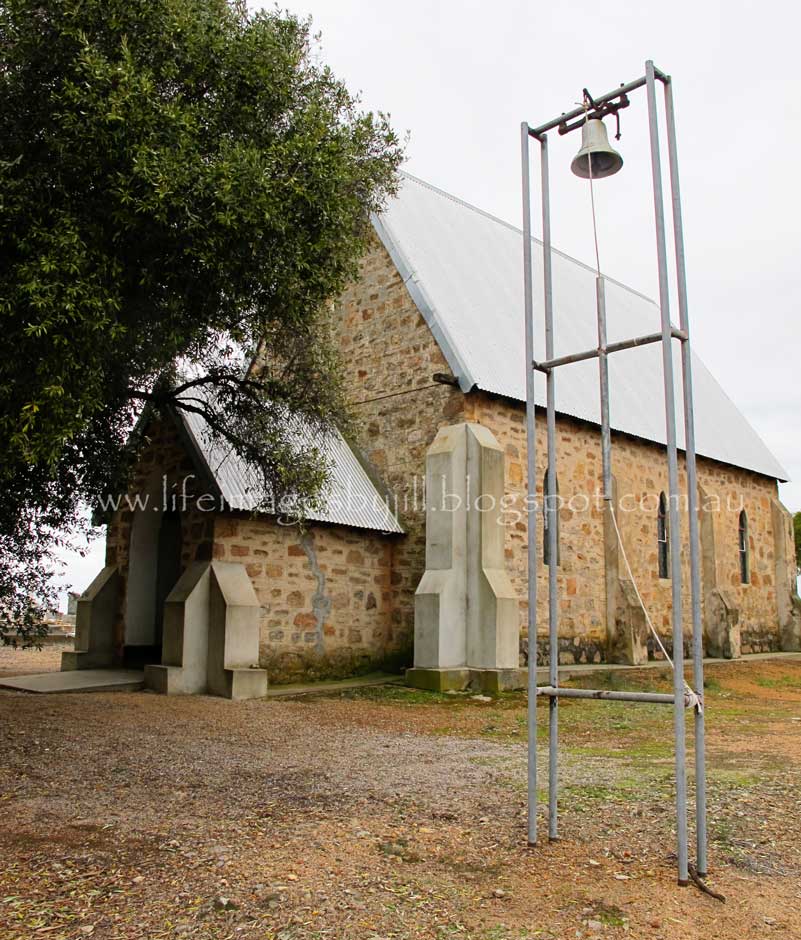
150th Anniversary of the Mourambine Church, 1873-2023 - Western Australia

On the 24th September this year we were priviledged to attend a church service to celebrate the 150th Year of the Consecration of St Patrick's church in the tiny town of Mourambine near Pingelly in Western Australia's wheatbelt. 

I know 150 years is not a lot in terms of the history of some countries, but for Australia it is. To put it in perspective, the first European settlement in Western Australia was at Albany in 1826, followed by our capital city, Perth, in 1829. Settlement of inland Western Australia didn't happen immediately. 

The tiny church at Mourambine and its church yard, sits on a small rise overlooking undulating grain fields, and holds a special place in my family history. 

I first wrote about it in 2014 - you can see the post here - Peace in a country church


My Dad lived just down the road from the church during some of his boyhood and he often spoke about Mourambine. We visited several times with my father in his latter years, and if we are going this way we stop to lay flowers on family graves. 

My grandparents - my father's father and mother - Bob and Roma Clayden (nee Fairhead), my Great-grandparents on Roma's side - George Valentine and Florence Fairhead (nee McBurney), and my Great-great-grandparents - James and Mary Fairhead (nee Welsh). Along with other family members, including 2 small babies. They all had large families who are now scattered across Australia. I have recently made contact with the daughter of one of Roma's brothers, and I am hoping to learn more family history. 

The unnamed grave on the bottom right here is baby Alex Fairhead son of George and Florence, and twin of Bernard. I finally found out his name when we were there in September. Alex died at 2 and a half months old in 1920.


James Fairhead was the first to come to Australia arriving on 30 April 1853 as convict # 1863 on the ship Pyrenees. He was immediately given ticket-of-leave on 1 May 1853 on arrival in Fremantle and given a Conditional Pardoned on 15 September 1855. He married Mary Welsh on 1 December 1859 and they bought land in Beverley in the wheatbelt. They had twelve children in twenty years.
Below is a photo of James Fairhead.

I am yet to find a photo of Mary or any of the details of how she came to be Western Australia. I made a couple of new contacts at the anniversary celebration but my search still continues for a photo and details of Mary. I think I will need to go to the Battye Library in Perth to search.


The 150th commemoration service was conducted by
The Right Reverend Dr. Ian Coutts Bishop of the Anglican church in Bunbury. Over 150 people attended the service. As the tiny church only holds 50 people, the elderly were given first preferance and the remainder sat outside. We could hear the service through a two way microphone. Thankfully the sprinkling of rain earlier held off while we were there.


After the service the Bishop planted a commemorative olive tree in keeping with the olive trees that are growing along the path leading to the church. I enjoyed meeting Bishop Ian. 

At the old Atkins house down the road from the church is a large olive tree said to have been planted by Benedictine monks from New Norcia when they passed through the district around 1873. I am wondering if this was where the olive trees at the church also came from. 


A little short history of the church - (with thanks to the 150th celebration committee) 

Settlers arrived in the district around 1846 and the townsite of Mourambine was declared in 1884. Years later the railway bypassed the town and Pingelly (7 kilometres to the west) became the centre of the district. 

The Reverand F Lynch from Gilgering held a monthly service in Mourambine from 1869 onwards. Two blocks of land, each of 50 acres were gazetted. Originally the church was going to be built from timber, but the carefully selected timber was burnt in a bushfire before building could begin. The residents then decided to build a stone church from local stone. The church was built by William Atkins, a stone mason, under the supervision of John Shaddick, Edward Robinson and John Seabrook Jr who were responsible for its erection. 

It was orginally roofed with hand-split she-oak shingles but these were later covered with corrugated iron roofing, the building having no ceiling. The seats in the church were made at the 'Establishment' in York by convict labour. The building was consecrated in the presence of 45 people by Bishop Hale on Sunday 18 May 1873, costing 89 pounds to erect. 


After the celebrations at the church we were treated to a delicious lunch at the Pingelly Recreation and Cultural Center put on by the Pingelly Shire. 

For more about the church - Western Australian Heritage Council
And an interesting article from Trove where you an search newspapers and gazettes - Trove - 1886 letter to the Editor
And also from Trove - Notes from Mourambine
A list of graves - Ozburials

Thank you so much for stopping by. Do you have a church yard that holds significant value to your family? 

I value your comments and look forward to hearing from you. I will try to visit your blogs in return. Have a wonderful week. 
I am linking up to the link-ups below. 

Please click on the links to see fabulous contributions from around the world - virtual touring at its best!


   Mosaic Monday @ Soul & Mind & So On

Monday, 5 June 2023

Meeting an Echinda in the Dryandra Woodland National Park, Western Australia

He wasn't waiting for anyone to take his photo -  this hurrying bundle of spines. We have just returned from a couple of nights in the Dryandra Woodland National Park, just over 2 hours from where we live in the south west of Western Australia. 

We had a quick visit during Easter, but wanted to return again for a longer stay. Unfortunately we needed to come home after only two nights due to weather reports forcasting heavy rain and thunderstorms. We were dissapointed to cut our trip short, but glad we came home early as it has been raining and blowing ever since. You can see some of our earlier trip by clicking here. - Time Out in The Dryandra bushland-April 2023

In case you didn't recognise him - this bundle of spines in the picture is an Australian echidna - Tachyyglossus Aculeatus - just one of the creatures you might be lucky to see walking in the Dryandra bushland.  

There are a number of marked loop walking tracks in Dryandra ranging from 1km to 12.5km, with varying degrees of difficulty - from level and easy slopes to steep rocky slopes. Walkers please be aware of your own capabilities, wear good walking shoes and a hat, and carry water. 

And whilst echidnas are fairly common, they blend into the surrounds so easily you need to be on the lookout. When they hear you approach they more than likely will roll up into a ball and stay still. You can't see me! 

There are two types of echidna (pronounced i-kid-na) – the Long-beaked Echidna (native to New Guinea), and the Short-beaked echidna (found in Australia). So the one in Western Australia is the short-beaked echidna.


After taking a couple of closeup snaps I moved away and he cautiously lifted his head and then high-tailed it out of there off through the bush. I got ahead of him, and crouched down, and he almost ran straight into me, at the last minute ducking behind the tree I was crouching behind. 

You can see his long snout in this picture. Echidnas have a long sticky tongue about 15 cm long which is used for slurping up ants, worms and insect larvae. 


Here are a few fun facts from Brisbane Kids website. 

  • The echidna and the Australian platypus are the only living egg-laying mammal species. They lay one egg at a time. 
  • The Short-beaked Echidna is featured on the Australian 5cent piece.
  • Echidnas ranges from 35-52 cm in length and can weigh up to 6 kg.
  • Echidna’s spines are actually long, tough, hollow hair follicles. They also have shorter fur to keep them warm. 
  • When under threat, they will roll up into a ball of radiating spines to protect themselves or dig themselves to safety.
  • The echidna’s scientific name, Tachyglossus actually means ‘fast tongue.’
  • Echidnas have claws for digging. 
  • Echidna babies are called ‘puggles.’ (such a cute name!)
  • Echidnas have been known to live for up to 50 years in captivity, and 45 years in the wild.
One other thing I learnt about them on the weekend that I hadn't really considered before.... Echidnas can walk very fast despite their short legs and they wobble as they walk - my excuse for the blury quills on my pics - that and the low light. 


And in case you were wondering: Are hedgehogs and echidnas in the same family?  In spite of echidnas' outward resemblance to hedgehogs, the two animals are not related and belong to separate mammalian orders. Britannica.com

And a few more facts from the net:  a-z-animals.com/animals/echidna/

Here are a few more facts I found on the net - 

We stayed at the 
Gnaala Mia campground, and did a couple of walks, as well as the 23km Darwinia Drive that has marked stopping points, from where we did a bit of bush wandering hoping to see echidna's and the elusive numbat. (unfortunately we didn't see any this time around, but think it might have been too cold) 

There are two campgrounds suitable for caravans, camper trailers and tents, and there are cottages and group facilities at the the Lions Dryandra Woodland Village.  The campgrounds have no power or water, but do have basic camp kitchens with BBQ and long drop toilets. Please take your rubbish awayt with you. Minimal cost applies.  Each site has a picnic table and camp fire ring (some wood is supplied). 

And the setting is beautiful. 


I jumped out of bed in my jarmies, a thick coat and my ugg boots to take a few pics of the fog through the eucalypt trees in the morning light, and then jumped straight back into bed to warm up again. So cold. But we had beautiful weather for bushwalking, and a campfire at night to toast marshmallows - if you sit quietly you might have a Woylie come into your camp! 


And of course there were wildflowers - Banksias mainly - but that will be for another time. 

You might light to look at some of my previous posts about Dryandra: 


Thank you so much for stopping by. I highly recommend a visit to Dryandra - only about 2 hours drive from Perth. 

I value your comments and look forward to hearing from you. I will try to visit your blogs in return. Have a wonderful week. 
I am linking up to the link-ups below. Please click on the links to see fabulous contributions from around the world - virtual touring at its best!
   

    Tuesday, 23 August 2022

    Wheatbelt camping - Jam Patch, Lake Grace, Western Australia

    Hi everyone, I hope you and yours are well. Today I am taking you camping in the central Western Australian wheatbelt. 

    A couple of years ago we explored some of the Western Australian painted silos trail. You can see more on my blog here: Explore the painted silos trail, Western Australia. You can see two of them below here. Amazing aren't they. 

    When you are exploring the central Western Australian wheatbelt, or following the silos art trail as we were, and are looking for an easily accessible free campsite for the night, Jam Patch about nineteen kilometres north of Lake Grace might suit you perfectly.

    Please click on read more to continue reading....

    Monday, 20 September 2021

    Hunting for wild orchids - Western Australian wheatbelt

     Hi everyone, I hope you and yours are safe and well.

    It is spring and wild orchid time here in the south west of Western Australia. I've blogged about wild orchids before...Here is one... Hunting for wild orchids in Western Australia's mid west ... more links at the end of this post. 

    So as you can see I love wild orchids. Many are shy and tiny and hide under bushes or logs, so you need to look carefully to find them. Some of their colours also blend in to their surrounds, particularly the green ones. 

    Our orchid hunting this year started back in mid August as we were making our way south through the mid west and wheatbelt after being in the north west of Western Australia for 6 weeks. The wildflowers have been spectacular throughout Western Australia this year, but more about them another time..... 

    Our first orchid find was in the Wilroy Nature Reserve, about 18 kilometres south of Mullewa. These little snail orchids were hiding under a tree not far from the carpark. There are several varieties of snail orchid - Pterostylis - all very similar, so I can't identify which variety this is. They tend to grow in colonies like this one. 


    Continuing south our next orchid find was at our campsite at Bunjil Rocks about 25kms south of Perenjori. We have camped here before and it is always a nice quiet camp off the highway.  
    Granite rocks in the wheatbelt are always a good place to look for orchids around the edges of the rock, and also in the little rock gardens formed on depressions on the rock. We were devastated to see the influx of weeds at this camp and the damage done to the trees by tropical Cyclone Seroja in April this year. 

    We had seen Little laughing leak orchids - Prasophyllum gracile - here for the first time last time we camped here and knew where to look in one of the rock gardens. These orchids are tiny and really blend into their environment. 


    We had also seen Lemon Scented Sun Orchids - Thelymitra antennifera - here before, but never in numbers like this clustered under a tree at the base of a rock - glorious! Also known as the Vanilla Orchid, this is one of my favourites. I love their little faces. This orchid is very common and opens with the sun and likes wet area around granite rocks. On a cloudy day or early in the morning they will most likely be closed up. 


    Our next stop heading south was Mia Moon Reserve, 17kms west of Wubin. This is a flat rock area which we had visited several years ago. Here we saw again the Lemon Scented Sun orchids and the Little Laughing Leek orchids, but also the Bee Orchid - Diuris laxiflora. It was nice to be able to show some other visitors these orchids. 


    We now headed slightly east further into the wheatbelt and stopped at Xantippe Tank. Built between 1923 and 1927 this is similar to 11 other tanks throughout the wheatbelt. The water is channelled into the tank via a series of rock walls near the base of the rock and constructed with pieces of the rock itself. Here we saw donkey orchids and again the little laughing leek orchid. For an orchid we had only seen for the first time last year, we were certainly seeing a lot of them! Perhaps we just know what to look for now. 


    We had lunch in Kalanie and noticed the the sky was progressively looking darker - rain clouds were approaching. We were keen to get to our next destination - the old Kwolyin townsite camp about 37kms east of Quairading. We had also camped here a couple of times before and were happy the rain had cleared by the time we got there - although the mosquitoes were in full force! 

    However a little later we were able to have a campfire and cook the last of our marshmallows. 

    Next morning we took a walk around camp and over the rock behind the campsite.  Below you can see donkey orchids (there are many varieties), the lemon scented sun orchid (not open), and the Clown Orchid - Caladenia roei - also known as the ant orchid or jack-in-the-box orchid. I love his little stripy pants We had only seen this orchid a couple of times before, and not in these numbers, so he was a very exciting find. 


    We were now only 41km to our final destination before home for our trip - Bruce Rock - where my sister's family farm. It was lovely to catch up with family, especially my two cousins who were part way through a driving trip from Tasmania. The canola and lupin crops were looking fantastic. 

    While we were there we went out to Bruce's Rock and the old rifle range with my sister and cousin to look for orchids. My cousin from Tasmania had never been orchid hunting before. 

    At Bruce's rock we saw....yes...you guessed it... Lemon Scented Sun Orchids and Little Laughing Leek Orchids. This laughing leek was more brown in colour than the greener varieties we had seen before. There are actually around 25 species of leek orchids in Western Australia - orchidswa.com.au/prasophyllum-leek-orchids/


    We then went out to the old Bruce Rock rifle range. I had been told by a lovely lady in the Bruce Rock CRC (Community Resource Centre) that orchids were starting out there. It is quite a large area of bush and we wandered around out there for quite a while. 

    We found donkey orchids, spider orchids and blue fairy - Pheladenia deformis - orchids. I won't even try to identify the variety of donkey and spider orchid - there are many many varieties. 


    As you can see in this pic below many of our wild orchids are tiny....


    There are acres of everlastings and many other wildflowers along the road verges and through the bush in the wheatbelt this time of year, drawing tourists into the wheatbelt. But more about them another time.


    The next day we headed 4 hours to home. We have just started seeing orchids around our area. I'll be back with some of those another time. 

    I hope you have enjoyed this little look at some of the wild orchids found in the Western Australian wheatbelt. There are many more which you can find if you know where to look and are able to travel out to the wheatbelt during orchid time. Around the base of granite rocks and in their 'rock gardens" is a great place to look. I think we were a little early to see many varieties. September would have been better. 


     A good orchid identification resource is helpful like these two: 
    Orchids WA

    WA Native Orchid Study & Conservation Group

    You might also like some of my previous posts:

    Hunting for wild orchids in Western Australia's mid west - September 2017

    Down in the woods today - hunting for wild orchids - September 2018

    Hunting for wild orchids - Dunsborough - September 2019

    Orchids in the Stirling Ranges National Park -  September 2020

    Thank you so much for stopping by. I value your comments and look forward to hearing from you. I will try to visit your blogs in return. Have a wonderful week. 


    Hello there! I love reading your comments. If you scroll down to the bottom you can comment too! I would love to hear from you.