Welcome to Life Images by Jill

Welcome to Life Images by Jill.........Stepping into the light and bringing together the images and stories of our world. I am a photographer, writer and multi-media artist.
Focussing mainly on Western Australia and Australia, I am seeking to preserve images and memories of the beautiful world in which we live and the people in it.

Welcome!

Welcome!
PLEASE CLICK ON THE IMAGE TO GO TO MY RED BUBBLE STORE.
Showing posts with label Western Australian wildflowers. Show all posts

Monday, 10 February 2025

Flowering cream & rosea Marri trees and red flowering gums

 Hi everyone. I hope all is well with you. A few years ago I brought to you the beautiful Rosea Marri - Pink Rosea marri tree - Corymbia calophylla variation "rosea" - and as it is flowering here at the moment I thought it deserved another showing - along with two other flowering gums - also in the Corymbia family - that are currently flowering in our hot Western Australian summer. 


Rosea in it's various shades of pink is a less common variation of the very common creamy form of Marri - Corymbia calophylla - which I brought to you a couple of years ago here - The Marri Trees are flowering


The tree is spectacular in flower. The bees love the flowers and the cockatoos and parrots love the nuts. 

Marri is the indigenous aboriginal Noongar name. Growing to 40-60 metres tall they are not suitable for suburban gardens, but they are common in bush blocks and road sides everywhere in our area, as it occurs naturally through the south west of Western Australia in a range of habitats. The trees in summer are covered in flowers. 

Corymbia calophylla - commonly known as Marri - is one of around 80 eucalypts which were transferred in 1995 from the genus Eucalyptus to the newly created genus Corymbia. The species was formerly known as Eucalyptus calophylla and that name is still preferred by some. Australian Native Plants Society

The common name Marri is a Noongar word for blood, which has been used to describe the sap that weeps from wounds in the bark.  The large urn shaped nuts on this tree are commonly referred to as honky nuts. They hold large seeds that provide a food source to native birds such as parrots and cockatoos. WA Botanic Gardens and Parks Authority

You can see the nuts in this photo here. Prior to this I love the way the tops pop off the buds and the flowers burst out. 


Another tree flowering right now - though more common further south is - the red flowering gum - Corymbia ficifolia - which is another eucalypt which was transferred from the eucalypt family to the corymbia family. It grows to about 10 metres. Corymbia ficifolia is superficially similar to Marri, Corymbia calophylla. It differs in that it has barrel shaped fruits rather than urn shaped (Australian Native Plants Society). 

You can see the difference in the nuts comparing the photo above, with the photo below here. 


Here you can see images of the buds, nuts, and tree

More information at:

Australian Native Plants Society - Australian Plants OnLine

Australian Native Plants Society - Corymbia ficifolia

You might also like:

The Marri Trees are flowering

Pink Rosea Marri

The trees are blooming for Christmas

Thank you so much for stopping by. I hope you enjoyed the native summer trees that are flowering in my area. I value your comments and look forward to hearing from you. I will try to visit your blogs in return. Have a wonderful week. 
I am linking up to the link-ups below. Please click on the links to see fabulous contributions from around the world - virtual touring at its best!


Hello there! I love reading your comments. If you scroll down to the bottom you can comment too! I would love to hear from you.
Until then, enjoy your day...and make it as good as you can....


Friday, 11 August 2023

The wildflowers are blooming in the Western Australian Kimberley north west region

We might feel like we are in the depths of winter here in the South West of Western Australia, but it is wildflower time. Followers to my blog might know that photographing wildflowers is a passion of mine, so this is my favourite time of year. Usually I have to wait till September to get out and about taking photos of wildflowers, but I was lucky that my wildflower experience started in late June this year when we travelled north to the Kimberley during the north-west's warm and sunny winter dry season.


I am particularly lucky in Western Australia in that we have up to 12,000 known species of wildflowers including eight bio-diversity hotspots. The flowering period spreads over several months starting from July in the north till November in the south. However you will always find something flowering in the Western Australia bush somewhere.  

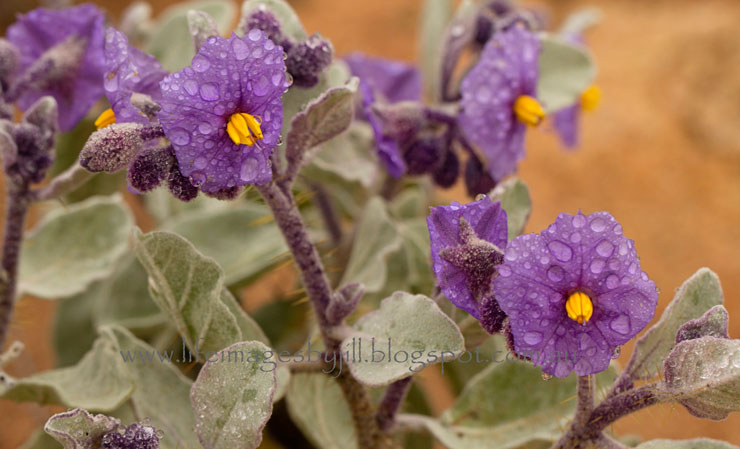
Our wildflower experience started on the first day of our trip at The Granites just north of Mount Magnet on the Great Northern Highway. Despite the rain I was out photographing this prickly character, the Flannel Bush - Solanum lasiophyllum.
  
 
From Broome we travelled north up the dirt Broome to Cape Leveque Road to go camping with friends. It was up in this region, the Dampier Peninsular, that we came across the Splendid Batchelors Buttons - Gomphrena canescens. You can see them also at the beginning of my post. I love them singularly and on mass.

 
If you saw one of my previous posts - The Boab Tree - about the Kimberley's iconic tree, the Boab - Adansonia gregorii - you would have seen this photo of the Boab flower. If not, you can click on the link to check out my post.  I had never seen a Boab flower before, but a few trees were flowering in Broome.


One of my favourites since our first trip north 30 years ago - the Mulla Mulla - Ptilotus. Widespread in arid and semi-arid areas, there are about 100 species in the genus Ptilotus, all but one occurring only in Australia. Here photographed backlit at Purnululu. Cathedral Gorge, Purnululu


You will see the bright yellow flowers of the Kapok Bush - Cochlospermum fraseri - flowering from April to September throughout the Kimberley, particular in rocky sandstone areas. The large scented flowers are up to seven centimetres in diameter, and the swollen green fruits burst open to release silky seeds. It was the first time I had ever seen the inside of the fruit, see below, which we found on the hill overlooking beautiful Marglu Billabong south of Wyndham. 


The beautiful water lillies of Marglu Billabong. There is a bird-hide here. I've borrowed the two bird pics from my husband. The one on the left is a Brolga - Grus rubicunda - which is found across tropical northern Australia as well as southwards to north and east central regions, inhabiting large open wetlands, grassy plains, coastal mudflats and irrigated croplands. There courtship dance involves an elaborate dance. You can find out more here - Birdlife Australia.

Another birding site for Wyndham - Birding WA


And yes in the second picture can you see a crocodile in the background behind the White Egret. This is a salt-water crocodile. Yes, they do eat people, so definitely one you don't want to get near, and the reason why the bird-hide is enclosed in heavy-duty wire mesh. In case you can't see that croc....


Back to wildflowers...

Below is the Sticky Kurrajong - Brachychiton viscidulus - also known as the Kimberley Rose, or by the Aboroginal names darlab or djalad. We saw many of these along the Gibb River Road and also at Mt Elizabeth Station. Flowering from April to December the spectacular red flowers appear after the leaves have dropped. There are male and female flowers on the same plant, attracting large numbers of nectar-feeding birds. They usually grow in sandy area on hills and amongst sandstone and basalt rocks.  


 I confess I had never heard of the flower below before this trip - the Bat Wing Coral Tree - Erythrina vespertilio. The pea shaped scarlet flowers are produced along 30cm racemes and appear when the tree is mainly leafless during winter and spring.  There was a huge tree near the access gate we went through on the way to Mornington Wilderness camp about 90 kilometres south of the Gibb River Road. There was a flock of Red-Collared Lorikeet - Trichoglossus rubritorquis - chattering noisily as they enjoyed the blossom.

I love the unexpected nature of wildflower photography as you never quite know what you will find and it is thrilling to find varieties you haven’t seen or photographed before, especially the rarer species.


And below is Rosella - Hibiscus sabdariffa -  a species of Hibiscus. The petals of this plant, which are very high in Vitamin C, can be made into jam. They have a delicious sour-sweet taste. This was another plant that I had never seen before, though I had tasted the jam made by a local friend - delicious! I would love to see if I can grow this at home. We saw these plants near the Barnett River just off the Gibb River Road and at Mt Elizabeth Station. More info on the Rosella plant here - Green Harvest


I hope you have enjoyed these few wildflowers of the Kimberley. So much red! But then that is the colour of the Kimberley dirt. I have many more wildflower photos to share with you soon. In the meantime you might like to visit a couple of my posts (see the links below) where I give you a few tips about photographing wildflowers. But my most important tip is - get out there with your camera! 


Taking wildflower photos doesn’t need to be complicated. Slow down, think about your camera settings, choose the best specimen, and think about composition, orientation and how you want your photo to look. Are you going to get in close or take a wider view? Do both, and take photos from various angles. Set your aperture according to how much depth of field do you want. Remember small numbers ie F4.6 equals shallow depth of field with a soft blurred background.

Photographing Wildflowers 
How to take great wildflower photos 


Thank you so much for stopping by. I value your comments and look forward to hearing from you. I will try to visit your blogs in return. Have a wonderful week. 
I am linking up to the link-ups below. Please click on the links to see fabulous contributions from around the world - virtual touring at its best!
   

Sunday, 2 October 2022

The Iconic Australian Banksias


Banksias are among Australia's most iconic plants. they were named after Sir Joseph Banks (1743-1820 ), who, in 1770, was the first European to collect specimens of these plants while on his voyage of discovery with Captain James Cook. Cook mapped the east coast of Australia which paved the way for British settlement 18 years later.

Banksias belong to the plant family Proteaceae. Characterised by their flower spikes and woody seed cones they range from ground hugging plants to 30 metre high trees. There are 78 known Banksias, 76 species in Australia, 62 of which are endemic to Western Australia, and 30 of these growing between Esperance and Walpole on our southern coast. In recent years the genus Dryandra has been incorporated into the genus Banksia, so the genus now totals 173 species.

This one you see below here is the Candlestick Banksia - Banksia attenuata, commonly known as the candlestick banksia, slender banksia or biara to the Noongar people. This tall tree grows prolifically in the area where I live south of Perth. 

Over the last couple of weeks I have spent time trying to identify some of the Banksia varieties we saw during our south coast travels in August to East and West Mt Barren, the Fitzgerald River National Park near Hopetoun, Tozers Bush camp near Bremer Bay and the Stirling Range National Park north of Albany.

Here are some of the Banksias I have been able to identify with the help of The Wildflower Society of WA's facebook page, Kevin Collins, Kathy Collins & Alex George's book Banksias, and Gillian Craig's book Native Plants of the Ravensthorpe Region.Thank you all!

I hasten to add I am not a botanist, but I have tried my best.


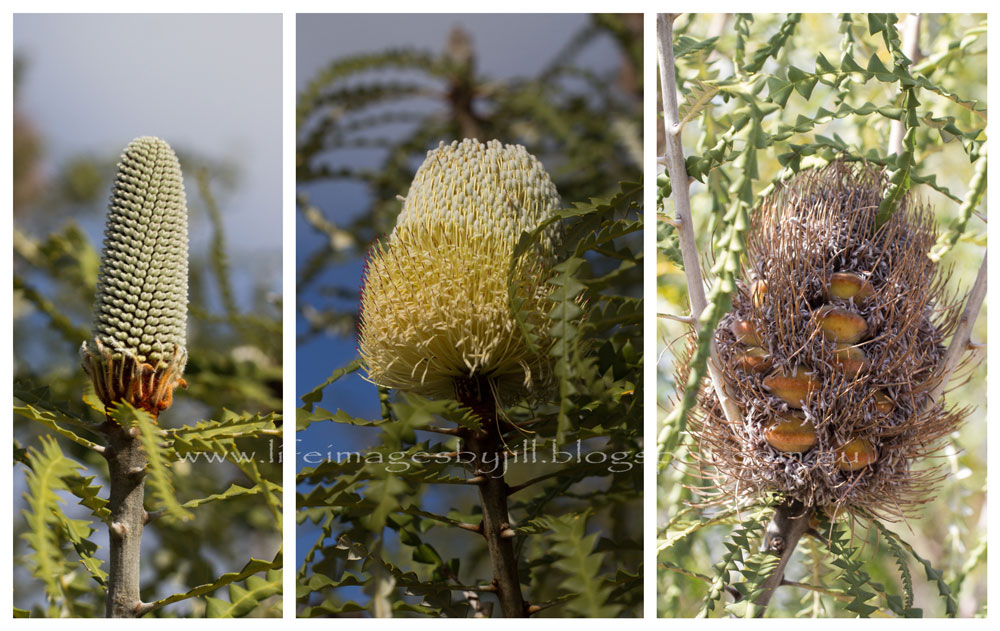
Below is the Showy Banksia - Banksia speciosa. It grows along the south coast from East Mt Barren to Israelite Bay. A shrub to 8 metres tall it flowers throughout the year, with a peak in summer and autumn. You can see in this photo the beginning of the flower, flowering, and then the seed head. These photos were taken near Esperance.


One of the most spectacular of the Banksias in Fitzgerald National Park is the Scarlet Banksia - Banksia coccinea. Also growing up to 8 metres, it grows from Albany to the Stirling Ranges, Fitzgerald National Park and east to Stokes National Park. It flowers from June to January. These photos were taken in the Stirling Ranges National Park but we also saw them widespread in the Fitzgerald National Park on the coast.


This one is the Lemann's Banksia - Banksia lemanniana. It is a shurb to 5 metres and grows near the south coast from West Mt Barren to Ravensthorpe. As you can see below, the flowers hang down. It flowers from October to January. We saw this one in the Fitzgerald National Park near East Mt Barren.


One of the largest Banksias flowers is the Woolly Banksia - Banksia baueri. A 2-3 metre high shrub it flowers from May to July, so these flowers you see here are finished. We saw this plant in Fitzgerald National Park and Tozers bush camp near Bremer Bay. It flowers from Kweda and Toolibin to Bremer Bay, east to Munglinup and also on the South Stirling plains.  

Another banksia which had finished flowering when we visited is Baxter's Banksia - Banksia baxteri. We also saw this one in Fitzgerald and Tozers. It grows to 4 metres near the south coast from the Sitrling Ranges to Oldfield River east of Hopetoun. It flowers from December to May. 

The one below shows how tough Banksias can be. This is the Suuthern Plains Banksia - Banksia media. We saw it clinging to the rocky cliff below the lookout at Cave Point in the Fitzgerald River National Park near Hopetoun. There is a huge variation in size of this plant from 10 metres to a prostrate 0.2metre shrub. It grows from the eastern end of the Stirling Ranges to Israelite Bay. 

Flowering March to August these flowers you see here have finished. 

I am told this is also the Southern Plains Banksia - Banksia media. In this variation the tips of the "perianth" are coloured. They can be grey, gold, pinkish-red, chocolate brown or even black. Below you see the side and above views. 

The flower below we saw along the access road to Mt Trio in the Stirling Ranges National Park, in an area that had been completely burnt out prior to our visit in 2019 following the devastating summer bushfires. It was so heartening to see the bushland coming back. 

I believe this is the Fox Banksia - Banksia sphaeracarpa - the botanical name relates to its spherical form. A shrub to 2 metres tall it has a wide range from the Darling Plateau east of Perth south to the Stirlling Range and Cape Riche. 

I believe this ground hugging variety, which we saw growing at the Central lookout on the Stirling Range Drive, to be Banksia gardneri var brevidentata due to the short tooths on the leaves. It flowers from April to July and is restricted to the Stirling Ranges and a single population near Albany.


Well that is it from me today. It has been a fascinating journey tryng to identify these banksias. I learnt that the leaves of the different banksia varieties are all a bit different so it is important to photograph the leaves as well as the flowers.

Here is a close up of the Banksia fruit or nut. The follicles open to release the seeds. Sometimes this does not happen until the nut is burnt or completely dried out.


I have blogged about banksias before -

In celebration of the Australian Banksia

the Candlestick Banksia

Oh and just one more, not from the south coast but I am going to include it anyway just because I liked it and we saw it in a Banksia park near Esperance - Lesueur banksia or pine banksia - Banksia tricuspis. You can see how different the leaves of this banksia are. A small tree to 4 metres it grows around Mt Lesuer near Jurien on the west coast north of Perth and flowers from March to July. 


Thank you so much for stopping by. I hope you have enjoyed seeing some of the 30 Banksia varieties that grow along our south coast region of Western Australia. 

Here is a link to some more Banksia information:
Book review - Banksias by Collins, Collins & George

I value your comments and look forward to hearing from you. I will try to visit your blogs in return. Have a wonderful week. 
I am linking up to the link-ups below. Please click on the links to see fabulous contributions from around the world - virtual touring at its best!
   
MosaicMonday at Letting Go of the Bay Leaf
Sharon's Sovenirs 
Our World Tuesday

Pictorial Tuesday 
ThroughMy Lens 
Image-in-ing
My corner of the world through my camera 
Wednesday Around the World at Communal Global hosted by Randomosity. 
       and Little bird - Pienilintu
Thankful Thursday 
Welcome to Nature Thursday


Hello there! I love reading your comments. If you scroll down to the bottom you can comment too! I would love to hear from you.