Welcome to Life Images by Jill

Welcome to Life Images by Jill.........Stepping into the light and bringing together the images and stories of our world. I am a photographer, writer and multi-media artist.
Focussing mainly on Western Australia and Australia, I am seeking to preserve images and memories of the beautiful world in which we live and the people in it.

Welcome!

Welcome!
PLEASE CLICK ON THE IMAGE TO GO TO MY RED BUBBLE STORE.
Showing posts with label jam. Show all posts

Tuesday, 5 October 2021

Lemons lemons lemons

 Hi everyone. I hope you and yours are all doing well. I thought spring had arrived but now we seem to be back into winter. 

I have loads of lemons on our backyard lemon tree, and it has started flowering again, so I picked a few yesterday to make Lemon Butter and a sweet French Marmalade. It didn't seem to make much difference to what was left on the tree. I need to start giving them away. It was a wet dreary day yesterday, perfect for a morning in the kitchen. 


I have blogged about the Lemon Butter making a couple of times before - if you click here you will find see more: Lemon butter

Here is the recipe: 

  • Juice of 4 lemons and finely grated rind of three
  • 500gm (1 lb) white sugar
  • 250gm (1/2 lb) butter
  • 4 eggs, well beaten together. Make sure they are well beaten so you don't get strands of white in your mixture. 

  • Place all in a large bowl stranding in a pan of boiling water on the stove. Stir constantly until the consistency of honey, but do not allow to boil. This takes about half an hour. 

Bottle and keep in fridge. Delicious on scones! or slathered on a sponge with cream. 


I also made French marmalade out of my old Australian Country Women's Association Cookery Book and Household Hints. This marmalade is a sweet marmalade made from carrots, lemons and sugar, and is so easy to make. 

3 large carrots - I always find this a difficult measurement - how much is 3 large carrots?
2 1/2 kg (5 lb) white sugar
4 lemons
8 cups water. 

Grate the carrots. Cut the lemons into quarters and dig out the seeds. Put through a mincer, including the peel. Mix the carrots and lemons together and leave in a basin overnight with half the water - 4 cups. 
In the morning add the rest of the water, and boil for half an hour. Then add sugar and cook for about 2 1/2 hours. Bottle immediately in hot jars. 

Note: This marmalade still seems very liquid when it starts to set, so please test as you go so as not to overcook. I just spoon a small amount onto a saucer and put in the fridge for a few minutes. If it doesn't move around on the saucer when cold it is ready. 

My friend in Malta made this recipe with half lemons and half oranges. She said it was delicious too. 


This is an old favourite photo of mine I created for a special friend on the other side of the world one morning a few years ago. I couldn't resist sharing again. Sharing a cup of coffee or tea with a friend doesn't need to be complicated. 


While the French marmalade was bubbling away I also made a batch of muffins from a packet I bought when we were out in the wheatbelt recently. These are gluten free made from lupin flour. They were nice, but a bit heavier and grainer texture than the muffins we usually make with normal self-raising flour. 


My quince tree has an amazing number of flowers on it this year for such a small tree. I love quinces. Do you? So delicious. I am already looking forward to quince season - but I will have to wait till around March-April! We always net the tree to keep the birds off. 


Thank you so much for stopping by. Do you make jam? Do you have a favourite? Perhaps you would like to tell us about it in your comments. 

I value your comments and look forward to hearing from you. I will try to visit your blogs in return. Stay safe and have a wonderful week. 
I am linking up to the link-ups below. Please click on the links to see fabulous contributions from around the world - virtual touring at its best!


Hello there! I love reading your comments. If you scroll down to the bottom you can comment too! I would love to hear from you.

Tuesday, 28 February 2017

Making Scones with Yoda


A slightly different post for you this week....

For my writing homework for yesterday's meeting of my writing group, the South Side Quills, we had to write instructions for something in the voice of a well known person, writer, poet, personality.  An example we were given was writing in the voice of Shakespeare, but failing in my ability to write something of that caliber I chose Yoda, Jedi Master from Star Wars.  There was much laughter in the group as I read it. I thought I'd share it here for your amusement. Those that "know" Yoda will know that he says many things backwards. The words in "apostrophes" are his actual quotes from Star Wars. 

Enjoy you will I hope.


 Please click here to learn how to make scones with Yoda....

Sunday, 10 April 2016

How to make Lilly Pilly Jam - a delicious Australian bush tucker delight

When we moved to our current home about 20 years or so ago we found a Lilly Pilly bush in our front yard.  This is a plant native to the eastern states of Australia, but which grows well in the west too. It has very fleshy leaves and a very attractive small flower, which you can see below, but which withers almost immediately if picked.  The bees love them.


Following flowering a small red fruit forms, about the length of your thumbnail. We have tasted them from time to time over the years. They have a crisp flesh, not unpleasant taste, though slightly acid, and probably an acquired taste.  They have a small stone in the middle. You can see my bush and the fruit below here. 


The origin of the name Lilly Pilly is unknown. The first recorded sighting of a lilly pilly in Australia was Syzygium paniculatum. On May 3 1770 at Botany Bay botanist Joseph Banks stated in his journal: They "found also several trees which bore fruit of the Jambosa kind, much in colour and shape resembling cherries; of these they eat plentifully and brought home also abundance, which we eat with much pleasure tho they had little to recommend them but light acid."
From:  Australian Plants OnLine 

There are several varieties of Lilly Pilly, belonging to the  Myrtaceae family. 
The Lilly Pilly was a bush tucker for the Aboriginal inhabitants, and was prized by early European settlers for making jams and jellies.  It seems to have been used soon after the establishment of Sydney town in New South Wales. 

Jam making is a tradition in my family and I have been intending to make Lilly Pilly Jam ever since I discovered the plant in our front garden, and yesterday I did. My husband wanted to prune the bush as it had got quite big and was starting to develop a scale infestation as it had the previous year. So I picked about a kilo and a half of fruit and made the jam on Saturday morning. 


 The recipe I used came originally from the National Trust of Australia, New South Wales, and is in my Australia's Home Made Jams and Preserves Book compiled by sugar company CSR. I have used many recipes in this little book. 

The recipe was actually for jelly, but I adapted it to make jam. 

Lilly Pilly Jam 

Remove stalks and stones from the fruit and wash well. Place in the pan with a little water. I used 2 cups of water to 1.245kgs of fruit. Cook until fruit is tender (about an hour). I also added one lemon cut in half to the pan as the lemon will help with setting. 
When the fruit is tender add the same weight of sugar as the weight of fruit. 
Boil till jam sets when tested. This took about another hour, but will really depend on the quantity you are cooking. 
Remove the lemon halves, bottle the jam in sterile jars and seal immediately. 


The jam is a beautiful deep pink-red colour and I think tastes a little like a mix between plum and strawberry jam. Delicious! I made scones this morning so my family could taste the jam. They all enjoyed it, so I think I will from now on be making Lilly Pilly jam every year. 


Another reference to the Lilly Pilly can be found in May Gibb's children's book, The Complete Adventures of Snugglepot and Cuddlepie, an Australian classic about the gum nut babies first published in 1918. I told you about the bad Banksia Men from the book a couple of weeks ago. Please click here if you missed it -  Celebration of the Australian Banksia

Here is an illustration from the book of the characters Lilly Pilly and Ragged Blossom. In the book Lilly Pilly is an actress.  You can see here below on the left with the lilly pilly fruit forming the skirt of her dress. 
For more about May Gibbs click here - May Gibbs


I hope you have enjoyed my blog post about the Lilly Pilly. If you are in Australia and you have it growing in your garden, I hope you will make some Lilly Pilly Jam. 
Is there a native fruit that you make into jam? Perhaps you would like to share with us in the comments.

Here are a couple of references on the web:
Burke's Back Yard
Australian Native Plants Society
Evergreen Growers - scale pest on Lilly Pilly
Taste Australia - Bush Food


Thank you so much for stopping by. I value your comments and look forward to hearing from you. I will try to visit your blogs in return. Have a wonderful week.

I am linking up to the link-ups below. Please click on the links to see fabulous contributions from around the world - virtual touring at its best!

Mosaic Monday
Travel Photo Mondays

 Lifestyle Fifty Monday Linkup 
 Life Thru the Lens

Our World Tuesday
Through My Lens 
Image-in-ing
Wednesday Around the World at Communal Global
Worth Casing Wednesday
What's It Wednesday
Travel Photo Thursday

The Weekly Postcard

 You might also like - 
Quandongs, delicious Australian bush food
And slices of quince which they ate with a runcible spoon
Tamarillos, lost food of the Incas 


Monday, 11 November 2013

Quandongs - delicious Australian bush food

Have you ever tasted Quandongs - or Quandong jam? Do you know what Quandongs are? Have you ever seen them in the bush?

Today I have taken a little side step from my blogging about our recent trip through South Australia - but really this post is a little more detail about a bush food you can see and taste in South Australia - the Quandong 


My curiosity with the Quandong started many years ago..... but even before this newspaper article in the West Australian newspaper in 1995 I knew about Quandongs. My mother said when she was a child they used to use quandong nuts on their Chinese Checkers game. 


 I wrote this creative piece for my writing group exercise -


The shiny red baubles hang in clusters glistening in the shafts of early morning light. It is a surprise to see them amongst the dull grey green. Their beauty entices me to crouch underneath their bright canopy. I reach up and gently tug at the nearest bauble. It resists and then yields. The ball is round and hard. I can see where it has been marked by creatures unseen. 
I squat on the carpet of green, red, yellow and brown balls that have fallen from the tree. Some are split and broken revealing a glimpse of the treasure within. I pick up one and pull aside the thin shell to reveal a perfectly round hard ball patterned with wavy lines. 
Curious I bite into the red ball that I have plucked from above. The tart bitter sweetness is a shock, but is irresistible. I nibble away the thin red and yellow layer and then secret the round knobbly nut in my pocket.  
As I reach up to pluck another bauble I sense someone is watching me. Looking across the clearing I see the soft brown eyes of a kangaroo gazing at me. In its hands is a bright red shiny bauble. 
- Jill Harrison, May 2013- 

  
I had seen plants during our travels through the Western Australia wheatbelt - but it was only a couple of years ago that I saw them fruiting and had the opportunity to taste them. They have a sharp bitter taste when eaten raw. 


Santalum Acuminatum or the Quandong 
CommonName: Quandong; Sweet Quandong, Wild Peach, Desert Peach, Native Peach, Guwandhuna, Gutchu, Wanjanu, Mangata, Goorti, Wadjal (Aboriginal names)
BotanicalName: Santalum acuminatum

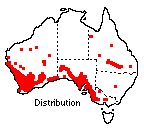
distribution map The Quandong is a truly unique native Australian fruit. Traditionally the Quandong was an important food and medicinal source for Australian Aborigines and was also used by early pioneers and settlers as a fruit, or in jams and chutneys. Found in the arid and semi-arid regions of all Australian mainland states, Quandong trees are ideally adapted to arid environments. The Santalum Acuminatum species is known to be a semi-parasitic plant. Quandong trees can tolerate high soil salinity levels and often rely for their complete water requirements from the root systems of host plants. Across their native distribution range, Quandong trees typically grow 2 to 3 metres in height, with a dense leathery crown of leaves perhaps 2 metres wide. 

 You can read more about Quandongs at "Nullarbor Net" by clicking here - Quandongs - Nullarbornet

We have seen Quandong trees many times during our travels through the West Australian wheatbelt and along the Hyden to Norseman Road in Western Australia. More recently we saw them during our travels through South Australia.  They have a dull green dry looking leaf, but in season the bright red fruits attract your attention.
We saw this beautiful specimen you see here in the Coffin Bay area of the Eyre Peninsular in South Australia.

Quandongs are very similar to - Australian Sandalwood (Santalum spicatum) - and in fact belong to the same family.  Below you can see the Sandalwood on the left and the Quandong on the right.  The nut of the Sandalwood is smooth (sorry you can't see it in this picture) whilst the nut of the Quandong is nobbly. 


Harvesting wild Quandong fruit is prohibited, but when we visited the Australian Arid Lands Botanic Garden  in Port Augusta in South Australia in October, I purchased some Quandong fruit leather, preserves and dried Quandong, from plantation grown fruit by Bush Food Australia - click here - Bush Food Australia . We also tried the Quandong icecream and the Quandong cake in the Arid Lands cafe. The fruit has a tart-bitter sweet taste - delicious!


After our return home I made some Quandong jam - seen here below served with wattleseed pancakes and cream with wattleseed sprinkled over (watteseed is another bush food I bought from the Australian Arid Lands Botanic Garden)
Oh my goodness I am in raptures over quandong jam! 
I cooked down the fruit with a couple of green apples and the juice of 2 lemons. 
 

 You can buy dried Quandong from "Native Tastes of Australia" - click here to see more - Native Tastes of Australia
 On their site you will see some Quandong recipes including jam.  


 Here is an interesting post about edible native foods - click here - why-havent-we-embraced-indigenous-foods

 Thanks for stopping by. I hope you enjoyed learning something about the Quandong. Next week we will return to our South Australian travels.
If you missed any of my previous posts about our South Australia trip you can catch up by clicking on the links below -


 I am linking up to linkup sharing blogs below. Please click on the links to see fabulous contributions from around the world - virtual touring at its best!  Have a wonderful week.

Mosaic Monday
Travel Photo Mondays
Our World Tuesday
Tuesday Around the World  
Foodie Tuesday
What's It Wednesday
Travel Photo Thursday
 Oh The Places I've Been


Sunday, 17 February 2013

Grapes are not just for wine

We are blessed to live in a Mediterranean climate in the stunningly beautiful South West corner of Western Australia, and not far from three prime vineyard, grape growing, and premium wine making areas - Geographe, Margaret River and Pemberton. 


According to my preserves book, Australia's Home Made Jams & Preserves, compiled by CSR -  The history of grape growing in Australia goes back to 1791 when Governor Phillip (Australia's first Governor who lead the First Fleet to Australia in 1788) provided grape cuttings and granted 140 acres of land on the north bank of the Parramatta River at the farming settlement of Rose Hill (as Parramatta was then called) in New South Wales to Phillip Schaffer who started what must have been one of the first vineyards in Australia.  Ten years later, two Frenchmen also began producing wine at Parramatta and the Australian wine industry began. 


For as along as I can remember my family have always had a grape vine in their backyard. When my mother and father moved to live in a retirement village nearer to us, I brought a piece of their vine with me. My son also took cuttings to grow in his garden. You can see our grape vine in this picture. We put net over it to keep out the birds, however they still seem to find a way in!


A few months after Mum and Dad were married Dad became Depot Supervisor with the Vacuum Oil Co at Goomalling (a country wheatbelt town in Western Australia). They moved there on 15th February, 1952. In the backyard of their rented house there was a grape vine with grapes hanging on it. Dad went to the store and bought a preserving pan and they made their first grape jam. Ever since, up until they moved to our town, they have had a grape vine in their back yard and made grape jam every year in that same preserving pan.  
 Dad still makes grape jam. In fact he made some this weekend from grapes which came from the vine in my yard.
Here are some stages of the grapes. 


My son and I carry on our family's grape jam making tradition. I fact, surprisingly, considering we live in a grape growing region, I have never seen grape jam anywhere else! Perhaps it is the huge job of taking out the seeds that is the problem! But I think the result is worth it.

The basic recipe is half the amount of sugar to weight of grapes. We always pluck the grapes off the bunches the night before, weigh them and put them in the pan ready to cook the next morning. Squish up the grapes with your hands to let the juice out. (I have great memories of helping to do this as a child out on our back patio. I loved the squishy feeling of the grapes between my fingers)
You don't need any water as there is plenty of juice. I usually throw in a couple of halved lemons and take them out later, as the pectin in the lemon peel helps the jam set. Cook the grapes for about an hour before adding the sugar. The seeds will rise to the top during cooking, and you will need to scoop them out. A seedless grape would probably make great jam as the seed removing is a huge job!


The scones you see in the bottom photo where made with unprocessed ground wheat flour straight from my brother-in-law and nephews farm at Bruce Rock.  The jam jar with the brown lid is a special jar with unusual cut sides. My mother gave me this jar and I always use it for grape jam. 

When I was a child and Mum was making pastry for a pie if there was any left she would roll it out in a rough shape, bake it and then spread jam on it. I still do this - I guess it is one of those childhood memories I hold on to. I am sure we all have memories we cherish from our childhood.

 
The last few weeks I have been doing a Lightroom e-course with Kim Klassen. Below you can see some different versions of the scones. I rather like the bottom right hand one - sort of an antique rustic country look.


 When the autumn comes I still enjoy photographing my grape vine.


To close, a little quote from Ruth Tearle.


 Do you make jam? Have you ever tasted grape jam?
Thanks for stopping by. I look forward to hearing from you.Have a wonderful week. 

I am linking up with  Mosaic Monday at Little Red House. And also Our World Tuesday  
Please click on the links to see the offerings of contributors from around the world.

To learn more about some of Western Australia's wine growing regions you can visit the websites of the Geograph, Margaret River, and Pemberton wine regions.

You can also learn more about the Geographe wine region at Jo Castro's fabulous Western Australian travel and lifestyle blog - Zig-a-Zag -  click on the link here - Wineries in the Geographe Wine Region 

 You might also like - 
Spring Jam making  
Cumquats from tree to marmalade