Welcome to Life Images by Jill

Welcome to Life Images by Jill.........Stepping into the light and bringing together the images and stories of our world. I am a photographer, writer and multi-media artist.
Focussing mainly on Western Australia and Australia, I am seeking to preserve images and memories of the beautiful world in which we live and the people in it.

Welcome!

Welcome!
PLEASE CLICK ON THE IMAGE TO GO TO MY RED BUBBLE STORE.
Showing posts with label reading. Show all posts

Sunday, 7 February 2021

The Dictionary of Lost Words and the Oxford English Dictionary

I have just finished reading The Dictionary of Lost Words by Pip Williams. Have you read it? 

This is a fascinating history about the production of the first Oxford Dictionary by Dr Murray and his lexicographers in a corrugated iron shed, the Scriptorium, in Dr Murray's garden in Oxford. Published in separate parts, fascicles, A-Ant was published in 1884, with the last section V-Z published in 1928. The dictionary eventually contained around 400,000 words, definitions and phrases demonstrating their usage. 

Into her book, Pip has skilfully woven real and fictional characters with a background of historical fact like the Women's Suffrage Movement in England and the onset of World War 1. 

I was interested to learn that women in South Australia were granted the right to vote in 1884 and could be elected to Parliament, although it wasn't until 1902 when white women were given the right to vote in Australian Federal elections.

Postscript.... I have just been alerted to the fact that... on 9th September 1893 New Zealand became the first self governing country in the world to give women the right to vote.  

Whereas women were not granted voting rights in the UK until 1928. White women in the USA were given the right to vote in 1920. In all cases, for people of colour and ethic background, the right to vote was granted much later than this. 


The book's blurb says -  In 1901 the word bondmaid was discovered missing from the Oxford English Dictionary. 
This is the story of the girl who stole it. 

Who was this girl? She is Esme and her father, who she refers to as Da, is one of the lexicographers. Esme's mother has died, and Dr Murray's housemaid and Esme's minder Lizzie, and her aunt, "Ditte" (Edith Thompson) are major characters in Esme's life.  

As a young child Esme sat under the sorting table at the Scriptorium to keep out of the way while her father worked. Esme steals a discarded word that has fallen to the floor. The word is Bondmaid. She hides the word in a trunk underneath Lizzie's bed. Many more words are added to the trunk over the years and Esme eventually becomes a lexicographer - a person who compiles dictionaries.

Edith Thompson actually wrote the History of England for schools in 1881. Edith and her sister Elizabeth Thompson provided 15,000 quotations for A & B, and continued to provided quotations and editorial assistance until the last word was published.
Pip says that The Dictionary of Lost Words was her attempt to understand how the way we define language might define us.  Pip asks Do words mean different things to men and women? 

The first dictionary was defined by men, ....older, white, Victorian-era men....with women cast in minor or supporting roles. In addition to Edith & Elizabeth Thompson, there was also Hilda, Elsie and Rosfrith Murray who worked in the Scriptorium to support their father. Eleanor Bradley worked at the Old Ashmolean as part of her father's team of assistants. Countless women sent in quotations for words. The women who wrote novels, biographies and poetry that were considered as evidence for the use of particular words. 

The Scriptorium stored the words - written on a slip of paper the size of a postcard. Volunteers mailed them from all over the world. They were kept in bundles in hundreds of pigeon holes that lined the shed walls, with examples of their usage attached as proof. 

The word Bondmaid was discovered missing from the dictionary in 1901 following a letter from the member of the public. 

Bondmaid is not the kind of word people drop during conversation anymore, and that’s for the best: It means “a slave girl.” The word was most popular in the 16th century. Murray’s file for bondmaid, however, reached back even further: It included quotations as old as William Tyndale’s 1526 translation of the Bible....

However all was not lost for the lost word.....In 1933, bondmaid made its Oxford dictionary debut. It had taken nearly five decades to make the correction.  The Time the Oxford Dictionary Forgot a Word

Today the dictionary archives, original slips and proofs are held at the Oxford University Press in Oxford. 

Below you can see Dr Murray in the Scriptorium, and in the group photo, Dr Murray with some of the staff, including his two daughters Elsie and Rosfrith.  


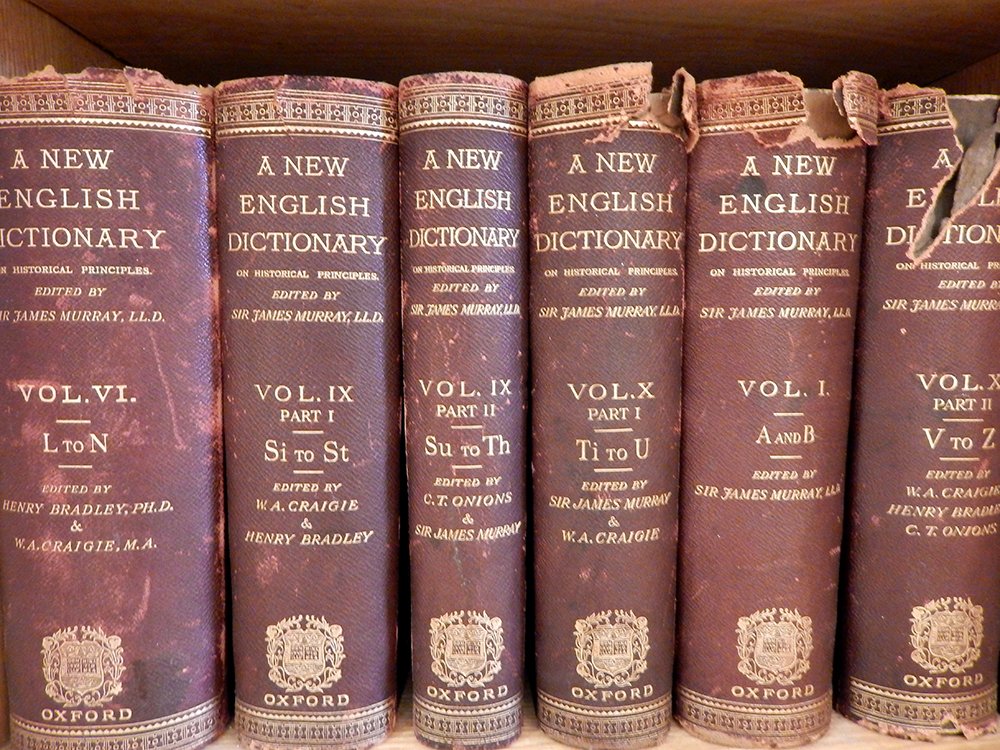
When I was in high school, many years ago, I had a "Little Oxford Dictionary". Last week I went to our two local libraries to find an Oxford Dictionary, but could only find these two. 


At over $1000 Australian Dollars obviously a local library is not going to house all these volumes! I wonder if our State Library might. The Dictionary of Lost Words has really sparked my interest in the Oxford Dictionary and the origin of words. 


The second edition of the dictionary was not printed till 1989. You can now access it on line, but you do need to subscribe. More words being added every year. You can see the new words list here - New words list January 2020

In 2020 the Oxford's Word of the Year encompassed several "Words of an Unprecedented Year". Unfortunately you have to subscribe to find out what they are. I think you might be able to guess what they might be. 

Mental Floss has a list of 13 Facts about the Oxford English Dictionary. It makes amusing reading. 
The most complicated word in the Oxford English Dictionary? Set. In the dictionary’s 1989 edition, the three-letter word contains 430 senses (that is, shades of meaning) and requires a 60,000-word definition. Other short words with endless definitions? Run (396 senses), go (368 senses), and take (343 senses).
 
Have you been to Oxford? We visited briefly on a bus tour in 2005. I now wish I had gone to Oxford University Press archives. But we did visit The Eagle and Child pub, made famous as a meeting place for fantasy authors CS Lewis and JRR Tolkien. You can see it below here. 


Thank you to the sites from where I have borrowed photos and information. 
For more information and your own research: 

Lynda Mugglestone - Lost for Words

Peter Gilliver - The Making of the Oxford English Dictionary

Oxford English Dictionery on line 

History of the Oxford English Dictionery

Oxford English Dictionary blog

wikiwand.com/en/Oxford_English_Dictionary

Book review - Publishing Arts Hub

Mental Floss.com - The Time the Oxford Dictionary Forgot a Word

and 13 Facts about the Oxford English Dictionary

Wikipedia.org - Oxford_English_Dictionary

I hope you have enjoyed my look at the Oxford English Dictionary. The more I research the more interesting it becomes. 

I love curling up with a good book. Don't you? What have you been reading lately? Perhaps you would like to tell us in your comments. 


Below is a pic of my old school dictionary. I just noticed it was published in 1941! No I am not that old! It actually belonged to my sister originally and then passed to me. It still has her name in it. Perhaps I should give it back to her. 

Thank you so much for stopping by. I hope you and yours are doing well. 
My old school dictionary
I value your comments and look forward to hearing from you. I will try to visit your blogs in return. Have a wonderful week. 

I am linking up to the link-ups below. Please click on the links to see fabulous contributions from around the world - virtual touring at its best!


Hello there! I love reading your comments. If you scroll down to the bottom you can comment too! I would love to hear from you.

Monday, 20 August 2018

There's discoveries to be found in a book

I don't know if you are a reader, but I've been a reader as long as I can remember. I always have a book to read when I go to bed at night. Sometimes I am lucky to have time to read during the day...but sadly not often. 

I have found memories of borrowing books from the travelling library van that came to our house during the school holidays, and laying engrossed on the cool lino of the passage in the heat of summer reading the latest Milly-Molly-Mandy book, or Enid Blyton's Secret Seven or the Famous FIve series. And oh! the delicious smell of a new reading book!

I love to see my grandies reading when they come to my house. It is so much better to hold a real book in your hands rather than an e-reader don't you think?


The last couple of weeks I have been relieving in our local primary school library while the library officer is on leave, and I am very happy to be there for book week and to see the fabulous array of short listed and awarded books for the Childrens Book Council of Australia 2018 children's book awards.

There are so many wonderful books being created for children with amazing illustrations. In in this world of digital technology I think there is so important to introduce children early to the wonderful world of books. Visuals attract us, so a great cover and illustrations are very important.


2018 is the 72nd year of the Children’s Book Council of Australia book of the year awards and the theme for this year is "Find Your Treasure".
From the 444 entries and 36 shortlisted titles, the judges selected one winner and two honoured books for the five categories and one winner for the Crichton Award for New Illustrators.

“Professor Margot Hillel OAM, Chair of the CBCA National Board said, “This is our 72nd Book of the Year Awards and the high number of engaging, imaginative and inspiring stories that continue to be published for young Australians each year is very encouraging, particularly in an age where digital technologies compete for their time and attention.”

 I haven't personally had time to read the winning books as yet, but I intend to do so over the next week at school. 


The Book of the Year for younger readers is “How to Bee” by Bren MacDibble.
 Peony lives with her sister and grandfather on a fruit farm outside the city. In a world where real bees are extinct, the quickest, bravest kids climb the fruit trees and pollinate the flowers by hand. A story about family, loyalty, kindness and bravery, set against an all-too-possible future where climate change has forever changed the way we live.

Honoured in this section were “Henrietta and the Perfect Night” by Martine Murray and “Marsh and Me” by Martine Murray. 

The Early Childhood book of the year is “Rodney Loses It” by Michael Gerard Bauer and illustrated by Chrissie Krebs.

Rodney was a rabbit who loved nothing more than drawing. He never found it tiresome, tedious or boring. But then one day, disaster struck, the one thing Rodney feared, while working at his drawing desk his pen just… DISAPPEARED!  A truly hysterical search for a missing pen.

Honoured in the Early Childhood section was “The Very Noisy Baby” written and illustrated by Alison Lester and “Hark, It’s Me, Ruby Lee” by Lisa Shanahan and Illustrated by Binny.
Picture Book of the Year is “A Walk in the Bush” written and illustrated by Gwyn Perkins -

“A story about the wonders of nature, the funny side of life and spending time with the ones we love.”
Honoured books in the Picture Book section were “The Great Rabbit Chase” written and illustrated by Freya Blackwood and “Mopoke” written and illustrated by Phillip Bunting. 

The Eve Pownall Award for factual information was awarded to “Do Not Lick This Book” by Idan Ben-Barak and illustrated by Julian Frost.  Honestly what child could resist picking up a book with a name like that! 
A brilliantly simple, funny, interactive picture book that introduces children to the strange, unseen world of microbes all around them through the character of Min the microbe.

Honoured in this section were “Left and Right” by Lorna Hendry and Koala by Claire Saxby and illustrated by Julie Vivas.

The Crichton Award for New Illustrators went to “Tintinnabula” written by Margo Lanagan and illustrated by Rovina Cai. Rovina's illustrations are truly amazing. 

"In wild times and in wartime, in times of fear and illness, I go to Tintinnabula, where soft rains fall."  

Tintinnabula is a picture book that explores light and shade. Through a poetic narrative, the story looks at the different things that can confront us, while conveying the message that in times of trouble it is often within ourselves that we find comfort.


The Book of the Year for older readers was "Take Three Girls" by Cath Crowley, Simmone Howell and Fiona Wood. This lively novel captures the good and the bad of female friendship"
Honours in this section were awarded to to Mallee Boys by Charlie Archbold and In the Dark Spaces by Cally Black. 

For more information please go to the Childrens Book Council of Australia - www.cbca.org.au/
I hope you have enjoyed this short look at the 2018 Children's Books of the Year Awards in Australia. What was your favourite book as a child, what is your favourite book now? Perhaps you would like to tell us about it in your comments. 

It is hard for me to pin them down exactly to one book, but as a child some of mine were the "Milly-Molly-Mandy" books and just about anything written by Enid Blyton,  and currently Kate Morton's "The Forgotten Garden", but I also adored recently, "The Guernsey Literary and Potato Pie Society" by Mary Ann Shaffer and Annie Barrows. Have you read them? I recommend them to you if you haven't.

 Thank you so much for stopping by. I value your comments and look forward to hearing from you. I will try to visit your blogs in return. Have a wonderful week. 

I am linking up to the link-ups below. Please click on the links to see fabulous contributions from around the world - virtual touring at its best!
Life in Reflection

Hello there! I love reading your comments. If you scroll down to the bottom you can comment too! I would love to hear from you.


Monday, 30 April 2018

April Randoms

Can you believe it is the end of April already? I'm not sure where it has disappeared to. In the southern hemisphere we are enjoying the cooler days of autumn, while in the north you are, I hope, reveling in the spring sunshine. I've compiled a few of my April randoms, with a few links to previous posts if you care to look over there.

April is: 

Quinces - stewing delicious quinces "which they ate with a runcible spoon". Autumn is the time when the quinces ripen and are available in our local farmer's market. Have you tasted them? You can't eat them raw, but cooked they are delicious! We have just planted a quince tree, and I am so looking forward to picking my own quinces in the future! The quince is an old orchard variety that is making a comeback. 
I've blogged about them before here - The quince, the symbol of love in ancient Greece and Rome and And slices of quince which they ate with a runcible spoon


Monday, 18 January 2016

2016 Reading challenge

I recently came across this 2016 reading challenge through Facebook. It came along various paths from its original creator Anne - Modern Mrs Darcy - over on her blog at Modernmrsdarcy.

It is an interesting list so I've decided to give it a go and have already earmarked a few books for my challenge.

I've already ticked off my first book recommended by my sister -  In Love and War by Liz Byrski published in Western Australia by  Fremantle Press in 2015.  Please click on the links to read more. 

in love and war  


Liz's personal memories and experiences as a young child in the final years of World War 2 in the English country town of East Grinstead, and her trip in 2007 to find the England of her youth, are interwoven with the stories and memories of "The Guineas Pigs"  and their nurses. Cronically burned airmen were brought to the East Grinstead hospital where Archibald McIndoe rebuilt their faces, hands and bodies while the nurses and townspeople helped rebuild their self-esteem and lives. In the process of walking familiar paths, interviewing airmen and nurses and writing the book Liz made peace with her memories and banished some of her own personal ghosts.