Welcome to Life Images by Jill

Welcome to Life Images by Jill.........Stepping into the light and bringing together the images and stories of our world. I am a photographer, writer and multi-media artist.
Focussing mainly on Western Australia and Australia, I am seeking to preserve images and memories of the beautiful world in which we live and the people in it.

Welcome!

Welcome!
PLEASE CLICK ON THE IMAGE TO GO TO MY RED BUBBLE STORE.
Showing posts with label candlestick banksia. Show all posts

Tuesday, 9 November 2021

The Candlestick Banksia - it must be November


Hi everyone. I hope you and yours are doing well. 
It must be November because here in Western Australia the Candlestick Banksias are coming into flower. They remind me of giant Christmas candles. Can you see why? 


Banksia attenuata, commonly known as the candlestick banksia, slender banksia or biara to the Noongar people, is a species of plant in the family Proteaceae. Commonly a tree, it reaches 10 m high, but it is often a shrub in drier areas 0.4 to 2 m high.  The candlestick banksia is found across much of the southwest of Western Australia, from north of Kalbarri National Park in the mid west down to Cape Leeuwin on the south west corner and across to Fitzgerald River National Park on the south coast.  wikipedia

These ones you see below here are growing in a small bush block near my house. They always tell me that summer and Christmas is on its way. 


Here is a closer look at some of the stages of the flower.  The brilliant yellow inflorescences (flower spikes) occur from spring into summer and are up 5 cm (2.0 in) wide and up to 25–30 cm (9.8–11.8 in) tall.

The last image is the nut stage. The 'eyes' burst open to release the seeds. 


The first 2 images here are new leaves unfurling. The rest show the stages of the flower. 

The candlestick banksia is pollinated by and provides food for a wide array of animals in summer months. Several species of honeyeater visit the flower spikes, as does the honey possum, which has an important role as a pollinator. 


That's it from me today. I hope you have enjoyed this little look at the Candlestick Banksia. I have blogged about Banksias before - please click here to explore other varieties I have photographed -   Celebration of the Western Australian Banksia

There are over 75 species of Banksia, all but one occurring naturally within Australia. The greatest concentration of species is found in Western Australia.

You can find some notes here at the Western Australian Department of Parks and Wildlife - Dpaw.wa- Banksia notes

Thank you so much for stopping by. Do you have a favourite flower this time of year? Perhaps you would like to tell us about it in your comments. I value your comments and look forward to hearing from you. I will try to visit your blogs in return. Stay safe and have a wonderful week. 


Hello there! I love reading your comments. If you scroll down to the bottom you can comment too! I would love to hear from you.

Tuesday, 15 December 2020

Summer colour in the south west Western Australian bush - Manea Park

 I have always said that there is always something flowering in the Western Australian bush. And it is true even in summer.

Those of you who follow my blog will know that I am a wildflower hunter, and I feel incredibly lucky to live in Western Australia. 

There are more than 12,000 species of wildflowers in Western Australia, making it the world’s largest collection.....60% of Western Australian wildflowers are found nowhere else on Earth. 

This is Jarrah - Eucalyptus marginata - flowering spring and summer 


We have been making regular visits to Manea Park near where we live over the winter and spring months. I've shared pics of orchids with you from time to time during my Covid Photo a day project. 

There has been an orchid we have been waiting to see come into flower over the last couple of months. And last week we were rewarded. 

When we first saw these leaves in the middle of the year they looked so much like eucalypt leaves we didn't know they were orchids, but the wonderful people at the Wildflower Society of Western Australia on Facebook helped me with identification. 

These are Slipper orchids or Western tongue orchid - Cryptostylis ovata - a summer flowering orchid endemic to Western Australia's south west. They grow in colonies and four to fifteen flowers form on each stem, though not all plants will flower each year. 


But I have gotten slightly ahead of myself. We had hardly started along the path into
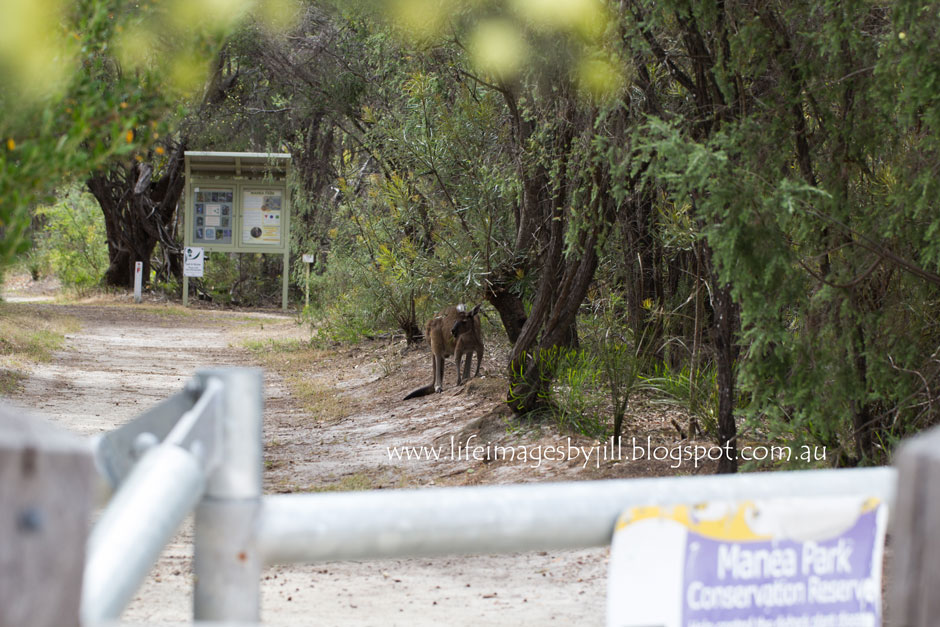
Manea Park when we spied a young kangaroo sitting on the edge of the path. He was unconcerned about us. I think he was last year's joey as sitting just off the path was his mother with this year's joey sticking his head and legs out of her pouch. So cute! These reserves of bush in our cities are so important for the preservation of wildlife and flora. They are good for our well-being too! 


There was not a lot flowering, as it is summer here, but there are still flowers to be seen. I know why I don't frequent this bush block in summer - it was hot! - and probably why there were flowers I hadn't seen before. 

Below here you can see clockwise from top left - Spider smokebush - Conospermum teretifolium, Snotty gobble - Persoonia saccata, Jarrah - Eucalyptus marginata, and one of the pea family 


And here is one of the Fringe Lilys - Thysanotus multiflorus


We had never seen this one before. Yellow starflower - Calytrix angulata. Rather gorgeous don't you think. 


And the Spearwood - Kunzea glabrescens. Evidently it's long straight branches were useful to the indigenous people for making spears. 


And this is the Candlestick Banksia  - Banksia attenuata, also known as slender banksia or biara to the Noongar people. It reminds me so much of giant Christmas candles this time of year. This tree commonly reaches 10 metres tall and the flowers 25cms long. 


You can see it at the different stages of flowering here. I love how the new leaves unfurl - as in the first two photos. The bottom right photo is the hard banksia nut. 
There are many forms of banksia - I have blogged about some of them here - 


The bees love them


Thank you so much for stopping by. I hope you and yours are well and that you have enjoyed my post today. Take care and stay safe. 
I value your comments and look forward to hearing from you. I will try to visit your blogs in return. Have a wonderful week.  

I am linking up to the link-ups below. Please click on the links to see fabulous contributions from around the world - virtual touring at its best!

Hello there! I love reading your comments. If you scroll down to the bottom you can comment too! I would love to hear from you.

Monday, 4 December 2017

December randomness

It's December and the summer heat has struck and it's beginning to look a little bit like Christmas is just around the corner.  How is your December going?  Today I am going to share a little December randomness from our corner of the world.

Below is the Candlestick Banksia (or slender banksia) - Banksia attenuata - which flowers from October to February in the south west of Western Australia. I always think the bright yellow candlestick shape flowers which grow up to 20-3-cm tall and 5cm across, are very appropriate for this time of year around Christmas. 
I blogged more about banksias here - Celebration of the Australian Banksias