Welcome to Life Images by Jill

Welcome to Life Images by Jill.........Stepping into the light and bringing together the images and stories of our world. I am a photographer, writer and multi-media artist.
Focussing mainly on Western Australia and Australia, I am seeking to preserve images and memories of the beautiful world in which we live and the people in it.

Welcome!

Welcome!
PLEASE CLICK ON THE IMAGE TO GO TO MY RED BUBBLE STORE.
Showing posts with label fruit. Show all posts

Sunday, 9 July 2017

The Quince - symbol of love in ancient Greece and Rome

I have had a love affair with quinces since I was introduced to them a few years ago, so I wasn't surprised to read that in Ancient Greece and Rome, the quince was a symbol of love and fertility.

According to -  ABC's Gardening Australia - Quinces originated from Persia, now Iran, and then spread throughout the Mediterranean. (click on the ABC link to read their informative facts sheet and learn more about the quince)

They are a hard fruit which you cannot eat raw, but oh my, the gorgeous aroma of them cooking and their flavour nearly leaves me swooning. Have you tasted them? If you haven't I encourage you to do so.


Quinces seem to be an old-fashioned fruit that you might only see in an old orchard. The quince grows on a small deciduous tree, a member of the apple and pear family. Here you can see a tree and the fruit on the tree.


This tree below is in the Balingup Tree Park was planted in 1982. See how it has had to be propped up? But despite this it seems to be doing well. (please click on the link to read my latest blog about the Park).


I always look for quinces this time of year and I was able to buy some a couple of weekends ago at the Boyanup markets.  I cooked them today in preparation for making a tart tomorrow.  You can just poach them in a saucepan with a little sugar and water, but below here is the simple, yet delicious recipe I used (if you have a little more time for the preparation - or do this the day before making the tart). 


 For about 4-5 quinces - peel, core and quarter the quinces (or thinner slices if large quinces). 

Put in an oven-proof dish, with juice and zest of 2 lemons and 1 orange (although I found that just one lemon was enough)
1 or 2 cinnamon sticks  (1 is enough for this quantity)
1 and a quarter cups of raw sugar
and about 500 mls water, enough to cover the fruit. (quantity dependent on the number and size of the quinces you have).

Cover with a piece of damp baking paper. Bake at 160-170 C for about 2 and a half hours. Turn off oven, and leave them in the oven till cool. The longer you cook the fruit the pinker they become, or sometimes not....


You can just serve them like this with a dollop of cream or icecream or make a pie.  


 Do you remember the poem by Edward Lear - "The Owl and the Pussy-Cat' -
   "They dined on mince, and slices of quince, Which they ate with a runcible spoon,
   And hand in hand, on the edge of the sand,  They danced by the light of the moon"....


  The recipe for the tart I found in "Spice" magazine a few years ago. Everyone loves it. 

Quince and Browned Butter Tart

3 quinces, poached in sugar syrup until cooked and rosy pink
1 x 26cm unbaked tart shell
2 eggs
half cup of sugar
50g flour
125g butter, cooked until golden brown and then cooled. (though I don't really do this - I just melt the butter and simmer for a few minutes)

Drain the quinces and lay them in the tart shell. Beat the eggs and the sugar until light and fluffy, fold in the flour and lastly the browned butter. Put over the quinces and bake in a 1280C oven until golden brown and set - about forty minutes. 

Serve at room temperature with a dollop of cream. 
You could also make this recipe with other fruits ie apples, pears, peaches, apricots.

This is my tart photo from a couple of years ago. As you can see the fruit is quite red-pink colour. Sometimes it is, sometimes it isn't, but however it looks it still tastes and smells divine! 


 I seem to blog about quinces every couple of years, so you might also like:
And slices of quince which they ate with a runcible spoon
Autumn arrives in Western Australia

Thank you so much for stopping by. Have you ever tried quinces? Do you have a favourite quince recipe? Perhaps you'd like to share in the comments. 
 I value your comments and look forward to hearing from you. I will try to visit your blogs in return. Have a wonderful week.

I am linking up to the link-ups below. Please click on the links to see fabulous contributions from around the world - virtual touring at its best!

Life in Reflection

Hello there! I love reading your comments. Just click down here to comment too! 

Monday, 5 August 2013

And slices of quince which they ate with a runcible spoon........

 Most of us I am sure know the poem The Owl and the Pussycat -

They dined on mince, and slices of quince,
Which they ate with a runcible spoon.
And hand in hand, on the edge of the sand.
They danced by the light of the moon, the moon, the moon,
They danced by the light of the moon.


The Owl and the Pussycat by Edward Lear (1812 - 1888) was first published in 1871 - click here to read the entire poem - The Owl and the Pussycat

Don't you love that word - runcible - but what the heck is a "runcible spoon"?   I found several definitions on the web - mostly similar - so I am thinking it is a bit like a splade we know today -  or a "spork" as Americans know it.  
Here is the definition I found -  "A fork curved like a spoon, with three broad prongs, one of which has a sharpened outer edge for cutting".

But it is not the runcible spoon that I am here to talk about - but I will talk about quinces....


I must admit that I have had a love affair with quinces since I was introduced to them a few years ago. I wasn't surprised to read that in Ancient Greece and Rome, the quince was a symbol of love and fertility.


According to -  ABC's Gardening Australia - Quinces originated from Persia, now Iran, and then spread throughout the Mediterranean. (click on the ABC link to read their informative facts sheet)


 You can see below a gorgeous botanical drawing by  Franz Eugen Köhler in 1897 -


The quince grows on a small deciduous tree, a member of the apple and pear family, and we only seem to see them in our market here for a short time in winter, so I snap them up when I see them. It is now August (the last month of winter) and I have just read that their harvest season is from late March to May (Autumn) - so I don't know why I can only usually buy them around June-July (winter). I should ask the market!

 They seem to be mostly only found in old orchards - The brother of a friend of mine has one on his family farm out in the Ferguson Valley. I was hoping to go out there this weekend and pick some quinces, but then she rang and told us the quinces are finished and the tree is completely bare!  Hopefully I can go out there next year when the tree is in fruit.  Here is a view of the Ferguson Valley, not far from Bunbury in Western Australia.

beautiful Ferguson Valley, Western Australia
 As far as I know I have only seen a quince tree once. It was a gnarled twisted old thing with it's spreading branches propped up by an old chook (hen) shed. It looked like it hadn't been pruned in years, but we were able to pick a bucket of quinces to make quince paste. 

One of my favourite weekend getaways is the Blackwood River Cottages located on a farming property edged by the Blackwood River and forrest in Nannup (you can see some pics below). There are stairs going down to an old garden orchard and I wonder now if there is a quince tree hidden in there somewhere.....


I had heard that there was a quince tree at historical King Cottage in Bunbury and as I had to go into town this morning, I took a chance that they might be open. As it happened they had a school group visiting, so I went around to the back and quickly took this picture you see below - and yes the quince tree was bare except for a few last leaves clinging grimly to the branches. I will need to go back at the right time next season.  Built in the 1880s by Henry King, King Cottage Museum is a project of the Bunbury Historical Society and is open from 2-4pm daily. You can read more about it by clicking here - King Cottage


Quinces turn from green to yellow when they are ripe, and evidently are ready to pick when they start to drop from the tree. Even though the flesh is hard they bruise easily. The fruit can be stored for around three months in the refrigerator. 

They also start to brown off quickly when cut as you can see in these images. 


 But beware - the fruit is very hard and cannot be eaten raw (however out of curiosity I did taste it today - it tastes a bit like furry pear). Wash the quinces to remove the "down", peel, core, and cut them into slices, (you might want to cover them in water as you do this as they brown quickly in the air after cutting) and then poach them gently in sugar and water. The slower and longer the cooking time the deeper rose colour they will become.  I have read though it does depend a bit on the ripeness of the quinces - riper fruit turns a deeper colour. 


I found this simple delicious recipe - 

For about 4-5 quinces - peel, core and quarter the quinces (or thinner slices if large quinces). 
Put in an oven-proof dish, 
with juice and jest of 2 lemons and 1 orange (although I found that just one lemon was enough)
1 or 2 cinnamon sticks  (1 is enough)
1 and a quarter cups of raw sugar 
and about 500 mls water, enough to cover the fruit. (quantity dependent on the number and size of the quinces you have). 

Cover with a piece of damp baking paper. Bake at 160-170 C for 2-3 hours. 


 Serve them up with dollops of cream or icecream - delicious! I really can't describe the incredible aroma and sweet-tart taste. Their gorgeous perfume invades the house when I cook them, and the flavour - oh my goodness - so divine. It is indescribable. 


You can also make quince paste to spread on crackers with cheese or just spread on bread and enjoy!


 And what about a piece of delicious quince pie for afternoon tea? Photographed in beautiful afternoon diffused by clouds natural light on my patio. The beautiful china came from my mother-in-laws china cabinet. It was given to her by her work friends when she married in the early 1950s.  I think this delectable quince pie deserves beautiful china.


Quinces - have you tried them? Do you like them?  And have you seen a runcible spoon?

Thank you for stopping by - I hope you have enjoyed learning about quinces, and if you haven't tried them that you will look for them in your market in Autumn. They really are delicious! I look forward to hearing from you. 


 I am linking up to Mosaic Monday,  Our World Tuesday, Tuesday Around the World, Travel Photo Thursday, Oh the Places I've Been, and the "What's It Wednesday" party going on over at "Ivy and Elephants". Please click on the links to see fabulous contributions from around the world - virtual touring at its best!

Mosaic Monday
Our World Tuesday
Tuesday Around the World 
Travel Photo Thursday
 Oh The Places I've Been
What's It Wednesday 

You might also enjoy -

Tamarillos - lost food of the Incas 
Lemons and lemon butter 
Cumquats - from tree to marmalade 
Delighting in a bowl of cherries  


Sunday, 16 June 2013

Tamarillos - ‘tomate de arbol’ - Lost food of the Incas

 Do you know what these are?......
Have you tasted them?


Since I have started playing around with food photography, I have been trying fruits I have never tasted before in the search of something different to photograph.

Their origins read like an ancient history book.

and all these fruits are from other countries, so in a way tasting these fruits takes you to their origins. I love going to local markets when travelling, seeing the fresh produce and tasting new flavours. 

Here you can see the market in Bercy, Paris.  Wow, look at those cherries and raspberries!


I have tried -

Persimmons                   and       Cumquats  from China


Pomegranates from Iran to the Himalayas


and Quinces  from Turkey

                        
My latest sweet tangy tart taste sensation is Tamarillos - lost food of the Incas.


Tamarillos are a relative of the potato, tomato, eggplant and capsicum pepper. Also known as the tree tomato it is native to Central and South America.  Listed among the lost foods of the Incas and known as the ‘tomate de arbol’, tree tomatoes have all but disappeared from their native habitat.
Tamarillos were first introduced into New Zealand from Asia in the late 1800’s.  Originally only yellow and purple-fruited strains were produced.  The red tamarillo was developed in the 1920’s by an Auckland nurseryman from seed from South America.


Tamarillos rate very highly as a source of vitamins, minerals and antioxidants when compared with other common fruits and vegetables.

Tamarillos can be eaten raw (don't eat the skin), cooked, in savoury and sweet dishes, and in chutneys, jams and sauces.      

I found a very simple recipe - just halve, dolop on a bit of butter, spoon on some brown sugar, grill under the griller for a minute or so, and then serve with yoghurt. I added some Pomegranate seeds too.   Oh my goodness! Delicious! Delicious! 

I am going to have to try my friend's recommendation  -  "I peel and slice them, sprinkle them with a good bit of icing sugar and leave them to sit a few hours or overnight. You get this wonderful sweet and tangy flavours. Looks fantastic and tastes great with Pavlova."


  Have you tried Tamarillos?  Is there another interesting fruit or vegetable you have just discovered?
 If you haven't tried Tamarillos before you should! ps - don't eat the skin. 
I am going to put some away in the freezer to add into my tomato chutney next summer. 

I have just added three tamarillos to the tomato sauce in this Pumpkin & Recotta Cannelloni - they certainly added an extra tang. You peel them by first plunging them in boiling water for a few minutes - like you would do with tomatoes. They can then be peeled easily.
I wish I knew how to make cannelloni look less messy on the plate!


Want to find out more about Tamarillos? You will find lots of background info, recipes etc by  clicking onto the New Zealand Tamarillo Growers Association site here - Tamarillo

Thanks for stopping by. I look forward to hearing from you.
I am linking up with Mosaic Monday and Our World Tuesday and Travel Photo Thursday  Please click on the link to see contributions from around the world.   
Mosaic Monday at Little Red House
Our World Tuesday
Travel Photo Thursday 

You might also like - 


Persimmons and pasta 
The fruits of summer
Cumquats - from tree to marmalade

Monday, 11 February 2013

The fruits of summer

I love the fruit this time of year, especially the beautiful stone fruits that we can buy locally grown in our area - peaches, nectarines, plums. The plums with the dark red flesh are my favourite. I used to always buy satsuma plums, but now they are hard to find, so I buy a "rosa" plum variety. Evidently the red flesh varieties are very high in anti-oxidants. 

According to the Department of Agriculture and Food "The south-west region has a temperate Mediterranean climate, suitable soils and availability of good quality, irrigation water which favours the production of high quality, flavoured and well coloured stone fruit". So how lucky are we!
Mixed in with that we also have strawberries, blueberries, grapes, cherries, rhubarb, bananas, apples.... No wonder I love the fruits of summer!


hmm...where are the strawberries! We haven't grown strawberries for years. At one time we used to go out to a strawberry garden just out of Bunbury where you could "pick your own" (tastings allowed). We used to pick a few kilo, eat them fresh and make strawberry jam - so delicious straight from the vine.


We only have a small back garden, but we have an apricot, lemon, and orange trees and two grape vines. And during summer a few tomato plants. Below you can see our trees. On the RHS of the top picture you can see the net "structure" made from irrigation pipe that we put up over our apricot tree so that the birds don't take all our fruit. The apricots are usually finished by mid-January, so then we take the net off and put it over our grape vine (LHS). It is the only way we can keep the birds away, but still they manage to find little holes to come through.


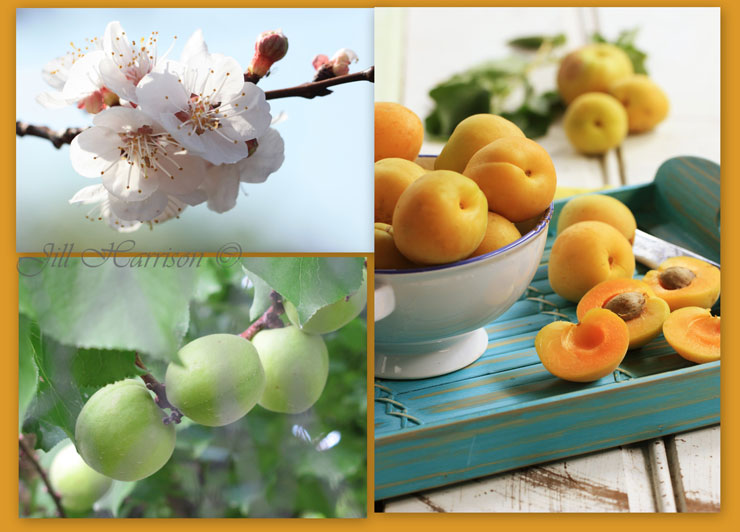
So from apricot flowers to fruit - 


How about a beautiful apricot dessert -

This one has Tiramisu  mixture on the top - 


or a delicious apricot and almond dessert slice with cream. I made this with home bottled apricots, you can see them in the background.
Recipe compliments of Tartlette - go here for the link - Apricot & almond tart


Or how about a simple fresh summer fruit bowl with yoghurt or for breakfast with musli? I don't know why I don't have a breakfast like this every day this time of year!


And of course you can't forget the jam making


So there you have it. The fruits of summer. Do you have fruit trees growing in your back yard?
Next week I will come back and tell you about the grape jam making - it is a tradition in our family.

Until then...... I'm having breakfast on my patio with the travel section of the newspaper while I dream about our next holiday.  Have a wonderful week. I look forward to hearing from you. 


I am linking up with Mary and the other wonderful contributors at Mosaic Monday at Little Red House and Our World Tuesday. Please click here on the links to see their contributions...... 

You might also like - please click on the links -


Sunday, 1 July 2012

Delighting in a bowl of cherries

Welcome July!  We are now past the shortest day of the year which means we are well into winter and spring is on it's way! Though I must not hurry it on as we desperately need the rain, the dams are so low down after several dry winters.

Of late whenever I go to our local fruit and vegetable market I look for interesting delicious fruit and vegetables to buy and bring home to photograph. I don't mind the simple approach to just photographing the fresh fruit in natural light.

It is mid winter here and certainly not the time for cherries - but our local market has been selling cherries imported from America - so of course I had to buy a bag of cherries so that I could photograph them and eat them after! Seen here photographed in natural light on my patio.  The china bowl has come from my mother-in-laws china cabinet.


There was also these Pomegrantes. This is my first try at photographing and eating pomegranates. Seen here photograhed in natural light on my patio and also in the bottom right hand corner under tungsten light on my kitchen bench. Drizzled over icecream and eaten by me afterwards - delicious! I must buy some more!


The cherries were so delicious l I just had to go and buy some more so I could play around taking more images. And of course eat them also! They feel like such a luxury! Photographed here in natural morning light on my kitchen windowsill - I really like the reflection in this one.


For this image I put the cherries on a mirror with a white backdrop-


And I also found these wonderful squat red pears at the market....


It is also the time when we have oranges and lemons ready to be picked in our garden. I always think that fresh tree oranges are so much more sweet and delicious than shop bought ones.....


And what about quinces - such a delicious smell and flavour - I can't describe it. They are a rock hard fruit that you can't eat raw, but when you cook them they turn a delicate pink - the aroma is wonderful. You can also make quince paste to have with biscuits and cheese!


and to finish apple tart..........


I hope you have enjoyed my fruit collages - what is your favourite fruit?

Have a wonderful week.

I am linking up to Mosaic Monday at Little Red House. To see the work of Mary and other wonderful contributors - click here - Mosaic Monday
I look forward to hearing from you and your comments are always welcome. I love making new connections and seeing parts of your worlds too!