Welcome to Life Images by Jill

Welcome to Life Images by Jill.........Stepping into the light and bringing together the images and stories of our world. I am a photographer, writer and multi-media artist.
Focussing mainly on Western Australia and Australia, I am seeking to preserve images and memories of the beautiful world in which we live and the people in it.

Welcome!

Welcome!
PLEASE CLICK ON THE IMAGE TO GO TO MY RED BUBBLE STORE.
Showing posts with label convicts. Show all posts

Monday, 12 August 2024

Convict built Spiky Bridge, Tasmania, Australia

Hi everyone. I hope you are all doing well. Today for my post, I have travelled to Australia's island state of Tasmania, the worlds 26th largest island, lying 240 kilometres off the south eastern tip of Australia.

At least one-fifth, or 20%, of Tasmania is a World Heritage Area. The area which covers 1.58 million hectares includes national parks, marine, and forests reserves

Here is a map to orientate yourself. The red dot on the map shows the location of Spiky Bridge.  I live way on the other side of Australia between Perth and Margaret River. 

Just over seven kilometres south of Swansea on Tasmania’s east coast is Spiky Bridge, a curious relic of Tasmania’s convict era and one of many convict built bridges in Tasmania. In fact you will find many buildings, bridges etc built by convicts throughout Tasmania and Australia during the convict period.  Between 1788 and 1868 more than 162,000 convicts were transported to Australia.

 Listed on the register of Heritage Places, Spiky Bridge was built by convicts in 1843 along the old convict-built coach road connecting Swansea to Little Swanport and the east coast road to Hobart. With its location opposite the beaches and seascapes of Great Oyster Bay, you need to be careful you don’t miss the turnoff while admiring the ocean views.

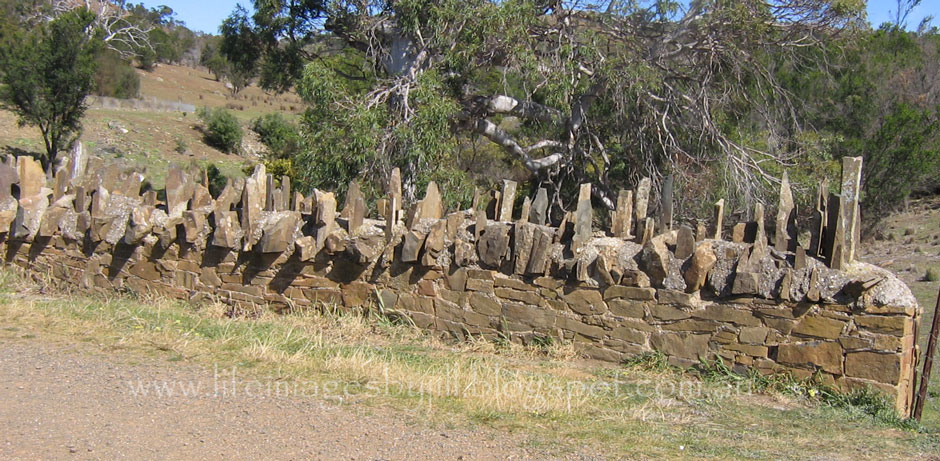
 The bridge was built from local field stones without mortar or cement and a small arch allows water to pass beneath the bridge. The parapet was constructed using jagged field stones stood vertically on end – hence the name Spiky Bridge.

Looking at a side view of the bridge you can see a water channel running down the wall from a slot at the base of the roadway to the arch beneath the bridge, allowing water to drain off the road.


By the 1820s European settlement was pushing northwards along the east coast from Hobart, drawn to the area by farming and whaling. Workers were not abundant in the area until the Rocky Hills Probation Station was constructed in 1841, providing free convict labour to build roads, bridges, clear land, and construct station buildings including the prison.

The reason why the bridge was decorated with these upright stones is the subject of speculation. One theory says it was to stop cattle falling into the gully or to prevent suicide jumpers. Another suggests that the convicts building the bridge used it as a form of revenge. It is questionable how they could do this whilst under supervision.  Either way, the Spiky Bridge is now a curious stopping point for tourists.

Popular history says the bridge was built after Irishman Edward Shaw of Redbanks gave his friend Major de Gillern, Superintendent of the Rocky Hills Probation Station, a ride home one night after a game of piquet (pee-kay).  Shaw had repeatedly requested that improvements be made to the road between Swansea and Little Swanport, particularly the steep gully south of Swansea. His requests had evidently fallen on deaf ears so to prove his point Shaw drove his gig and his passenger, the Major, through the gully at full gallop. It must have been a thoroughly uncomfortable trip because the bridge was erected shortly afterwards.


Initially the bridge was called Lafarelle’s Bridge after surveyor and civil engineer Thomas Lafarelle who was Assistant Superintendent at Rocky Hills Station between 1843 and 1845 and who probably supervised the building of the bridge. On the nearby hill overlooking the bridge are the remains of the Governor’s cottage.

The Rocky Hills Probation Station only lasted eight years, coming to an end during an economic depression in the late 1840s. Under the convict probation system during the 1840’s, all convicts had to serve time in a government work gang. Previously, convicts had been assigned to work for private settlers when they first arrived in the colony, clearing land and planting crops.

Swansea is Tasmania’s oldest seaside town.  It was first settled by the Welsh in the 1820s who named it Waterloo Point.  It was renamed Swansea in 1842. 

There are many convict built bridges in Tasmania, which can be explored on Tasmania's Convict Trail. 

Below are three of them - Red Bridge at Campbell town which was built on dry land and then had the river diverted under it; Richmond Bridge, 25 kilometres north of Hobart, built in 1825, is Australia’s oldest surviving large stone arch bridge; and Ross Bridge built from sandstone in 1836, according to a 2006 Engineers Australia report, the only example of a stone bridge in the World that includes carvings along all of its arches

Where is it?

Turnoff is on the western side of the Tasman Highway, 7.5km south of Swansea on Tasmania’s east coast, 127km north of Hobart.

Piquet – (pronounced pee kay) – is a trick-taking card game for two players, using a 32-card pack consisting of the seven to the ace only.

More information at:

Discover Tasmania – Tasmania’s Convict Trail 

Tasmanian Expeditions- Fascinating Facts About Tasmania

National Museum of Australia-Convicts

Thank you so much for stopping by. I hope you have enjoyed this little visit to Tasmania. 

You might also like on my blog: 

Searching for Platypus - Great Short Walks in Australia

Wombling with Wombats in Tasmania
I value your comments and look forward to hearing from you. I will try to visit your blogs in return. Have a wonderful week. 

I am linking up to the link-ups below. Please click on the links to see fabulous contributions from around the world - virtual touring at its best!

Monday, 29 January 2024

Australia Day - I am, You Are, We Are Australian


Friday 26 January was Australia Day -
Australia Day is the official national day of Australia. Observed annually on 26 January, it marks the 1788 landing of the First Fleet and the raising of the Union Flag of Great Britain by Captain Arthur Phillip at Sydney Cove, a small bay on the southern shore of Sydney Harbour.

In present-day Australia, the government Australia Day Council organises events that seeks to recognise the contributions of Australians to the nation, while also encouraging reflection on past wrongs including towards Indigenous Australians and also giving respect and celebrating the diversity and achievements of Australian society past and present                 wikipedia.org/wiki/Australia_Day

There has been a great deal of controvosy, discussions and protests over the last few years about whether we should be celebrating on 26 January - the indiginous people of Australia claiming it to be "Ïnvasion Day" and wanting to change the date.

I won't buy into this debate here. I am proudly fourth generation Australian on both sides of my family - both early free settlers and convicts, those who fought and died for their country, battled the Depression, cleared and farmed the land, worked hard for what we have. No matter what colour, religion, or nationality we are, we are all an important part of what makes this country a wonderful place to live. We should celebrate this.


Instead I will share of song with you, which I think says it all.

Aunt Stella Floyed, possibly at the time of Federation

I am, you are, we are all Australian.
I AM AUSTRALIAN.
(1987 - by Bruce Woodley, The Seekers and Dobe Newton, The Bushwackers)
I came from the dreamtime from the dusty red soil plains I am the ancient heart, the keeper of the flame I stood upon the rocky shore I watched the tall ships come For forty thousand years I'd been the first Australian.
I came upon the prison ship bowed down by iron chains.
.I cleared the land, endured the lash
and waited for the rains.
Great Great Grandfather James Fairhead
arrived Australia 1853
I'm a settler. I'm a farmer's wife on a dry and barren run,
A convict then a free man
I became Australian.

I'm the daughter of a digger
who sought the mother lode, The girl became a woman on the long and dusty road

I'm a child of the depression
I saw the good times come I'm a bushy, I'm a battler I am Australian

Great Grandmother & Grandfather Floyed 1887
Great Grandfather born in Australia 1858 


[chorus] We are one, but we are many And from all the lands on earth we come
We share a dream and sing with one voice: I am, you are, we are Australian I am, you are, we are Australian.

I'm a teller of the stories
I'm a singer of the songs
I am Albert Namatjira I paint the ghostly gums


Great Uncle Norman Clayden, died Gallipoli, WW1
I am Clancy on his horse I'm Ned Kelly on the run I'm the one who waltzed Matilda I am Australian.

I'm the hot wind from the desert I'm the black soil of the plains I'm the mountains and the valleys I'm the drought and flooding rains.
I am the rock, I am the sky The rivers when they run The spirit of this great land I am Australian
[chorus] We are one, but we are many And from all the lands on earth we come We share a dream and sing with one voice: I am, you are, we are Australian I am, you are, we are Australian.

And below from You Tube an inspiring rendition of this song.


You might also like -


Thank you so much for stopping by. I value your comments and look forward to hearing from you. I will try to visit your blogs in return. Have a wonderful week. 
I am linking up to the link-ups below. Please click on the links to see fabulous contributions from around the world - virtual touring at its best!

Australia Day Fireworks