The 25th April marks an important national day in Australia's and New Zealand's calendar. And the Dawn Service is a vital part of that day - for it was a dawn that the Allied servicemen landed at Gallipoli on 25 April 1915.
In cities and towns all across Australia you
will find war memorials to remember those who have made the supreme sacrifice
in war. Some like the Australian War Memorial in Canberra require a two day
visit to fully absorb it all. In Western Australia three of our most significant
examples are the Kings Park War Memorial overlooking Perth and the Swan River, the Desert Mounted Corps
Memorial in Albany, and the HMAS Sydney Memorial in Geraldton.
You can see them below - clockwise from left - Geraldton, Perth, Albany.
On our travels around Western Australia we
often stop at town war memorials and read the names inscribed there. In small towns there might be just a simple
stone column with only a few names. Despite their size they are a significant part
of the town and district’s history.
We have found the simplicity of some
memorials really stir the emotions.
Not many sunrise locations in Western
Australia look east over the ocean. The ANZAC
WAR MEMORIAL in the Onslow Memorial Park at Beadon Point in Onslow takes
advantage of this. Unveiled at sunrise on Anzac Day 2008, the memorial was
designed by internationally acclaimed artists Joan Walsh-Smith and Charlie Smith.
The Corten steel sculpture is a stylized
interpretation of the Australian Defence Force’s Rising Sun insignia badge, and
is geographically positioned so that the sun rising over the bay shines directly
through the arch at dawn on Anzac Day. The inscription simply says “We will
remember them”.
The Smith’s say is was a surprisingly
difficult feat of astrophysics to calculate exactly where the sun would rise on
the 25th of April, to ensure the sun would be exactly central within the six
metre high arch. This was achieved with the assistance of the surveying skills of
Shire Engineer, Jeffery Breen.
“Our difficulty was the fact that we would
be installing the memorial months before Anzac Day.” There must have been a
huge sigh of relief when the sun rose that first Anzac morning.
Even though our stay in Onslow wasn’t in
April, I was so enthralled by the atmosphere surrounding the memorial, I
visited it at sunrise every morning of our stay. It is easily accessed along
the path from the caravan park.
The Onslow War memorial was dedicated on
the 15th September 2008, by Reverend Steve Cloudsdale, Chaplain to the Pilbara
Regiment and attended by the Federal Minister for Veterans’ Affairs, the Hon
Alan Griffin MP. The ceremony also marked the 65th anniversary of the bombing
of Onslow by enemy aircraft. Pilots from 2 FTS RAAF Pearce performed a fly
past.
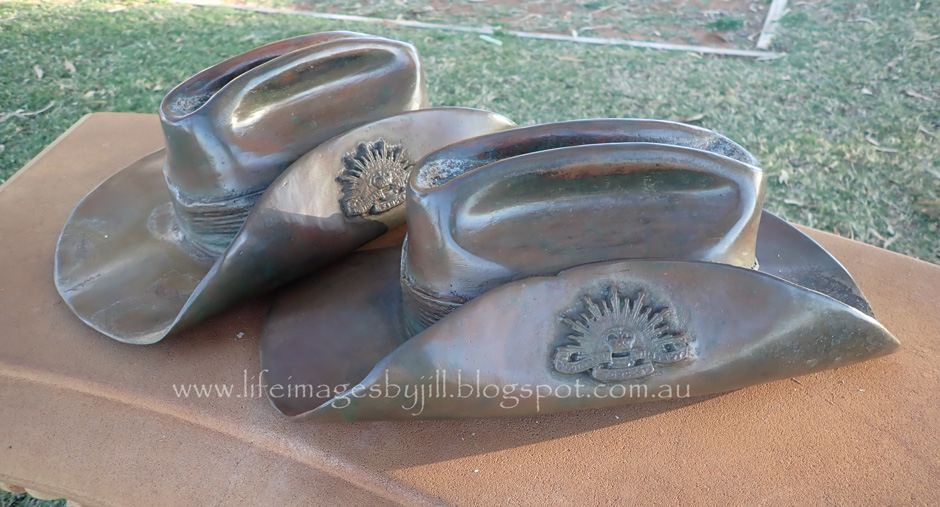
Nearby two brass slouch hats also
created by Smith Sculptors and dedicated to the Onslow Volunteer Defence Corp, rest
on a concrete bench. Soldiers wear
their slouch hats with a khaki hatband, known as a 'puggaree', with the Rising
Sun badge on the left-hand side.
The Navy
used the Onslow jetty for refuelling during World War II and the RAAF operated
a radar station at Onslow. The town was bombed on the night of 15 May 1943 when
Japanese planes dropped three bombs on what they thought was the airstrip, but
was actually a claypan. There were no casualties or damage.
Following the success of the Onslow
memorial, the Shire of Ashburton was approached by Swansea RSL in New South
Wales and the Smith’s agreed to build a replica at Swansea. The Swansea RSL
Rising Sun Anzac Memorial was completed in 2015.
Joan and Charlie and their team at Smith’s Sculptors in
Perth also designed and built the HMAS Sydney memorial in Geraldton, as well as
many other commemorative and public artworks, including the National Memorial
to the Australian Army on Anzac Parade in Canberra.
Location: Onslow Memorial
Park, Beadon Point, Second Avenue, Onslow.
***********
On a trip through the wheatbelt in 2022 we
visited the LIGHT HORSE MEMORIAL, on Yeerakine Rock,
near Kondinin, after reading
about it in our tourist brochure.
Overlooking wheatfields and facing the
rising sun on the eastern summit of Yeerakine Rock, a three and a half metre
high corton steel silhouette cutout sculpture depicts a Light Horseman on his
horse. Designed and created by artisans from Arforms in Bilbra Lake, Perth, the
sculpture is layered and embossed to add realism and detail. Funded in part by more than
$1000 from community fundraising, the memorial was officially unveiled on
25 April 2015 to commemorate the Anzac Centenary.
The sculpture is dedicated to the many men
and horses from the Kondinin district who served in World War 1 in the 10th
Light Horse Regiment, as well as other service personnel. Recorded on a plaque
are the names of locals who lost their lives in WWI and WWII, shattering the
small community.
The 10th Australian Light Horse
Regiment AIF (Australian Imperial Force) was the only AIF light horse regiment
recruited in Western Australia during the WW1. The regiment began in October 1914
when it became apparent that Western Australia could provide more than a single
squadron of mounted soldiers.
The regiment joined the 3rd Light Horse
Brigade in Egypt and served dismounted at Gallipoli. The regiment's most
notable actions were the charge at the Nek on the Gallipoli Peninsula on 7 August 1915, and Hill 60
on 29-30 August 1915 which was the last major
assault of the Gallipoli Campaign. The Light Horse regiments were noted for
their plume of emu feathers on their slouch hats.
Used by indigenous people for thousands of years as a water source and
elevated lookout, the rock was first sighted by Europeans by Surveyor General John Septimus Roe when he camped there on 22
September 1848. A water catchment was built in
1927 to provide water for Kondinin. There are
two walk trails through the sheoak woodlands, one leading to the summit to see
the memorial and expansive views. There are interpretative panels along the
way.
My only regret was that I wasn’t there at sunrise to see the sculpture
silhouetted against the rising sun. Please
wear suitable walking footwear and a hat. If walking at sunrise, please take a
torch.
In Kondinin itself you can visit the Kondinin
War Memorial and the Memorial Garden located on the corner of Jones Street and
Gordon Street. On Anzac Day transport will be available from the rock’s first
carpark for the drive up for those unable to walk. Contact the Kondinin Shire
Office for details.
Location: Sloan Road,
Yeerakine Rock, located 13km south of Kondinin via the
Williams-Kondinin Road
************
The simple
wooden cross of the VIETNAM VETS
MEMORIAL in the 80 Mile
Beach Caravan Park south of Broome, draws people every April and August.
Located at the
edge of the caravan park just below the sand dunes and surrounded by a low white
picket fence, it was built by Vietnam Veterans who stay at the caravan park
annually. It remembers those who have lost their lives in the various
conflicts in which Australia has been involved.
Vietnam Veteran, Ray Miles from Wongan
Hills, later in life stayed at the Caravan Park for a few months each year. It
was here he conceived the idea for the memorial. With the help of others he
raised the funds for the materials and the caravan park owners set aside a
space for the construction and committed to its maintenance. For all those involved and others, it is a
special place to remember mates lost in Vietnam.
The memorial was officially opened and
blessed by the Rev Judy Knowling of Frontier Services on 18th August 2010. This
simple white cross is made the more poignant by its remote location, and yet
hundreds attend the services annually on Anzac Day 25 April and Vietnam
Veterans Day 18 August, on the anniversary of the Battle of Long Tan in
1966.
The design of the cross is the same
as the Long Tan Cross, designed
by ‘Pioneers’ from the 6RAR-NZ Anzac Battalion’s Assault Pioneer Platoon and
constructed in the 6RAR-NZ lines at Nui Dat in Vietnam on the third anniversary
of the battle, on 18 August 1969.
Australia's military involvement in the Vietnam War from August 1962 to
April 1975 was the second longest in duration of any war in Australia's
history.
Eighty Mile Beach Caravan Park is popular with people travelling north.
Long stretches of beach, popular for fishing and beach combing, 80 Mile Beach
is the longest uninterrupted beach in Western Australia extending 220km. It is
classified as an important bird area for shorebirds.
Location: 80 Mile Beach
Caravan Park, Wallal Downs, via Great Northern Highway and Eighty Mile Beach
Road (unsealed), 375km south of Broome.
Recently during our little Easter weekend trip through some of the Western Australian wheatbelt we visited the town of Pingelly which looms large in my father's family history. I went into their Memorial gardens and found on the wall there the name of my great uncle Norman Albert Clayden who died at the age of 19 on 27 April 2015 at Gallipoli. I had seen his name on the war memorial in Perth and Canberra, but somehow seeing it on this local memorial made it seem more real. He was in the 11th Battalion. I have blogged about him before. He has an unmarked grave at Gallipoli.
A couple of weeks ago I found a discrepency in the date of his death. It was not the 2 May as reported in the official records, but it was actually 27 April only two days after the Allied landing at Gallipoli. Such a terrible waste of young life. I actually have some more research to do after going to a historical writer's talk the other day. He said the descrepency could have come about between the date of his death, and the date it was reported to the command post.
When you travel around, I hope you take the time to visit our war memorials, and learn something about our history and the men and women who gave their lives.
My article, Remote Sunrise Reminders was published in April 2023 edition of On The Road magazine.
You might also be interested in:
Anzac Day Field of Lights - Albany 2019
More information:
Monument Australia: www.monumentaustralia.org.au
Smith Sculptors: www.smithsculptors.com.au
Things to See and Do in Onslow: www.onslowbeachresort.com.au/in-onslow/
Artforms: www.artforms.com.au
Kondinin Tourism: www.kondinin.wa.gov.au/tourism/attractions/visiting-kondinin
80 Mile Beach Caravan Park: www.summerstar.com.au/caravan-parks/eighty-mile-beach
 The Battle of Long Tan: www.battleoflongtan.com
Thank you so much for stopping by. I value your comments and look forward to hearing from you. I will try to visit your blogs in return. Have a wonderful week.
I am linking up to the link-ups below. Please click on the links to see fabulous contributions from around the world - virtual touring at its best!
Hello there! I love reading your comments. If you scroll down to the bottom you can comment too! I would love to hear from you.