Welcome to Life Images by Jill

Welcome to Life Images by Jill.........Stepping into the light and bringing together the images and stories of our world. I am a photographer, writer and multi-media artist.
Focussing mainly on Western Australia and Australia, I am seeking to preserve images and memories of the beautiful world in which we live and the people in it.

Welcome!

Welcome!
PLEASE CLICK ON THE IMAGE TO GO TO MY RED BUBBLE STORE.
Showing posts with label Canberra War Memorial. Show all posts

Sunday, 11 November 2018

Remembrance Day 11 November and the Red Poppy


In Flanders fields the poppies blow
Between the crosses, row on row,
That mark our place; and in the sky
The larks, still bravely singing, fly
Scarce heard amid the guns below.

We are the Dead. Short days ago
We lived, felt dawn, saw sunset glow,
Loved and were loved, and now we lie
In Flanders fields.

Take up our quarrel with the foe:
To you from failing hands we throw
The torch; be yours to hold it high.
If ye break faith with us who die
We shall not sleep, though poppies grow
In Flanders fields.

   by John McCrae, May 1915

Poppies in Malta
At the chiming of the 11th hour on the 11th day of the 11th month, November, we pause for one minutes silence to remember those who have died in conflicts. It is Remembrance Day (also known as Armistice Day), an important date on the Australian calendar.  The 11th of November 1918 was the day that the fighting ended on the Western Front in Europe signalling the end of World War 1. 

Following the war the allied nations chose this day and time for the commemoration of their war dead and so we observe this each year to remember those who died or suffered in all wars and armed conflicts.  You can read more here - Commemoration Remembrance Day - Australian War Memorial


From its association with poppies flowering on the First World War battlefields of Belgium, France and Gallipoli, the red poppy has become associated with remembering the loss of life and the destruction.  

"In soldiers’ folklore, the vivid red of the poppy came from the blood of their fallen comrades which had soaked the ground. The poppy flower grew rapidly and in large numbers across the graves of thousands of soldiers, leading it to become a symbol of sacrifice and loss."

In the photo above you can see one of two remembrance walls at the Australian War Memorial in our capital city Canberra, where are recorded on bronze panels the names of over 102,000 Australians who have died in conflicts. On one of these two walls you can find the name of your family member and place a poppy beside their name, as we did when we visited. This is the closest we can come to the burial place of my great uncle who died in WW1 and my husband's uncle in WW2, so it was a moving experience to be able to do this. 

This year a display of 62,000 handcrafted red poppies are being displayed in the Australian War Memorial's grounds symbolically representing Australian lives lost in the First World War.  You might like to view this short video about 62,000 poppies symbolising  62,000 lives lost.....


 In other places around Australia too, community groups have made their own poppy displays, on this year 2018, 100 years since the ending of World War 1. 

In Western Australia the Returned Service's League, also have a 62,000 poppy project to be displayed in the ground's surrounding the State War Memorial in Perth. Many thanks to  RSLWA on Facebook for sharing this image.


But I wonder, as conflicts continue around the world, have we learnt anything from the death and maiming of so many thousands, soldiers and innocents, and those that came home broken in body and spirit. 


 When we were in Spain, Malta and Italy in May this year we saw lots of poppies, in fields and along roadsides.
More often than not we were zooming by in the tour bus, and there was no stopping to take photos. But on a couple of occasions we saw them where I could take photos.  Below here are poppies near the The Colosseum in Rome, and in Pompei. 


On Sunday 11 November, I will be thinking of my Great Uncle Norman who died in the first few days of the Gallipoli campaign. He was only 19.  I never knew him, but the memory of him, and the loss of his young life, always brings me to tears at times like Remembrance Day and Anzac Day.

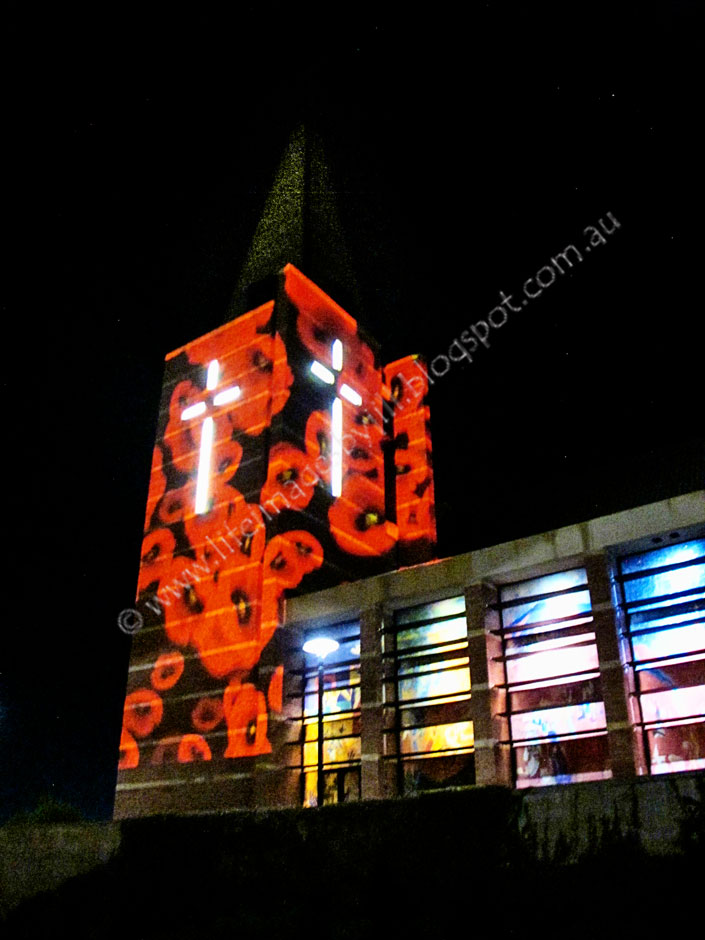
 In Western Australia where I live, the Department of Communities has contracted Perth company Impact Communications to conduct a cascading poppy lightshow. 
Places where it has been displayed are:  Exmouth's Vlamingh Head Lighthouse, Geraldton Museum, Kalgoorlie Town Hall, Albany Town Hall, Bunbury's St Patrick's Cathedral, Fremantle's WA Maritime Museum, finishing with Perth's St George's Cathedral on Sunday evening. 
 Below you can see the display at St Patrick's Cathedral in Bunbury. It really was beautiful.


 A river of hand-made poppies flowing over rocks at Peppermnt Lane Lodge in the Ferguson Valley where we held a small ceremony on Sunday at 11am. 


Please click on the links to read the story behind the poem In Flanders Fields and The red remembrance poppy
The Australian War Memorial and 62,000 poppies.  

Thank you so much for stopping by.  Do you have a day like Remembrance Day in your country? Perhaps you would like to tell us about it in your comments. I value your comments and look forward to hearing from you. I will try to visit your blogs in return. Have a wonderful week.  

You might also like:  
25th April - Anzac Day - when we remember them
Anzac Day - 25th April
On the 11th hour, of the 11th day, of the 11th month - Armistice
 
I am linking up to the link-ups below. Please click on the links to see fabulous contributions from around the world - virtual touring at its best!
Life in Reflection

Hello there! I love reading your comments. If you scroll down to the bottom you can comment too! I would love to hear from you.

If you are a blogger you can link up to Wednesday Around the World at Communal Global right here! - 


Tuesday, 24 April 2012

On Anzac Day we will remember them

25th April - is Anzac Day in Australia and New Zealand.

"ANZAC Day goes beyond the anniversary of the landing on Gallipoli in 1915. It is the day we remember all Australians and New Zealanders who served and died in all wars, conflicts, and peacekeeping operations. The spirit of ANZAC, with its human qualities of courage, mateship, and sacrifice, continues to have meaning and relevance for our sense of national identity".
To read more - click here - www.awm.gov.au/commemoration/anzac/

In January we visited our national capital, Canberra. The images below are from the Australian War Memorial - it is also a museum which is an amazing place to visit - and I encourage all Australian's to visit at least once in their life time - and allow at least one whole day to see it. The museum takes you through all the various conflicts up to the present day that Australians have been involved in - and gives you an insight into what our "diggers" went through and the thousands and thousands of lives that have been lost.

On the wall of remembrance you can place a poppy next to the name of loved ones who lost their lives in war.
We found the name of my great-uncle Norman Albert Clayden who lost his life in Gallipoli on 2 May 1915 (aged 19), and
my husbands uncle, Richard Ramsden who died as a prisoner of war on 29 October 1943 in Burma (aged 23).
As they are both buried overseas, at Lone Pine in Gallipoli and at Thanbyuzayat War Cemetery in Myanmar (Burma), it was wonderful to be able to place a poppy next to their name at the Canberra War Memorial.

..........
Tomorrow morning we will go to the Dawn Service in Bunbury which is an event that happens on Anzac Day all around the country in cities and towns, overseas where servicemen are still serving, where Australians and New Zealanders gather, at memorials in France, and on the shores of Gallipoli  where thousands go every Anzac Day to honour and remember.


The statue below is a copy of one originally forming part of a memorial which was erected at Port Said, Egypt, and unveiled on 23 November 1932, to remember members of the Australian Light Horse, New Zealand Mounted Rifles, the Imperial Camel Corps, and the Australian Flying Corps, who lost their lives in Egypt, Palestine, and Syria 1916-1918.  The statue was irreparably damaged during the Suez crisis in 1956.  The remnants were brought to Australia and two bronze replicas were made, the first erected in Albany, Western Australia in 1964. The second is this one in Canberra.

The memorial in Albany has been part of my consciousness all my life - and I have always been in awe of the image that the statue portrays of the two servicemen and their horses. Albany was the place from where Australian troops left on their way to fight in World War 1. For many thousands it was the last time they were to be on Australian soil.

Also on display in Canberra was one of the bronze horse heads from the original memorial, and now forming a memorial  to "Animals in War". For those who have seen the wonderful movie "War Horse", it is heart warming that a memorial has been erected in their memory.


Update - ANZAC Day - 25 April 2012

Images from this morning's Dawn Service in Bunbury


 After visiting Canberra, and researching and learning more about Norman and Richard, I found the Dawn Service even more moving and poignant as I thought about these two young men and the circumstances under which they died so far from home and how it must have affected their mother's and families.

Following the Dawn Service in Bunbury we were blessed with this beautiful sunrise - it was a timely reminder of all that we have to be thankful and grateful for.....


My sincere thanks to Flickr contact Stewart Glasson who took the time to research and send me links from The War Graves Photographic Project - click on the link here if you want to do research of your own - War Graves Photographic Project
which has lead us to more information about Norman and Richard - including an actual photo of Richard's grave site, and information about the Thanbyuzayat War Cemetery in Myanmar and background information and history about the war years and the people who are buried there.
We sincerely thank you.